




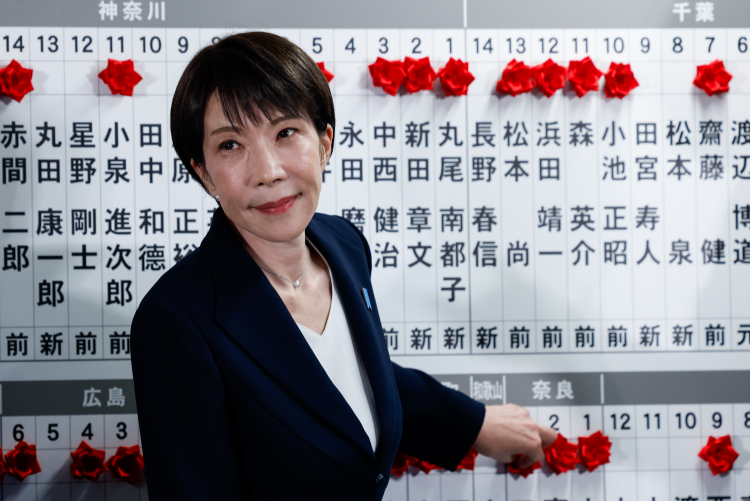
When Japanese Prime Minister Sanae Takaichi called snap elections four months into her tenure, the commentariat scoffed. Winter election? No policy record? Approval ratings near 70%, but untested at the ballot box? Conventional wisdom said she was overreaching.
Conventional wisdom was incinerated.
Voters delivered a sweeping mandate. The Liberal Democratic Party captured 316 of 465 seats—an outright two-thirds supermajority, the largest achieved by a single party in the postwar era. With coalition partner Japan Innovation Party seats included, the ruling bloc now commands 352 seats.
This is not a routine victory. It is the largest mandate in modern Japanese history—bigger even than those won by her late mentor, Shinzo Abe. After years of revolving-door prime ministers, Japan has chosen its most powerful leader in decades.
The message from Tokyo mirrors one heard in Washington in 2016 and again in 2024: voters want strength, growth, and national revival—not technocratic drift.
The Hudson Institute’s experts, in “Japan’s Historic Election: Insights from Hudson Experts,” noted Takaichi’s cross-generational appeal, including dominance among young voters. That fact alone demolishes the tired claim that conservative populism is a geriatric phenomenon. Like President Donald Trump, Takaichi speaks directly to citizens who believe their country has been mismanaged by cautious elites.
Her agenda is unapologetically growth-first. She plans a two-year suspension of the 8% consumption tax on food—relief aimed squarely at households battered by inflation. In 2024, Japanese families spent 28.3% of their budgets on food, a 43-year high. Cutting the food VAT is economically meaningful and politically symbolic. People eat. Corporations do not.
She is also leaning into economic security: strategic investment in artificial intelligence, semiconductors, and resilient supply chains; relaxation of arms-export limits; a national intelligence organization; and revisions to Japan’s three national security documents. Defense and growth are no longer siloed. They are integrated.
And she has confronted Beijing’s bullying head-on. When China retaliated with tourism restrictions, seafood bans, and export controls after Takaichi expressed support for Taiwan, voters rewarded her firmness. The lesson is unmistakable: strength deters; appeasement invites pressure.
Here is where the Trump-Takaichi alignment becomes geopolitically decisive.
President Trump offered his “Complete and Total Endorsement” before the election. The two leaders are expected to meet during a March 19 state visit in Washington, D.C. They are philosophically aligned: hawkish on defense, skeptical of open-ended immigration, supportive of industrial policy when it serves national resilience, and committed to challenging China’s coercive expansionism.
Trump understands leverage. Japan understands geography. Together, they can anchor a durable Western Pacific balance of power.
Critics, of course, warn of fiscal overreach. Japan’s FY2026 budget totals ¥122 trillion—roughly $783 billion—the largest on record. The Bank of Japan is normalizing policy as inflation rises. Debt exceeds 240% of GDP. Without a credible plan for discipline, markets could challenge Tokyo in a scenario marked by sudden financial instability and shaken investor confidence.
That risk is real.
Takaichi won decisively and now has unusual latitude. But markets do not vote in elections. They price bonds. If she cannot identify meaningful areas for spending restraint—or offer a convincing medium-term consolidation path—bond yields will climb and confidence in her government will erode.
Yet it would be a mistake to assume recklessness. Japan’s financial architecture—its Ministry of Finance, the Bank of Japan, and its major banks—has managed a complex equilibrium for decades. Takaichi has tools: gradual monetary normalization, calibrated bond purchases, and potentially selective use of Japan’s $1.3–1.4 trillion foreign-exchange reserves. The reserves generated ¥5.4 trillion in profit last fiscal year alone—more than enough to offset the revenue loss from suspending the food tax without issuing large volumes of new debt.
The real test is credibility. “Responsible yet aggressive,” as Takaichi describes her strategy, must not become merely aggressive.
For Washington, the calculus is clear. A stronger, more confident Japan reduces the burden on the United States. Takaichi plans to deepen cooperation with Australia, India, South Korea, and the Philippines. She will strengthen Japan’s defense industrial base and screen sensitive inbound investments. These steps reinforce—not undermine—the U.S.-Japan alliance.
Trump’s instinct is to negotiate hard. But Japan under Takaichi is not an adversary to be squeezed; it is a force multiplier. Pressuring Tokyo over manageable financial adjustments while both nations confront Beijing would be strategically incoherent.
The larger pattern is unmistakable. From Washington to Tokyo, voters are rejecting managerial centrism in favor of leaders who promise to return power to citizens, revive growth, and defend sovereignty. The old ruling class—comfortable, cautious, and frequently wrong—is on notice.
Takaichi has won the right to govern boldly. But bold governance is harder than bold campaigning. Markets must be reassured. China must be deterred without stumbling into escalation.
Still, for now, Japan’s Iron Lady stands at the apex of her power—and she will soon sit across from an American president who respects strength. If both leaders remember that allies are assets, not obstacles, the March summit could mark the consolidation of a new conservative axis—pro-growth, pro-sovereignty, and unafraid to confront the gathering storm in Asia.
James Carter is a Principal with Navigators Global. He previously served as Deputy Undersecretary for International Affairs at the U.S. Department of Labor (2006-07) and as the Director of the America First Policy Institute’s Center for American Prosperity (2021-23). Mieko Nakabayashi is a Professor of Political Science at Waseda University. Previously, she was an elected member of Japan’s House of Representatives between 2009 and 2012.
