




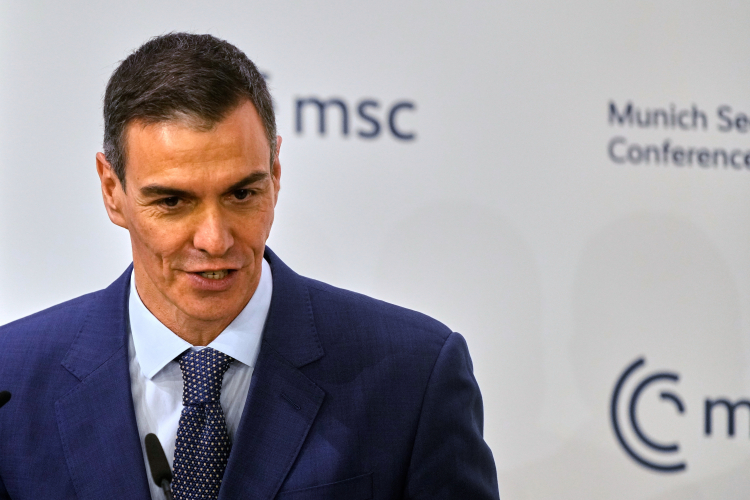
According to the progressive New Statesman, Spanish Prime Minister Pedro Sánchez is a left-wing icon, a man whose “words carry weight.” Elevated to his current post in 2018, one of his first acts was to offer amnesty to Catalan separatist leaders in return for parliamentary support.
The cosmopolitan technocrat – the first Spanish prime minister to speak fluent English – has overseen his nation create Europe’s fastest growing major economy by relying heavily on migrant labor and a 60% hike in the minimum wage. Today, two-thirds of new jobs are filled by migrants, and they have delivered 80% of the nation’s GDP growth over the last six years.
Many of these foreign workers are high-profile professionals, including athletes, lured to Spain by the so-called Beckham Law of 2005, which entitles qualifying foreigners to pay just 24% of their Spanish income (up to 600,000 euros) in taxes for up to six years (compared to the 47% normal rate for income about 300,000 euros).
The non-resident status proffered by the Beckham law limits the impact of Spain’s wealth tax and a new solidarity tax solely to assets within Spain. It also grants disabled descendants, spouses, and children under age 25 the opportunity to leverage Beckham’s benefits.
Under a December 2023 Royal Decree, individuals who became Spanish tax residents due to a move in 2022 or 2023 could also access the Beckham regime if they applied (as must all Beckham beneficiaries) within six months of registering for Spanish National Insurance. The changes also allowed certain self-employed people and digital nomads to qualify.
But, many are now learning, the devil is in the details.
Regulatory changes in 2022 to the wealth tax regime gave auditors a financial stake in every euro of unpaid tax liability they could claim was owed by often unsuspecting Beckham beneficiaries. A loophole empowered auditors to revoke Beckham status retroactively and impose back taxes, plus penalties, and interest.
Under Spanish law, contesting an audit requires posting the full amount claimed up front. As legal proceedings can take years, most who contest an auditor’s claims settle out of court for a fraction of the assessed amount.
The kicker? The auditor is paid based on the initial assessment, regardless of any settlement – a huge incentive to overreach.
The obvious unfairness of this bait-and-switch scheme has angered many Beckham taxpayers who claim the State Tax Administration Agency (AEAT) has established a pattern of violating fundamental rights and acting outside the rule of law. According to Robert Amsterdam, founder of the law firm Amsterdam and Partners, AEAT systematically “criminalizes” taxpayers, operates under a “psychology of fraud,” and forces inspectors to “act as predators” through this sketchy bonus system of penalties.
Amsterdam contends these retroactive actions and disproportionate sanctions violate fundamental rights, but AEAT contends that issuance of a Beckham certificate of inclusion merely acknowledges the application but does not imply approval of Beckham tax status. The AEAT’s retroactive reinterpretation of Beckham law has left hundreds of taxpayers facing multimillion-dollar tax liabilities and sanctions dating back more than a decade.
Does any rational person believe that a six-year investment commitment would be made on such a flimsy contingency?
Amsterdam and Partners has initiated actions against AEAT before the United Nations, the OECD, the Court of Justice of the European Union, and the European Court of Human Rights.
Their complaint over Beckham highlights the structural legal uncertainty built into the Spanish tax system. Inspection procedures often exceed the limits of proportionality, extend to areas outside tax matters (including personal lives), and apply indeterminate legal concepts.
Combined with the auditor incentives, the system generates a conflict of interest that questions the impartiality of the Sánchez administration. As more voices question the AEAT’s practices and institutional coherence, and the fact that more than 60% of those who contest audits win their cases, suggests the Spanish government rewards immediate collection over tax justice.
That progressively erodes the trust of citizens and companies.
Despite Spain’s economic growth spurt, foreign disinvestment in Spain increased by 115% in 2024 and rose another 35.6% in the first quarter of 2025. Moreover, there was a 27.2% decline in net productive foreign investment, the lowest since 2020. Investment from the United States, the largest source of Spain’s foreign investment, fell 40.7% in 2024 from 2023 levels.
Meanwhile, government revenues were exploding – from 193,951 million euros in 2027 to an expected 352,625 million euros in 2026. Spain today has nearly 2.7 million more inhabitants than it did in 2017 – but Spaniards have gone from contributing an average of 4,147 euros in taxes in 2017 to 6,573 euros in 2025 – a 58.1% increase.
As if this were not enough, a new legislative proposal, under the guise of “curbing real estate speculation,” would impose a 100% tax on property transfers made by non-resident foreigners.
Amsterdam says taxing the purchase of housing by non-EU foreigners at 100% could violate both the free movement of capital and the Spanish Constitution’s ban on confiscation. The move would effectively entrap Beckham investors, preventing them from cutting and running despite the bait and switch revocation of their authorizations.
Amsterdam, last September took yet another concern over the Spanish taxation scheme to the U.S. Treasury Department. Why is Spain, he asked, using Huawei servers to store sensitive data – including the AEAT’s storing of tax data – when both the U.S. and the EU have banned these servers in their respective jurisdictions over concerns with privacy and data security?
The AEAT’s use of (Chinese) Huawei servers raises serious implications, Amsterdam said, about the exchange of information provisions in the U.S.-Spain Treaty, a concern expressed by several members of Congress who urged National Intelligence Director Tulsi Gabbard to redact details of information shared with the Spanish government.
Amsterdam urged the Treasury, due to AEAT’s “systemic data protection violations,” to take appropriate steps to protect U.S. citizens until it can confirm that U.S. taxpayers are not being compromised by the AEAT’s use of Huawei servers.
The Amsterdam firm last May issued an initial report, “Hacienda vs. the People,” which revealed evidence that tax offenses were frequently invented by staff incentivized by bonuses and driven by an organizational culture that imposes peer and management pressure to assess more tax regardless of the accuracy of their analysis.
The law firm’s “Madrid Memorandum,” a deeper analysis of Spain and its peers, will show just how much of an outlier Spain is on taxpayer rights in law and practice. The memo includes recommendations on what can be done to bring Hacienda and AEAT back into line with international norms.
Meanwhile, Pedro Sánchez’s government continues to swing leftward, seemingly less concerned about the rights of the investor class and more about the half a million foreign workers newly granted legal status – the very people Sánchez says are bringing prosperity to his country.
Amsterdam, however, is not done. Spain, he says, “needs help. Its people need help. Americans who have moved to Spain need help. Help against the tyranny of Hacienda and the AEAT.
Duggan Flanakin is a senior policy analyst at the Committee For A Constructive Tomorrow who writes on a wide variety of public policy issues.
