




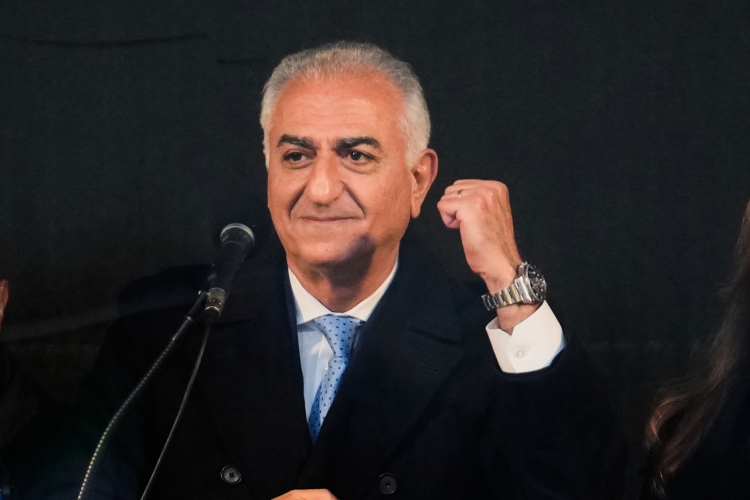
The son of the last Shah of Iran, Reza Pahlavi, has made himself the international face of protests in Iran. In press conferences, interviews, and gatherings in Western countries, Pahlavi has called for the overthrow of Tehran’s Islamist regime and its replacement with a “transitional government” – with himself as the leader. He has made this appeal in conversations with various governments, including at least one reported meeting with members of the Trump administration.
Pahlavi has numerous arguments for staking this claim. He claims to be trusted by the opposition. The protestors, he said, were demanding that he return, and “millions” were chanting his name. He has also made clear he was the only person who could unite the incredibly diverse array of Iranian opposition groups, telling one interviewer he has come forward “at their ask.” And finally, he has guaranteed that he would shepherd his people to democracy.
If these arguments sound thin, it’s because they are.
For starters, “trust” is almost impossible to quantify. Polling in Iran, particularly among those opposed to the regime, is incredibly unreliable. One 2024 poll supposedly revealed over 80 percent are waiting for the regime to crumble. But that poll was taken only by those who used VPNS – already a sign of opposition to the regime – and by people brave enough to give anti-regime answers to people they did not know.
How can anyone actually know if Pahlavi is trusted, other than his certainty? He attempts to quantify it, to stretch the word, by claiming the protestors have chanted his name in the streets. Some protestors indeed yelled his name. But that happened only sporadically at best; even if a few thousand chanted his name, it does not somehow represent the wishes of more than 90 million Iranians.
But that’s no matter. Because Pahlavi is convinced that only he can run the country. In mid-January, he announced, “I am here today to submit myself to my compatriots to lead them down this road of peace and democratic transition. I do not seek political power but rather to help our great nation navigate through this critical hour towards stability, freedom and justice.”
There’s an obvious hypocrisy in offering himself as a leader while saying he does not want political power. Pahlavi refused to say he would not remain in power, insisting it would be up to the voters, while leaving the door open to his becoming, like his father, a constitutional monarch. He also did not eliminate the possibility of ruling by decree until a democratic path was placed forward—though he insists he would leave if asked.
But he has argued that a handful of protestors is indicative of the people’s will. And if a small portion of the people can be used to justify his taking the throne, it is not hard to imagine him relying on the support of such a small portion to justify keeping it.
Some publications have run stories calling him the “reluctant prince,” but this ignores that Pahlavi has wanted to rule Iran his entire adult life and has constantly extolled the virtues of constitutional monarchy, at one point waving away the question of monarchy or republic by saying the form of government was “irrelevant.”
Then there are the image problems. America ensured the power of the Shah in the 1950s, instilling such hostility that it gave way to the revolution and the imposition of an even worse dictatorship. Does America want to, once again, help a king rule Iran? And not just any king. American foreign policymakers look back on the Shah’s rule fondly because he did what America told him to and kept American influence in a critical region during the Cold War. But the Shah of Iran was a brutal dictator, with a secret police which tortured and killed his opponents.
The potential for a counter-revolution to the counter-revolution is obvious.
Pahlavi supporters would likely ask what the alternative is: “Do you think it is better to stick with the mullahs?” But this is a question for Iranians, not Americans. Iran lacks the capability to harm Americans in the U.S. The Trump administration and Israeli actions have devastated Iran’s influence across the Middle East, and Tehran has now been reduced to killing thousands just to maintain control. The mullahs are a truly despicable band, and a peaceful, democratic Iran would be a better place than what they have turned the country into. But there is no guarantee that Pahlavi can shepherd a peaceful, whole, and democratic Iran, and the United States would be playing with fire by intervening.
This is not akin to the French intervening in the American Revolution. Then, there was a clear, organized movement, and the benefit –Britain, losing control of the entire eastern seaboard – was obvious. Here there are no organized movements, just a man living in a wealthy Virginia suburb who claims legitimacy because his name has been shouted a few times in the streets of a country he has not visited in nearly fifty years.
Pahlavi is maybe a genuinely good man. But the United States cannot conduct regime change on “maybes.” Iranians are obviously tiring of their regime. But that does not mean they want to be led by the son of a former dictator who would be, for all intents and purposes, America’s Guy.
There is no indication Pahlavi is going away. He was recently invited to the Munich Security Conference, where he is bound to meet with high-profile officials and make his case yet again. The United States should not buy his arguments. If Iran is to have regime change, it must come from the people themselves.
Anthony Constantini is a Contributing Fellow at Defense Priorities.
