




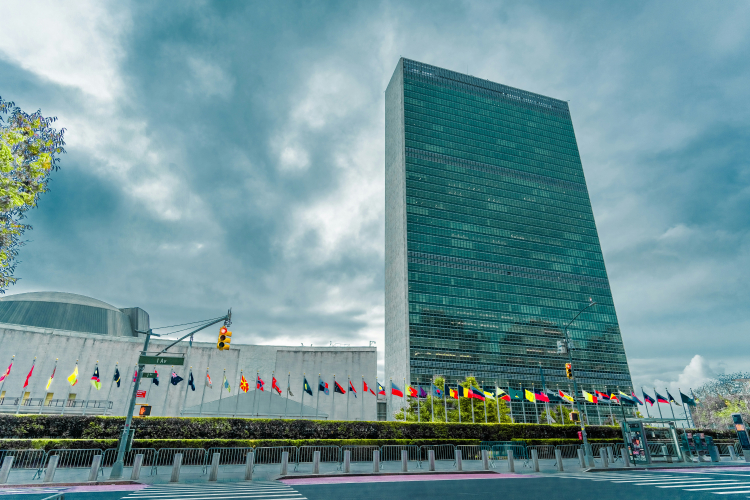
In his well-received speech at the Munich Security Conference earlier this month, Secretary of State Marco Rubio discussed the reform of global institutions like the United Nations. “We do not need to abandon the system of international cooperation we authored, and we don’t need to dismantle the global institutions of the old order that together we built. But these must be reformed. These must be rebuilt,” he stated.
Indeed, the Trump administration has an opportunity to reform the United Nations, to shift UN policy away from gender ideology, diversity, equity, and inclusion, climate alarmism, abortion extremism, and global censorship.
So far, the administration has made terrific statements in formal UN meetings and called for unprecedented votes against a few of the UN resolutions on these issues and in meetings of UN agencies. But success has been scarce on the most pressing cultural issues.
When it comes to results, the real wins have only come on UN security policy and the UN budget. That’s where Rubio and U.S. Ambassador to the United Nations, Michael Waltz, rightly focused in the first year of the second Trump administration. Now they should consider doubling down on social policy reforms.
Reforming radical leftist UN policy will be hard. It will require tedious diplomatic wrangling to convince the 193 members of the General Assembly. Success can be found based on shared values, common interests, and mutual respect. In this regard, the U.S. has more friends than many believe.
The administration will find open doors in capitals around the world. The biggest difficulty will be Europe. The issues Europe is least likely to concede on are censorship and social issues. Some of the UN votes on abortion, the transgender agenda in recent months showed as much. Europe remains as committed to exporting abortion, gender ideology, DEI, and its censorship apparatus today as it was when Biden was in the White House, maybe more.
The developing world awaits U.S. leadership on these controversial issues. Here is the problem and the opportunity. These issues are not yet a real part of the ongoing conversations about UN reform, but they should be.
Ambassador Waltz made a courageous and compelling case for UN reforms at the Munich Security Conference as well. In the face of hostile European Union bureaucrats and officials, he made the case for budget cuts. Unfortunately, as other Republicans before him, he only emphasized security issues and budget cuts. That won’t be enough to change the UN system.
For all the hair-pulling about UN financial collapse from the Secretary General and the EU Commission, the Waltz budget cuts are more of a temporary disruption to UN bureaucrats than actual reforms. They only affect the UN’s core budget of $3.8 billion and do not touch the real UN budget of over $60 billion the UN system receives through voluntary contributions. This means that the UN budget continues to fund censorship, gender, abortion, and DEI.
Waltz might have mentioned how the UN children’s agency (UNICEF) promotes transgender affirming care for children or how the UN Women’s agency wants men who believe they are women to gain access to women’s only spaces. These are things that U.S. diplomats have called out at UN headquarters, but they have yet to become a part of the conversation about UN reform. There is a real danger to fall into a bureaucratic trap here.
The cuts were achieved in the context of the UN80 initiative, a reform spearheaded by the UN Secretary General and the European Union. It is as much about the UN financial crunch as it is about making the UN system Trump-proof. Reforms are expected to take place in rapid-fire succession this year, giving barely any time for member states—and the U.S. in particular—to make reforms. The UN bureaucracy expects a fast-paced decision rubberstamping EU-backed policies.
For now, the UN80 reforms follow a similar pattern to previous UN reforms. There is talk of creating “efficiencies”, “delivering as one”, and a UN “fit for purpose.” But the main thrust is to consolidate power and resources in the UN bureaucracy. As a result, the overall effect will be to reduce U.S. influence and give more power and leverage to the European Union.
The European Union is the largest collective donor to the UN development system. From a UN point of view, it is a more stable partner than the U.S. government—something EU officials never tire of repeating. Unlike the U.S. Presidents and their cabinet, EU bureaucrats never get fired, and they never change policy.
The U.S. simply cannot allow the left-leaning EU bureaucracy to control the UN80 reforms any more. The U.S. should take the lead and insist on adding caveats in UN policy against abortion, shutting down climate alarmism, ending gender ideology and DEI, as well as firing the army of gender, climate, and DEI specialists hired by the current UN Secretary General. These are all 80-20 issues geopolitically.
In the long run, what is needed is a firewall to block these policies from ever being part of UN programming again. This will require creating a review mechanism within the UN80 discussions to ensure all UN programs respect sovereignty and the UN consensus. And it will require the administration to relentlessly articulate its vision for policy reform to other UN member states through white papers, diplomatic statements, and events.
UN reform has to be about more than budgets and process. It has to be about getting the UN out of the radical social policy business. If done right, a genuine reform can ensure that abortion, gender, DEI, and censorship will fade from the UN agenda. This would be a remarkable legacy for Donald Trump.
Stefano Gennarini is the Vice President for Legal Studies at the Center for Family and Human Rights (C-Fam), researching and writing on international law and policy at the United Nations in New York.
