




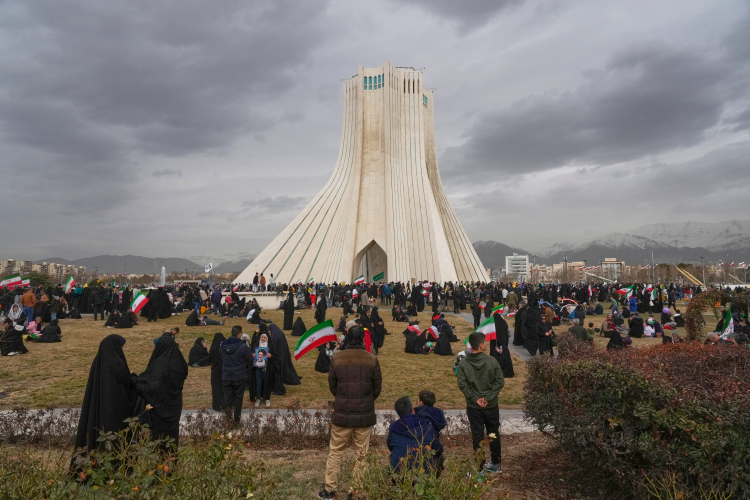
Now that the U.S. and Israel have crossed the threshold of war with Iran, and the apparent death of Ayatollah Ali Khamenei, Colin Powell’s “Pottery Barn Rule” will inevitably be resurrected. Caution argues, as would Powell, that if our invasion “breaks” the Iranian economy, we had best be prepared to “own” it. We will have to engineer a recovery that provides a standard of living that at least approximates pre-war conditions, otherwise we will have set in place the conditions of another endless conflict. While we would like to believe otherwise, there is some possibility that a more ruthless theocratic regime could emerge.
The experience that gives contemporary currency to Powell’s worry is the memory of our endless and largely unsuccessful withdrawal from Iraq. While Paul Bremer’s decisions to dismiss the Iraqi army and “de-Baathify” the Iraqi state apparatus are rightly seen as wrong-headed, causing the war to run much longer and cost many more lives, America’s extended struggle to find a way out was at least as costly.
When elected in 2008, President Obama set an 18 month target for withdrawal from Iraq. Impatient to find a quick way out led to a novel and thoroughly ineffective solution, now a widely embedded part of bureaucracy’s tool kit -- the “whole of government” approach. It presumes expertise exists in the federal government to solve any problem -- all that’s needed is to engage the pertinent agency.
In the circumstances, Army commanders turned to USAID, the federal agency for international development. USAID had been created fifty years earlier to draw new nations emerging from the collapse of colonialism to American-style democratic capitalism and away from the horrors of the Soviet system that would sacrifice millions in pursuit of its five year production plans.
In the fifty years it had been operating, USAID proved to be a Sphinx without a secret. It could not point to a single country where it had successfully started a national economy operating on a market-based system much like America’s. Nor had it produced one new American ally.
Looking at the Iraqi situation in a historic light, Admiral Michael Mullen, then chair of the Joint Chiefs, came to believe that post war economic development should be a critical element of American war fighting doctrine. Any proposed invasion should meet a threshold condition that the U.S. would always leave a working economy behind. Unfortunately, his remaining tenure with the Joint Chiefs was too brief to institutionalize an emerging alternative to what was then known as “nation building” in the aftermath of conflict.
What Mullen saw was a new perspective on America’s efforts to help poorer countries on the road to prosperity. The key to more success in restoring local economies in the aftermath of war was better thought of as entrepreneurial capitalism, the essence of the never ending process of economic renewal that Joseph Schumpeter, writing in 1950, had immortalized as the “perennial gales of creative destruction.”
I had recently advanced this perspective in Foreign Affairs as expeditionary economics. The name suggests an aggressive propagation of the ideas and practices that had been reshaping contemporary American capitalism, symbolized by the computer and software technology linked to Silicon Valley.
The elements of expeditionary economics serve as the guide to what will have to be accomplished if America really hopes that a modern, democratically inclined Iran can emerge. As a precondition the U.S. must solve Iran’s inflation, now exceeding fifty percent, a possibility if America can manage its oil sales.
As these efforts are underway successful reconstruction will hinge on the promotion of indigenous entrepreneurship. Every nation is home to substantial numbers of citizens with creative ideas eager to start businesses. The trick is not so much to recruit a cadre of entrepreneurs but to create institutional support that encourages more individuals to start businesses.
The most critical element of this support is the rule of law. No emerging economy has any hope of growth unless property rights and contracts are recognized and secured by neutral courts. Vital to a new entrepreneurial class, risk capital must be available for startups. Local banks should emerge as the principal source of capital for entrepreneurs, mediating investment by Iranians, not foreign venture capital funds.
Professionals supporting President Trump’s Iran planning appear extremely familiar with the country’s culture, the force the post-Khamenei regime holds over its population, the competencies of its military and intelligence systems, and the posture of its allies and enemies. It would be hard to draw any other conclusion given the success of last summer’s Operation Midnight Hammer. Hopefully, the joint Israeli - U.S. intervention will be seen as another initiative by Mr. Trump to improve the economic lives and security of a peoples long persecuted by a ruler with no thought of the welfare of those over whom he reigns and a step towards a more peaceful global order.
Carl J. Schramm is University Professor at Syracuse; a fellow of the Johns Hopkins Institute for Applied Economics, Global Health, and the Study of Business Enterprise; and a fellow at Action for Global Health.
