




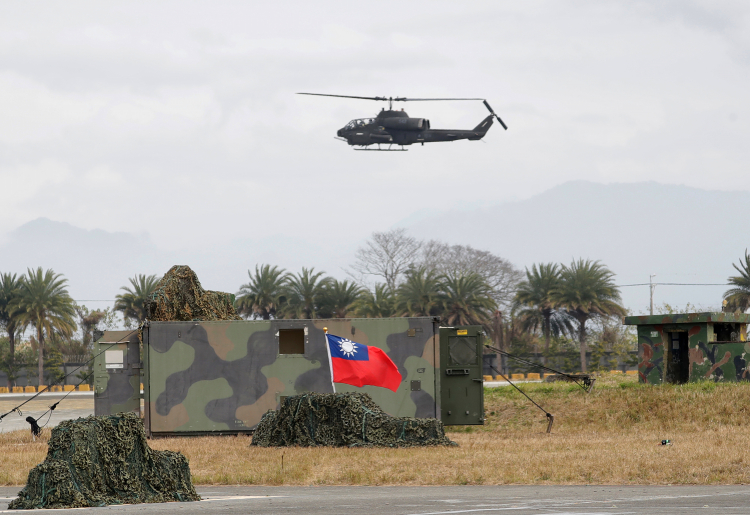
When the Taiwan legislature recently refused a large defense spending increase of $40 billion in favor of a much smaller allocation of $12 billion, many in Washington were surprised and dismayed.
They should not be. Political gridlock in Taipei over defense shows there are very real fissures on the island. It illustrates an evident understanding among some in Taiwan that political accommodation with China is preferable to armed confrontation.
The United States has consistently pressured the Taiwanese government to spend more on its own defense. Elbridge Colby, now the Pentagon’s undersecretary of defense for policy, argued emphatically a couple of years ago that “Taiwan has to do its part to make it plausibly worthwhile for America. Right now that’s not happening.”
U.S. officials in Taiwan have also expressed concern over the recent defense spending stalemate in Taipei while U.S. senators have registered their disappointment.
So why is Taiwan’s legislature stubbornly refusing to go along with Washington’s wishes? The simple answer is that the opposition KMT Party, along with the smaller TPP Party, have a majority in the legislature. They do not see eye-to-eye, to put it mildly, with President William Lai from the DPP Party, which has led Taiwan for the last decade.
Last year, Lai and his party suffered numerous political setbacks, strengthening the will of the opposition KMT Party to resist his program. The DPP under Lai’s leadership was accused in particular of undermining civil liberties under the guise of national security and military preparedness. A major opposition party figure had been arrested and some popular Chinese apps had been banned for allegedly enabling Chinese influence operations, generating significant consternation.
An even more serious political setback for Lai’s ruling DPP was the total failure of an electoral recall campaign to unseat many legislators from the main opposition KMT Party. These episodes fueled skepticism about Lai’s governing program, including his ambitious plans to massively increase Taiwan’s defense expenditures.
Lai has been making rather extreme statements with respect to cross-strait relations, predictably escalating tensions with Beijing. Meanwhile, the opposition KMT Party has moved in the opposite direction, raising concerns in both Taipei in Washington about the evidently increasing appetite among the Taiwanese to support some kind of political accommodation with China. The new KMT leader, Cheng Li-wun, has even been seeking a meeting with Chinese leader Xi Jinping.
The appeal of political compromise should hardly be surprising. Cross-strait trade amounted to nearly $300 billion in 2025, showing a 7.3 percent increase per annum. There are more than 300 commercial flights connecting China and Taiwan per week, including robust flows of tourists. It’s well-known in the region that Taiwanese companies played a major role in China’s economic miracle over the last several decades. The Taiwan National Palace Museum boasts the largest collection of Chinese antiquities in the world, highlighting the tight cultural and historical ties that exist between China and Taiwan.
Even seen from a strategic-military perspective, skepticism in Taipei over vast defense spending increases have a logical basis. Money has been poorly allocated in the past. For example, much of Taiwan’s defense budget continues to support the purchase of fighter jets that are less advanced than those now in the Chinese inventory. Many Western defense analysts believe these fighters will never get off the ground in a warfare scenario, since China has ample capability to destroy Taiwan’s air bases in the opening stage of any PLA attack.
The bottom line is that Taiwan’s defense advocates are likely better off focusing on low-cost quick fixes like land and sea mines or proven asymmetric weapons like Javelin anti-tank missiles over large, expensive systems including tanks, fighters, and submarines. Even more important for the island’s defenses could be organizational and training reforms, such as improving the quality of Taiwan’s reserve troops.
Many on Taiwan are aware of certain stark realities, including that they will never be able to win an arms race against China. They are additionally aware that the buildup advocated by President Lai is a major driver of cross-strait tensions at present. They know previous efforts to lower cross-strait tensions by fostering engagement, such as during 2008–16, have succeeded.
The machinations in the American Congress over Taiwan’s defense budget have a not-so-faint whiff of corruption. The same U.S. legislators up in arms over delayed contracts are getting political donations from the relevant U.S. defense contractors. Numerous D.C. think tanks are playing the same corrupt game, unfortunately.
Like many in Taiwan, Americans need to be clear-eyed and realistic. Whatever the short-term economic benefits of such arms transfers, Taiwan itself is hardly crucial to U.S. national security and certainly does not rise to the status of a vital interest.
The U.S. should not sleepwalk into a catastrophic and unnecessary conflict with another nuclear-armed power over an island on the other side of the planet. Cautious deliberation rather than bombast and bromides is what is now required on the delicate Taiwan issue.
