




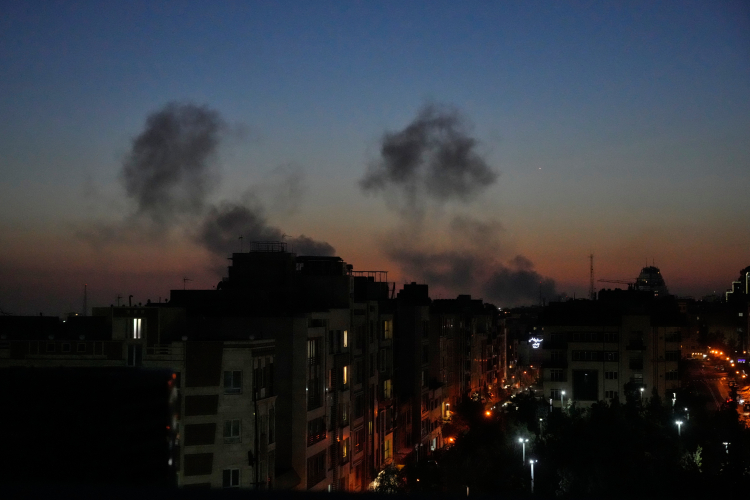
The United States and Israel have chosen war with Iran for the second time in just eight months, launching sweeping strikes aimed at toppling the regime. The assault once again comes amid negotiations between Washington and Tehran, raising serious questions of both U.S. sincerity in its diplomatic efforts abroad and the supposed “peace” mandate President Donald Trump has falsely claimed to support.
Trump’s stated reasoning for attacking Iran continues to fluctuate between Iran’s nuclear program, missile program, support for proxies abroad, and repression at home. That dynamic is concerning given the history of U.S. mission creep and, frankly, the ongoing desires of official Washington to cede increasing levels of power to the executive branch and its clear disdain for international law.
Given Oman’s foreign minister, Badr al-Busaidi, shared a major breakthrough in the talks between Washington and Tehran just hours before the strikes makes Trump’s decision all the more damning. In this regard, Iranian and U.S. officials supposedly reached a framework in nuclear negotiations that could have led to a profoundly better deal than former President Barack Obama’s nuclear deal with Iran in 2015. Per al-Busaidi, the framework effectively cut off any chance of an already non-existent Iranian nuclear weapon – exactly what Trump has loudly and repeatedly demanded from talks.
Ultimately, the decision to go to war with Iran was reportedly made weeks or months ago, in close coordination with Israel and in the name of advancing Israeli interests – not U.S. ones. Trump has chosen maximalism at the expense of Middle East stability and U.S. lives, with tens of thousands of troops and citizens caught in the crossfire.
Trump is rolling the dice, hoping that more military aggression in the Middle East – a part of the world with extremely limited strategic importance to the United States – will help him achieve some unlikely goal of turning Iran into a Western-friendly state, thus cementing his name in the history books. That effort is personal, having nothing to do with the average U.S. citizen, who will pay the tens of billions in cost to conduct this war – all for an effort to ostensibly change the government of a country that poses no real threat to our citizens at home.
While the White House certainly hopes for a quick Iranian capitulation, the reality on the ground is much murkier. Iran knows it is cornered and just lost senior leaders – including Supreme Leader Ali Khamenei – in the initial wave of strikes which kicked off the current fighting. Trump’s clear calls for an end to the Iranian regime make this an existential war for Tehran, inviting a broader Iranian response.
Tehran is already hitting U.S. bases and civilian areas across the Middle East. It may attempt to close the strategic Strait of Hormuz – a vital chokepoint where a large chunk of the world’s oil flows – having struck at least two ships. While difficult to achieve, even the threat of doing so and subsequent strikes will severely limit shipping. In parallel, Tehran has expanded its strikes to target oil production sites across the region. The goal is to pressure both the Gulf states and broader international community into speaking with Trump to end the war, based in the understanding that regional chaos and increased gas prices in the United States would cause Trump to shift course.
That is a bold assumption filled with risks, speaking to the escalatory ladder many analysts have long warned of in the case of such a war. At present, it may have backfired, pushing Arab states toward the West. However, the point of chaos can produce the same result – regardless of joint statements against Tehran’s actions.
In this context, energy is hardly the only concern. Iran’s so-called Axis of Resistance – a network of armed non-state militias across the Middle East – could decide to join the war at any time. That includes the Yemen-based Houthis, who will likely aim to shut down Red Sea shipping again. Groups in Iraq targeted U.S. installations in Erbil. Hezbollah, battered from its late-2024 war with Israel, struck Israeli cities over the weekend.
If the U.S. goal is truly regime change or regime collapse, it is producing another Iraq War scenario while fostering what can now be defined as a region-wide conflict with no de-escalatory ladder in sight. Tehran has every incentive to fight to the death, with the U.S.-Israeli air campaign being unlikely to seriously dislodge the regime as opposed to empower hardliners. That spells disaster and a potential quagmire if this war continues, especially as air campaigns alone rarely produce a positive outcome in a country – think Libya as an example.
What the White House needs to understand, however, is that the United States is not required to fight a war on Israel’s behalf without an endgame in sight. There is no U.S. interest in a new Middle East war, yet Trump chose one anyway. While the U.S. should have avoided this war of choice in the first place, the difficult task Washington should now adopt is to seek de-escalation and avoid turning this into a protracted war.
Alexander Langlois is a Contributing Fellow at Defense Priorities.
Comment
Show comments
Hide Comments
