




As the world focuses on Iran and all the uncertainties that the current crisis entails, attention on Venezuela has faded, despite the fact that it has been fewer than three months since President Trump announced that Nicolás Maduro had been seized for eventual trial in New York on narcotics trafficking charges and that the United States was taking control of then country’s oil exports and thus of its economy.
But much has happened since then, and while Trump has expressed satisfaction with the current state of affairs, he may not be able to avoid indefinitely some tough policy choices, given that he has in effect made Venezuela a protectorate, with the United States the determining factor in its political and economic future.
Shortly after Maduro’s seizure, Secretary of State Rubio outlined three stages which the United States envisioned for Venezuela: first, stabilization, to prevent the country from “descending into chaos;” second, recovery, which entails the entry of U.S. firms to revitalize its battered petroleum industry; and third, transition, at an unspecified pace, to democratic governance.
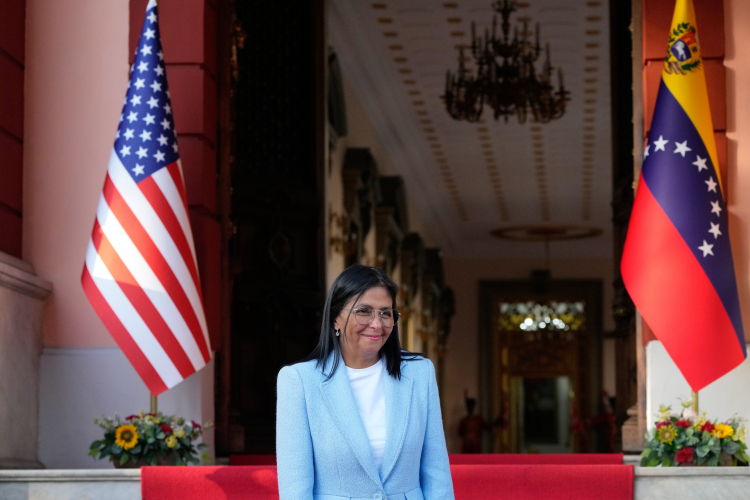
The Trump administration can point to success at its first goal, stabilization. Maduro’s Executive Vice President, Delcy Rodríguez, has assumed the reins of power; the streets are calm, and for most Venezuelans life goes on. But the machinery of the one-party “Bolivarian” state established by Hugo Chávez remains intact, and hardliners Diosdado Cabello and Vladimir Padrino remain as Interior and Defense Ministers respectively.
Some progress has been made on economic recovery. With the United States overseeing oil exports, Venezuela is now able to charge the full international price, instead of selling at a discount to China to avoid sanctions. New investor-friendly laws on petroleum and mining have been passed, and international oil companies are showing some signs of interest. The economy is beginning to grow, but how large and how sustained this recovery will be remains unclear, given broader uncertainties regarding Venezuela’s political future.
And, indeed, serious questions remain regarding the promised democratic transition. An amnesty law for political prisoners has been passed, but it is full of loopholes. Many prisoners have been released, but many remain. The police have been more tolerant of public dissent, but on occasion they have reverted to arresting opponents. The courts and the electoral authority are unreformed. And, of course, no date has been set for free and fair elections.
The Trump administration has remained largely silent regarding such elections. Its decision to affect events in Venezuela through its one-off seizure of Maduro and its control of oil exports, rather than through a conventional military intervention, meant that it had no choice except to deal with the existing regime, at least at first, but the danger exists that the longer the status quo prevails, the harder it will be to move on from it.
The United States has re-established diplomatic relations with what it terms Venezuela’s “interim authorities” and has told courts that the Rodríguez government is the “sole legitimate representative” of the country. And Trump has been effusive in praising her, saying she “is doing a great job,” while avoiding discussion of any democratic transition. And he has suggested that, like Rodríguez , an “internal candidate” might best for Iran.
Maria Corina Machado, the driving force behind Venezuela’s opposition, apparently seeing U.S. limited interest in democracy, has said that she intends to return to Venezuela “in a few weeks.” For his part, Trump has sought to wave her off of this idea, expressing concern for her safety. (And indeed Interior Minister Cabello has said that he has a “surprise” for her, should she return.)
But if Machado enters Venezuela and is detained or harmed, or she is left alone and galvanizes its public to demand elections, Trump could be be faced with a choice he does not want to make—will he use the tremendous power he has over Venezuela’s oil to insist on democracy or will he make clear that he accepts an authoritarian regime so long as it is pro-U.S.? As Trump strives for a positive outcome in Iran, his actions in Venezuela, which he has viewed as the “perfect scenario,” may come back to haunt him.
Richard M. Sanders is Senior Fellow, Western Hemisphere, at the Center for the National Interest in Washington DC. A former member of the Senior Foreign Service of the Department of State, he served at posts throughout Latin America, including at the U.S. Embassy in Caracas.
