




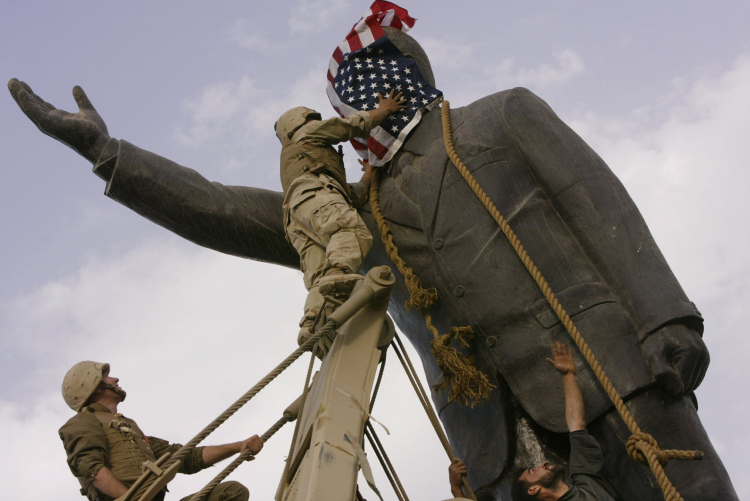
George Santayana’s sage observation, “Those who cannot remember the past are condemned to repeat it,” has come back to haunt us. In this case, the Trump administration’s war with Iran is a repeat performance of the war with Iraq in 2003, but with a global impact.
Robert Draper’s definitive account, To Start a War, is a helpful reminder. The book deals with Deputy Secretary of Defense Paul Wolfowitz’s “Sisyphean quest” to bring down Iraq’s leader Saddam Hussein, which culminated in the invasion of Iraq. The process involved convincing the Bush administration as well as the American public that Saddam was behind the 9/11 attacks and in possession of weapons of mass destruction (WMD).
Two months before the invasion, Vice President Dick Cheney stated the issue was “the safety and survival of civilization itself”. As Draper writes, the claim about WMD was little more than a series of hunches based on information that was badly outdated, almost completely circumstantial, and often fabricated.
Some foreign leaders, notably Britain’s Tony Blair, were sucked into the vortex. The Danish prime minister Anders Fogh Rasmussen, who later became NATO’s secretary-general, stated, "Iraq has weapons of mass destruction. This is nothing we just think. We know."
As secretary of state Colin Powell told Bush, “If you break it, you own it”. Rather than being met with acclaim, occupation forces were met with an insurgency, and in turn the collapse of the Coalition Provisional Authority led to the dominance of Iran.
The justification for the invasion of Iraq, although fictitious, was at least coherent, which cannot be said about the present war with Iran. Swamp Notes, a weekly podcast from the Financial Times, illustrates this.
According to Edward Luce, FT’s US editor, trying to determine the aim of Trump’s “war of whim” is like trying to nail Jello to the wall. The rationales for the war range from coming to the rescue of the protestors, a new nuclear deal, ceasing support for proxy groups in the region, getting rid of their ballistic and short-range missile stockpile, and regime change.
One aim is clear: Israel’s aim to obliterate the Iranian regime. Five days before the attack, Israel’s Prime Minister Benjamin Netanyahu called Trump and gave him the decisive information that Iran’s supreme leader and his top advisors would meet at a given location on Saturday morning.
Tehran has declared the Strait of Hormuz, the world’s most vital shipping lane, open to all except the U.S. and its allies. Israel’s attack on Iran’s South Pars gas field and Iran’s retaliatory strikes on gas and oil facilities in Qatar, Saudi Arabia, and Kuwait have also caused a steep increase in energy prices and alarmed Trump.
One unexpected beneficiary from the war is Putin’s Russia, which rakes in an extra $150 million a day from the increase in oil prices, prolonging the war with Ukraine.
General Dan Caine, chairman of the Joint Chiefs of Staff, earlier warned of the risks an extended military campaign would entail. One consequence has been that the military has burned through years of critical munitions since the start of the war.
The Pentagon has asked the White House to approve a more than $200 billion request to Congress to fund the war in Iran, and Trump has confirmed he will ask Congress. “It’s a small price to pay to ensure that we stay tippy top.”
Trump has previously lambasted the Biden administration for spending money to finance the war in Ukraine (an estimated $188 billion by December). And the National Security Strategy declares a predisposition to non-interventionism.
Caine also told Trump that an American attack could prompt Iran to close the strait, but bolstered by the success of the Venezuela operation, Trump told his team Tehran would likely capitulate before closing the strait.
The failure of the Dardanelles campaign in 1915 illustrates the folly of trying to force entrance to a narrow waterway, followed by boots on the ground to achieve the same objective, Turkey’s surrender and withdrawal from the First World War.
Trump’s appeal to U.S. allies to help open up the chokepoint has fallen on deaf ears, as none of them were consulted before the war. In return, Trump warned that NATO faces a “very bad” future if it fails to assist. The UK, France, Germany, Italy, the Netherlands, Japan, and Canada have in a joint statement condemned Iran’s blockage and offered to help, but how remains unclear.
The war has received little domestic support and dissent threatens to weaken MAGA. A marked protest has come from Joe Kent, director of the National Counter Terrorism Center, who in his letter of resignation called on Trump to reverse course, as he considered Iran to pose no imminent threat.
Kent also believes the war was started due to pressure from Israel and its powerful American lobby, who fomented a misinformation campaign in the same way America was drawn into the disastrous Iraq war.
However, there appears to be no exit strategy, and as in Iraq, America could face an ignominious retreat.
Robert Ellis is an international advisor at RIEAS (Research Institute for European and American Studies) in Athens.
