




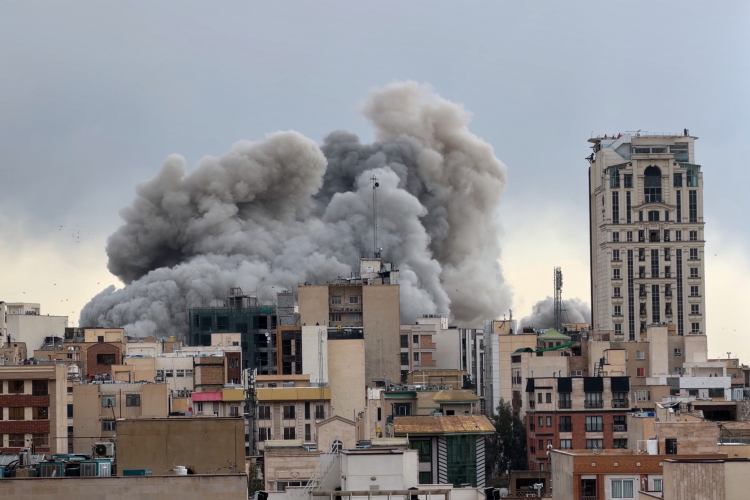
Former President George W. Bush once famously botched an old cliché as his administration painstakingly attempted to sell what would eventually be the illegal 2003 invasion of Iraq, stating “Fool me once … shame on … shame on you. Fool me … you can’t get fooled again.” Today, as the U.S. and Israel wage war on Iran, this hapless statement should serve as a lesson – that sloppy attempts to justify and rebrand military intervention abroad in the name of unachievable goals are likely to produce catastrophe.
Yet the same tactics and mistakes that characterized the misadventure in Iraq have returned in full force just weeks after the first Israeli and American bombs struck Iran. Take Vice President JD Vance’s words, for example: “The idea that we’re going to be in a Middle Eastern war for years with no end in sight — there is no chance that will happen.” Or consider the shaky response from Under Secretary of Defense for Policy Elbridge Colby during a hearing of the Senate Armed Services Committee, in which the Department of Defense’s number three official argued that operations against Iran are not “interventionism” or a “forever war.”
On their own, such statements from these officials and a plethora of others across the Trump administration are understandable in that there is a real desire among most in and around the Trump administration to not produce a prolonged conflict with Iran. The issue at hand, however, is that such rhetoric is just that: rhetoric. Just as the Bush administration attempted to justify the war in Iraq and, in turn, explain away its failings as it rapidly became a disastrous forever war, the Trump administration today employs the same tools to avoid the political costs of its decision to make a war out of what has been a long-running, escalating U.S.-Israeli campaign against Iran and its regional network.
The administration’s refusal to use the term “war” is all the more concerning, especially amid shifting rationalizations for the conflict and poorly defined goals for it. First, Washington should define air strikes against another state as an act of war. Second, the evolving rationalization and end-goals highlight that this administration is seeking political cover for its decisions with the understanding that it does not have well-defined and achievable goals in sight that can be accomplished purely through military force.
These factors seed the ground for mission creep. The lack of Congressional oversight amid a war in which the president refused to even attempt to obtain Congressional or United Nations Security Council authorization similarly limits accountability. Given that the warring parties are reportedly refusing to partake in serious negotiations to end this war, only worsens these dynamics. Tehran bets that it can force Washington into a quagmire that could not only help Iran regain deterrence but help sink Trump’s presidency. Right or wrong, Iran is willing to take more hits in what it views to be an existential war.
Now, emboldened by the tough international posture defining his second and final term, Trump finds himself in an unpopular war he likely underestimated. This war has further empowered Iranian hardliners from the Islamic Revolutionary Guards after killing Supreme Leader Ali Khamenei and other officials. In the process, and especially by letting Israeli Prime Minister Benjamin Netanyahu unduly influence his thinking, he has also been neglecting the diplomatic tools necessary to prevent such a war from cascading, likely harming any future diplomatic track in serious ways.
Trump’s bellicosity would always have diminishing returns, especially when bombing the other negotiating party in such sensitive talks. However, the Iran War goes beyond questions of policy effectiveness. A prolonged and catastrophic war with Iran carries real external implications, including a long-term and open-ended troop deployment, market disruptions, human rights violations, potential civil conflict in Iran and across the Middle East, and the possible fracturing of a nation of roughly 92 million people – including potential levels of refugee flows unseen since World War II.
Already, Israel is claiming its renewed war with Lebanese Hezbollah will be multiple weeks longer than the war on Iran, which is expected to be weeks longer itself. Israel has committed to a strategy in which instability in neighboring countries is acceptable for its own defense, producing an open-ended, region-wide forever war if necessary. Can Washington seriously be counted on to back out of this scenario?
Those potential future realities are why Trump and his team continue to painstakingly redefine conceptualizations of “war,” “intervention,” and the length of this conflict. No clear endgame is in sight. Yet merely repackaging the interventionist rhetorical playbook of old does not change this simple fact: mission creep is here. Only by ending the war can the worst outcomes be avoided.
Alexander Langlois is a Contributing Fellow at Defense Priorities.
