




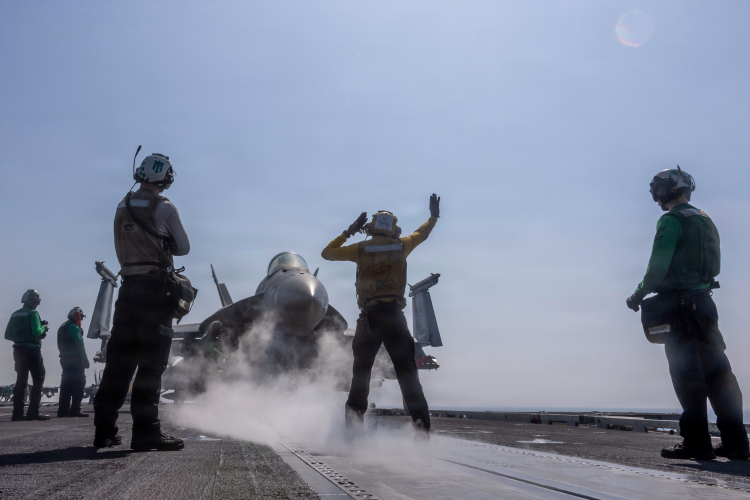
The Iran war and other recent misadventures by the Trump administration can seem like a radical departure from the U.S. foreign policy consensus. To be sure, the Trump administration has spurned the most sanctimonious aspects of U.S. foreign policy, which arguably reached their crescendo under the Biden administration. The gleeful gangsterism in Latin America and the Caribbean, the territorial threats against Canada and Denmark, the planned luxury condos on the mass graves of Gaza—all are indeed shocks to both the mind and the conscience.
Yet the Iran war is actually the culmination of Washington’s long-standing foreign policy pathologies, not a break with them.
The first example is Washington’s seemingly endless appetite for military interventions without any clear definition of success when the stakes for the U.S. are low to nil. This virtually ensures the war will be, at best, not worth the cost, and at worst, an open-ended disaster. The United States cannot mobilize appropriate means in the absence of achievable ends, nor can it be willing to do so if its core interests are not meaningfully involved. This has been a common thread throughout U.S. foreign policy failures, from Vietnam to Iraq to Libya.
The same is true now. The goals of the Iran operation have been defined schizophrenically: regime change (or not), destruction of Iran’s nuclear program (supposedly obliterated last summer), degradation of Iran’s navy and missiles, elimination of Iran’s proxies, etc. There does not appear to be any obvious alternative to the regime within Iran, nor can its capabilities be permanently suppressed. The means have so far been limited to air and naval power, though the administration is reportedly considering sending ground troops. When the ends are open-ended, the war is likely to be as well.
The best-case scenario is Trump rushing to find an offramp, while worse outcomes range from an even more extreme Iranian regime rushing toward a nuclear deterrent, state collapse or ethnic Balkanization, and the beginning of a generational “forever war.” None of these can be meaningfully defined as “victory.”
A second and related pathology is the almost reflexive use of military force when diplomacy would produce a better result. The strikes on Iran started just days after talks that were reportedly resulting in significant Iranian concessions on its nuclear program.
Washington has long tended to treat diplomacy as something to be gifted to friends and denied to enemies. When Barack Obama bucked this trend and negotiated the JCPOA nuclear agreement with Iran in 2015, he was attacked by leading members of both parties for doing so; perhaps not coincidentally, the deal proved successful in halting Iran’s military nuclear development without starting a war.
In this case, the Trump administration broke with tradition by agreeing to talks with Tehran, only to twice refuse to take yes for an answer and bomb them anyway.
In both cases, Trump’s decision to attack Iran was precipitated by Israeli Prime Minister Benjamin Netanyahu’s decision to do so first, likely with the intention of derailing any deal that left Iran intact.
This points to a third pathology: the conflation of U.S. interests with those of its allies and partners, the willingness to be drawn into new conflicts on their behalf, and the resulting overextension of the United States’ capabilities.
The consequences of this pathology can be seen in the United States’ dwindling munition stocks, which have already been stretched thin by its support for the wars in Ukraine and Gaza, and which may not be able to sustain a protracted air war on Iran.
The fourth pathology, and the most detrimental to the preservation of a democratic republic, is the radical indifference shown to the American people and the spurning of their constitutional order. Already, American soldiers have been killed and many more have been wounded for a war U.S. leaders have been at pains to explain. U.S. citizens in the Middle East were not warned beforehand to leave the region; now, they are scrambling to evacuate under threats to airports and commercial aircraft.
Most Americans do not support the decision to go to war and the administration made little effort to convince the public. Congress, which is constitutionally endowed with the sole power to declare war, has instead relinquished its authority. Unfortunately, the usurpation of congressional war powers by the executive branch has been intensifying for some time, as has the increasingly casual manner with which presidents send U.S. troops into harm’s way.
Fifth, even the Trump administration’s rejection of long-standing international norms can be seen as a pathology with precedent. Notably, the Bush administration claimed that prisoners they deemed terrorists were not prisoners of war and therefore unprotected by international law. The Trump administration has used its “narco-terrorist” designation to bomb seemingly random civilian boats in international waters.
There is little appreciation for the fact that many of these norms provide reciprocal benefits for states that uphold them. The United States, for example, should not torture or abuse prisoners of war because doing so raises the chances that American POWs might be also be tortured or abused. The targeted assassinations of heads of state, diplomats, and scientists; Hegseth’s recent declaration that the U.S. will have no “stupid” rules of engagement; the repeated use of diplomatic negotiations as a ruse to launch surprise attacks—all could dangerously backfire on Americans.
Most of the tendencies discussed above were products of a period when U.S. economic and military power was unchallenged. They now persist like a shambling specter as the unipolar moment ends, China rises, and economic power diffuses globally.
In response to this decline, both Biden and Trump sought to make Americans feel “great again” by flexing the United States’ military power and flailing after lost prestige. Both attempted, in different manners but equally unconvincingly, to demonstrate the United States’ continued vitality by exercising the use of force, appealing to a period many Americans still associate with growing prosperity, cultural cohesion, and military preponderance.
Future leaders looking to break with the Trump administration’s foreign policy will also have to break with U.S. foreign policy forged over decades prior. The United States should only engage in military action when its own interests are vital, the objectives are limited and achievable, and diplomatic alternatives have been exhausted. It should only do so after Congress has consented and do so in line with international agreements and norms that protect its own citizens as much as others. It should draw a clear distinction between its interests and those of its allies, and not allow its own power to be sapped in costly diversions. And finally, it must break its perverse addiction to war, and instead turn its attention to the welfare of its own citizens.
Chris McCallion is a Fellow at Defense Priorities.
