




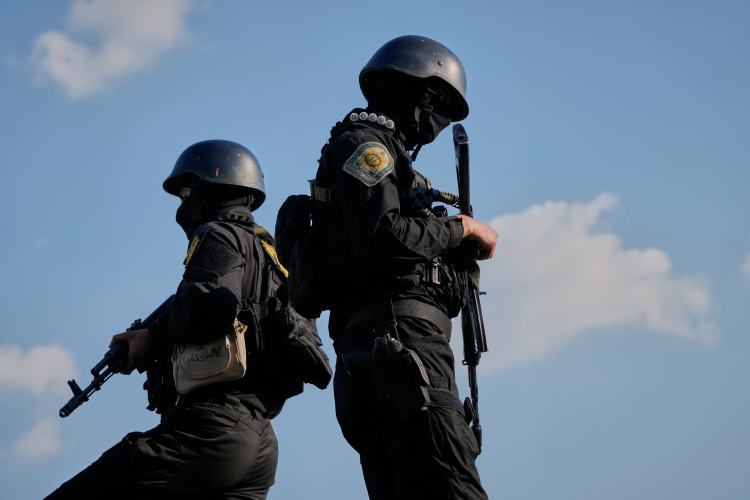
As international attention remains fixed on escalating tensions between Iran, the United States, and Israel, a quieter but more consequential development is unfolding inside Iran: the state is accelerating executions.
This week, Iranian authorities executed two men accused of links to the Mujahedin-e Khalq (MEK), according to reporting by Reuters. Their deaths were not isolated incidents. They are part of a broader pattern of repression that intensifies precisely when the regime faces external pressure.
Now, additional cases are emerging that point to what may come next. Vahid Bani-Amerian, 34, and Abolhassan Montazer, 68, both reportedly affiliated with the MEK, have been identified by rights advocates as being at imminent risk of execution. Their cases underscore the urgency of the moment and the trajectory already underway.
This pattern is not accidental. It is structural.
Authoritarian systems do not become more flexible under pressure. They become more coercive. War, or even the threat of it, does not weaken internal control mechanisms in Iran. It strengthens them. The state uses the external crisis to justify internal crackdowns, expand surveillance, and eliminate perceived threats before they can organize.
Executions, in this context, are not simply punitive. They are preventive.
They send a message to the population: dissent will not be tolerated, especially now. They remove individuals the state views as potential catalysts for unrest. And they reinforce a narrative that opposition is synonymous with treason, particularly when it can be framed as linked to foreign enemies.
This is why the timing matters.
At a moment when economic strain is deepening and uncertainty is rising, the Iranian leadership is not showing signs of fragmentation. It is moving decisively to close ranks. Arrests increase. Trials accelerate. Sentences are carried out swiftly, often under conditions that raise serious concerns about due process.
The implications extend beyond those already executed.
Political prisoners, activists, and detainees across the country face heightened risk during periods of external confrontation. The logic is straightforward: when the regime anticipates instability, it acts in advance to suppress it. The result is a cycle in which external pressure coincides with intensified internal repression.
This reality complicates a common assumption in Western policy debates, the belief that increasing pressure on the Iranian state will empower domestic opposition or create openings for change.
In practice, the opposite often occurs.
External escalation can narrow political space inside the country, not expand it. It can place the most vulnerable directly in harm’s way. And it can strengthen the very security apparatus that reformers and dissidents must navigate.
None of this absolves the Iranian government of responsibility. The decision to execute, to imprison, and to silence dissent rests entirely with the state. But ignoring how these dynamics interact leads to flawed assumptions and, ultimately, ineffective policy.
If the goal is to support the Iranian people, then the first step is to understand the environment in which they are operating.
That understanding carries consequences.
It means recognizing that people facing systematic state brutality will assert their right to resistance and self-defense. It means acknowledging their right to fight for democratic change, rather than reducing them to passive subjects of geopolitical strategy. And it means moving beyond symbolic pressure to concrete measures, including shutting down Iranian embassies and expelling regime representatives who operate abroad while repression intensifies at home.
Moments of war are not moments of opportunity for internal reform. They are moments of consolidation for those in power.
And for those behind bars, they can be moments of life or death.
Dr. Sofey Saidi is a scholar-practitioner specializing in international relations, democratic transitions, and global governance. She holds a PhD from the Geneva School of Diplomacy, with doctoral research focused on political transition dynamics in Iran, and advanced degrees from George Mason University and Duke University. Fluent in Farsi and Spanish, she has taught global politics and international relations at the University of Baltimore.
