




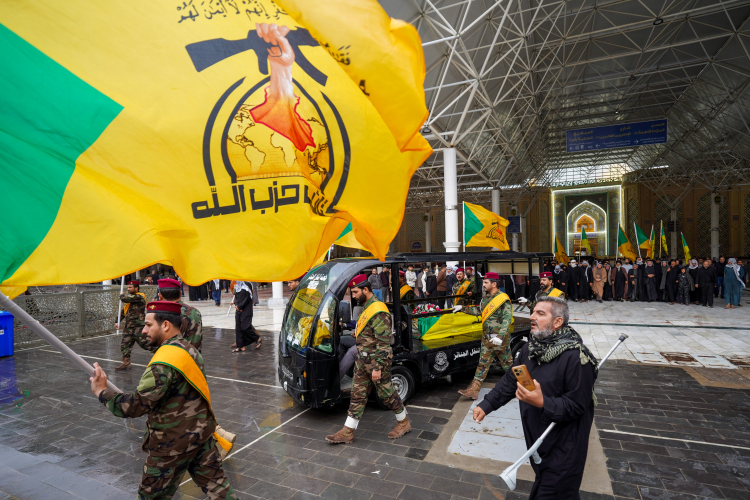
Shelly Kittleson, an American journalist, was kidnapped off the streets of Baghdad on March 31 and is now a bargaining chip for the militia that took her. It’s a tragedy on replay. Kataib Hezbollah, an Iran-backed terror group in Iraq, had previously held Princeton PhD candidate and Russian-Israeli citizen Elizabeth Tsurkov for more than 900 days, until her release in September 2025.
The group is just one of the Iran-backed militias in Iraq that has been escalating aggression since Operation Epic Fury against Iran began on February 28.
Tehran sponsors a network of armed groups who wield not only alarming military power in Iraq but have also gained extensive political and economic influence across the country. The militias feel particularly emboldened because, despite facing repeated American airstrikes, they are not under pressure from their own government. If anything, they are the ones exerting pressure on Baghdad.
Beyond hostage taking, the militias target U.S. assets in the region daily. This is despite a temporary ceasefire in the middle of March between Kataib Hezbollah and the United States, which only protected the U.S. Embassy in Baghdad in exchange for American promises not to target militia leaders. The militias launch daily drone and rocket attacks against the embassy’s support facility at Baghdad International Airport, and even boldly share drone footage of their attacks. They’ve also targeted American military and diplomatic facilities in Iraqi Kurdistan. Energy facilities, some owned and operated by American companies, have opted to go offline preemptively to evade damage from drone attacks.
The United States isn’t the only target. The militias echo their patron’s argument that American military facilities in Arab countries make them legitimate targets. One front group for Iran’s Iraqi militias, Saraya Awliya al-Dam, claimed attacks on U.S. bases in Saudi Arabia, Syria, Kuwait, and Jordan. They’ve also hit the Emirati consulate in Iraqi Kurdistan.
Iran’s proxies have also turned their weapons on Iraq’s own security forces. Militias struck Iraq’s Counter-Terrorism Service (CTS) on March 22, injuring five, and the Iraqi National Intelligence Service (INIS) on March 21, killing one. Tehran’s Iraqi partners view both security institutions with suspicion due to their close relationships with the United States.
But what has emboldened the militias is not just their violent success, but rather the weak response from Baghdad. Iraqi officials routinely fail to name the Iran-backed militias as the perpetrators of these attacks—a prerequisite to acting in response to their aggression. The Iraqi Ministry of the Interior statement after Kittleson’s kidnapping blamed “unknown individuals. Kataib Hezbollah's role was well known.
The Iraqi Ministry of Foreign Affairs rejected attacks on Gulf countries and Jordan through a vague statement that again placed no blame. Prime Minister Mohammad Shia al-Sudani’s condemnation of the attack on INIS only described the culprit as a “cowardly group.” Sudani’s military spokesman similarly condemned attacks on the U.S. Embassy in Baghdad but attributed them to “outlaw groups.”
Meanwhile, Sudani licensed the Popular Mobilization Forces (PMF), an official Iraqi security institution comprised mostly of Iran-backed militias, to respond to U.S. airstrikes against them, making retaliation an official policy.
Government officials in Baghdad will only act against the militias under U.S. pressure. Many Iraqi elites come directly from the militias or Iran’s sphere of influence. As the Trump administration navigates Iranian influence in Iraq, the United States has options. Iraq’s oil revenue, which accounts for roughly 90 percent of the federal budget, is deposited in the Federal Reserve Bank of New York.
On top of its funds routing through the United States, Iraq gets extensive aid from Washington. The 2026 National Defense Authorization Act prohibits the U.S. government from transferring more than 75 percent of the funds intended for Iraq security forces unless they take serious action against the Iran-backed militias — an increasingly unlikely outcome.
But the real question is not whether the United States has leverage, but rather is it willing to use it and use it effectively? To unravel the deeply penetrated Iranian and militia interests in Iraq, Washington will need to sustain pressure on those working in Iran’s interest. That means the military, the political class, and the economy.
The Trump administration should look carefully for partners in the genuine patriots of Iraq, those elites that are willing to put national interest above sectarian identity or loyalty to the Islamic Republic of Iran. It will be a process that demands great care, but the results would be well worth it.
Bridget Toomey is a research analyst at the Foundation for Defense of Democracies.
