




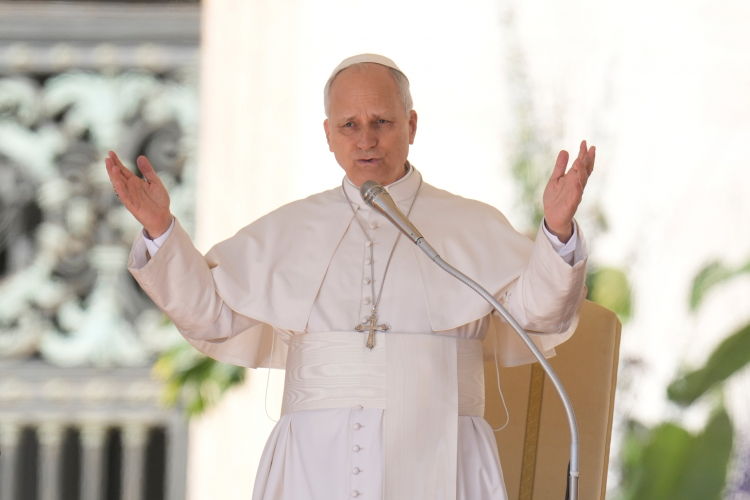
When Pope Leo XIV arrives in Algeria this April, he will do so not only as the first pontiff to visit our country, but as a pilgrim returning to one of Christianity’s earliest intellectual homes. His journey to Algiers and Annaba carries a significance that extends beyond ceremony, rooted in a shared history that has shaped both Algeria and the wider Christian world.
Algeria reflects layers of civilization rather than a single narrative. That continuity is perhaps most vividly expressed through Saint Augustine of Hippo, who was born in Thagaste, now Souk Ahras, in present-day Algeria, and preached in Hippo, now Annaba. His writings remain central to Christian theology, yet his life also reflects something broader: a tradition of inquiry and dialogue that emerged from North Africa and continues to resonate far beyond it.
That legacy is not confined to texts. It remains visible in Algeria’s landscape, from the Basilica of Saint Augustine overlooking the Mediterranean to the Basilica of Our Lady of Africa in Algiers. These sites are not relics of a distant past. They exist within a modern society that is overwhelmingly Muslim, yet conscious of the historical currents that have passed through it. The presence of this heritage, preserved rather than erased, reflects a continuity that has endured through political and cultural change.
The forthcoming visit builds on an established relationship between Algeria and the Vatican. Diplomatic ties have been sustained through regular engagement, including recent discussions between President Abdelmadjid Tebboune and the Holy See. These exchanges have focused on areas where interests converge: interreligious dialogue, regional stability, and the role of faith communities in addressing global challenges. In a region often defined externally by its divisions, such engagement has developed without spectacle, grounded in consistency rather than episodic attention.
Algeria’s approach to religious coexistence is shaped as much by history as by policy. The example of Emir Abdelkader, who protected thousands of Christians in Damascus in 1860, remains a point of reference not because it is invoked frequently, but because it reflects a set of instincts that continue to inform the present. Religious identity in Algeria has not been insulated from tension, yet it has also not been reduced to a tool of political contestation in the way it has elsewhere.
This context informs how Algeria views the significance of the Pope’s visit. It is not an attempt to rediscover a forgotten past, nor to present an idealized image of the present. Rather, it reflects an understanding that dialogue between faiths is most meaningful when it is anchored in lived experience. The small Catholic community in Algeria today, composed largely of foreign nationals alongside a limited number of Algerian faithful, operates within a framework that allows for engagement with state institutions and religious authorities alike. These interactions rarely attract attention, but they form the basis of continuity.
The visit also arrives at a moment when global discourse increasingly frames relations between the Christian and Muslim worlds in terms of friction. Algeria offers a different perspective, one shaped less by abstraction than by proximity. The history of North Africa is not one of separation between civilizations, but of overlap, exchange, and adaptation. That reality does not eliminate differences, but it places them within a broader context that makes dialogue possible.
When Pope Leo XIV visits Annaba, he will stand in the city where Augustine once wrote about the human search for meaning and belonging. Those questions remain relevant, though the context has changed. Algeria’s experience suggests that continuity does not require uniformity, and that engagement across traditions can persist without losing its grounding.
The visit will be measured in images and statements, but its significance will likely be quieter. It will be found in the reaffirmation of a relationship that has evolved over centuries and in the possibility that such relationships can continue to develop in a world that often assumes otherwise.
Sabri Boukadoum is the Ambassador of Algeria to the United States.
