




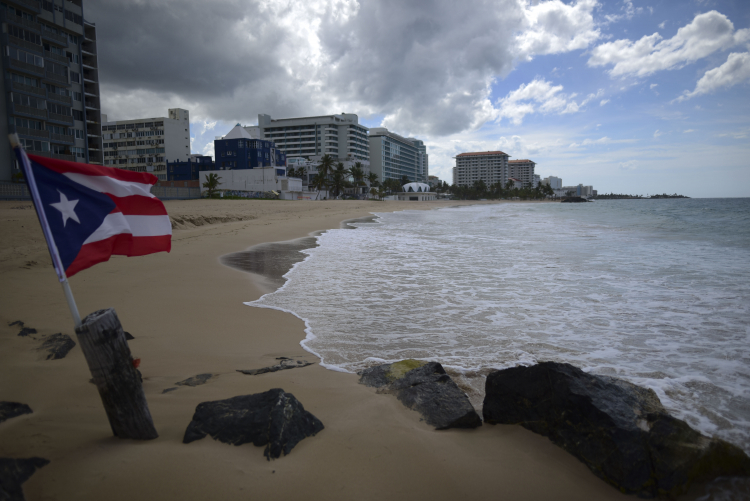
President Trump has a way of forcing questions onto the national stage that Washington would rather avoid. In recent months, he has again spoken in expansive terms about American reach, including arguing that the United States needs control of Greenland for national security. Also, joking after taking over Venezuela, he joked that it could become the 51st state. His administration has treated the Caribbean in the same strategic register. Defense Secretary Pete Hegseth traveled to Puerto Rico in September 2025 and told U.S. forces there they were defending the “American homeland,” while Governor Jenniffer Gonzalez said the visit recognized Puerto Rico’s “strategic importance” in the fight against drug cartels and Nicolás Maduro.
That conversation should lead to one obvious place: Puerto Rico. If the country is prepared to think boldly about what should stand more fully under the American flag, then it should begin with the U.S. citizens who already do. Puerto Rico is not a foreign acquisition, not an imperial fantasy, and not a talking point. It is already American soil, already bound to the Union, and already indispensable to American interests. The real question is not whether Puerto Rico belongs inside America’s orbit. The real question is whether Puerto Rico is prepared to make the disciplined case for admission as a state.
That question has become even more urgent because Cuba is once again reminding Washington that the Caribbean is not a side theater. Secretary of State Marco Rubio said in February that Cuba’s “status quo is unacceptable” and that Cuba “needs to change.” This month, Cuba’s deepening fuel crisis has become entangled with Russia-linked tanker traffic and U.S. sanctions policy, as one Russia-linked fuel shipment assessed as Cuba-bound diverted to Trinidad and Tobago while another Russian-flagged tanker was reported headed toward Cuba with roughly 730,000 barrels. The point is that the Caribbean is again a live zone of American pressure, adversary signaling, and strategic attention.
Puerto Rico should hear that message clearly. If Washington is tightening the legal and strategic perimeter around Cuba, if Russia is testing the edges of that pressure, and if the United States is already using Puerto Rico as part of its forward position in the Caribbean, then Puerto Rico should stop making the statehood case as a grievance and start making it as a readiness program. It should present itself not as a territory asking for sympathy, but as the already-American jurisdiction prepared to enter the Union on equal terms, under equal obligations, with institutions that operate by the same civic standards expected of every state.
Puerto Ricos’ annexation to America cannot be won on sentiment alone. It will be only won when Puerto Rico presents itself as the one serious, disciplined, already-American candidate for admission. That means Puerto Rico must act to quickly unequivocally align with America.
Puerto Rico cannot seek admission while preserving every comfortable ambiguity of territorial life. A territory may live in the contradictions of dual habits, expectations, and standards whereas a state cannot. If Puerto Rico wants voting representation, permanent union, and full equality inside America’s constitutional system, then it must operate like a place that is prepared to govern as a state.
That readiness must begin with constitutional clarity by fully adopting and governing using the Constitution Congress approved in 1952 which is in American English. For Puerto Rico’s equality movement, the governing principle is easy: one constitutional order designed to be equal to America. Statehood has to rest on American constitutional unity.
The territorial legislature must enact the civil and criminal codes, and government must operate, in American English. Public schools must educate students in American English. This is an argument for political maturity. While no American state is culturally identical to another, they all are legible inside the constitutional, legal, commercial, and civic life of the nation it seeks to join. Public laws cannot remain half inside and half outside the common American framework.
Puerto Rico must eliminate tax abatements to selling itself as a carveout, a shelter, or a permanent exception where American income taxpayers can go hide from their American income tax responsibilities. A state must compete through infrastructure, talent, transparency, public safety, reliable institutions, and enterprise. It must not ask for a star on the flag while preserving an economic model built on special dispensations. Equality cannot be argued persuasively while exception remains the business plan.
The territorial government must shrink as well until it can be supported with no more than a 10 percent income tax. A serious statehood movement cannot ask Congress to ignore bloated administration, chronic fiscal strain, and the habits of territorial dependency.
Puerto Rico must reduce welfare dependency to less than 20 percent of the population through growth, work, training, investment, and a civic culture. A healthy state is not built on passivity. It is built on resilience, upward mobility, and the dignity of work. If Puerto Rico wants the Senate votes that have been missing for generations, it must make the case that statehood would eliminate the history of American dependency.
And then Puerto Rico’s residents must immediately pay full American income taxes. Nothing would send a stronger signal to Congress or to Americans at large. Puerto Rico must say plainly that it is not asking to preserve the privileges of territory while receiving the prestige of statehood. It is asking for equality, and it accepts the obligations that come with equality. Rights and duties travel together. A place that wants full representation must be willing to shoulder full responsibility.
Supporters of President Trump should see this clearly. If this administration is willing to think seriously about American strength, American reach, and the strategic meaning of the Caribbean, then Puerto Rico should become the most serious domestic statehood question on the table.
Javier Ortiz, with over 30 years of experience in technology, business, and the public sector, leads investment technical due diligence and innovation at Falcon Cyber Investments. He was the Executive Director of Puerto Economic Recovery Initiative which advocated for policies to stabilize Puerto Rico's economy and reduce its dependence on federal transfers during the hotly PROMESA law debates.
