




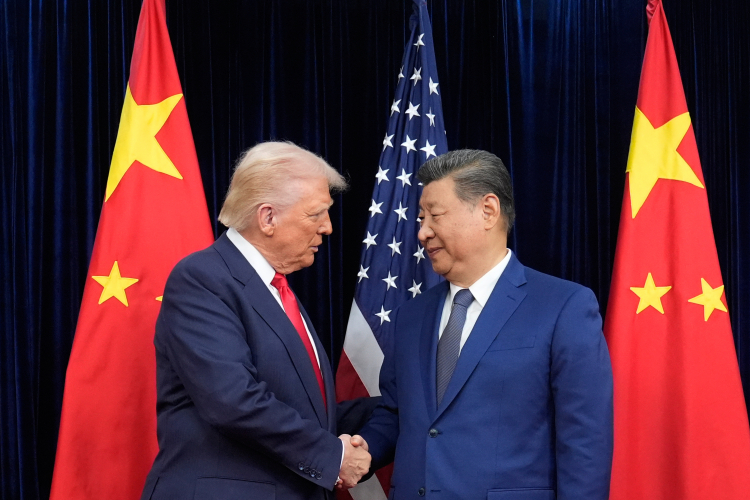
As the Iran war continues to roil the world economy, the Trump administration is understandably eager to point to East Asia where a few limited foreign policy successes have been notched.
The effort to coax America’s wealthy Asia-Pacific allies to invest more in the U.S. economy shows some signs of promise. There has also been some limited progress toward stabilizing the important U.S.-China relationship, though much more work is required.
These successes are encouraging and there’s an opportunity to build on them further, especially in national security matters. Most international security experts still believe that Taiwan constitutes the most dangerous potential flashpoint in the world.
To avoid a catastrophic war between the U.S. and China, Donald Trump and Xi Jinping should seize the moment and use their upcoming summit to ink a fourth communiqué, setting in place a new modus vivendi that will safeguard global security for the twenty-first century.
The first three communiqués between the U.S. and China were signed in a different era, the Cold War, but all played a major role in creating normal and constructive relations between the two powers.
The 1972 Shanghai Communiqué broke down Cold War barriers and created a key framework over Taiwan, including the phrasing that endures to this day: “The United States acknowledges that all Chinese on either side of the Taiwan Strait maintain there is but one China and that Taiwan is a part of China.”
The second communiqué was inked in 1978 and served to formally establish the bilateral U.S.-China relationship. The third communiqué from 1982 specified that the U.S. “does not seek to carry out a long-term policy of arms sales to Taiwan.”
Now, a fourth communiqué could help provide stability in key aspects of the bilateral relationship. It has been pointed out that Trump, who is less beholden to the dominant liberal worldview of previous presidents like Joe Biden, might be well positioned to significantly lower tensions between the U.S. and China.
A fourth communiqué could emphasize mutual respect and underline that neither America nor China is seeking to influence, gain control of, or overthrow the other’s system of governance. The two leaders could, moreover, set a mutual commitment to continue multi-day leadership discussions on an annual basis, institutionalizing U.S.-China bilateral summits.
Just as a fourth communiqué could enable an ideological truce, a similar goal could be a more stable framework for commercial interaction. That framework could be informed by powerful lessons from the recent past regarding economic warfare that has yielded pain on both sides, whether ever-increasing barriers confronting Chinese companies or the signficiant fears of a rare earth cutoff for American industrial sectors . It could aim to level the playing field while simultaneously acknowledging that U.S. export restrictions need to be eased in order to help close the yawning bilateral trade deficit.
But Taiwan remains the Gordian Knot of U.S.-China relations, and it is here that bold and creative diplomacy is so badly needed. It would be good if Trump could simply repeat and thus affirm the formulaic saying cited above from the Shanghai Communiqué, along with another stock phrase to the effect that the U.S. does not support Taiwan’s independence.
It would be even better if Trump was truly “ready to tear up the American playbook” for Taiwan policy that has caused substantial confusion in Washington for decades due to ambiguous wording and continued to sow grave instability into the bilateral relationship partially as a result. Indeed, it’s sad but true that an entire well-financed cottage industry exists in Washington to help maintain the fiction that “acknowledgment” does not equal recognition.
A much more commonsense rendering would jettison acknowledging other perspectives and just state plainly and crisply that the U.S. “recognizes” Taiwan as part of China. This amendment, that fully conforms with our stated one China policy, would help substantially to put Beijing at ease and might well result in reciprocal de-escalation, for example regarding the harsh rhetoric that Beijing has leveled at the island’s leader over the last year.
Words are cheap, however. It would be even more helpful if the communiqué were cemented with some verifiable conditions and even metrics. For example, the U.S. could abjure selling Taiwan certain long-range missile systems (e.g. ATACMS) in exchange for China’s agreement to halt its now-regular aircraft sorties crossing the median line in the Taiwan Strait.
An even more ambitious round of U.S.-China de-escalation would specify that China would cease or at least slow its rapid buildup of large amphibious attack ships in exchange for a U.S. agreement to stop increasing its military presence and military exercise pattern in areas immediately proximate to Taiwan, namely in and around Luzon island in the Philippines and in Japan’s Ryukyu Islands. Applying these measures of reciprocal military restraint could do wonders to stabilize the bilateral relationship.
Two very recent developments suggest that war might not be inevitable in the Taiwan Strait. A report from the U.S. Office of the Director of National Intelligence suggested that war is not imminent. Beijing also invited the Taiwanese opposition leader for an extended visit to China.
These are positive trends that, along with the good will flowing from summit pageantry, should be built upon with concrete results. To that end, Trump and Xi should aim for a history-making fourth communiqué in Beijing that takes as a focus the imperative to avoid war over Taiwan.
Lyle Goldstein is Director of Asia Engagement at Defense Priorities.
