




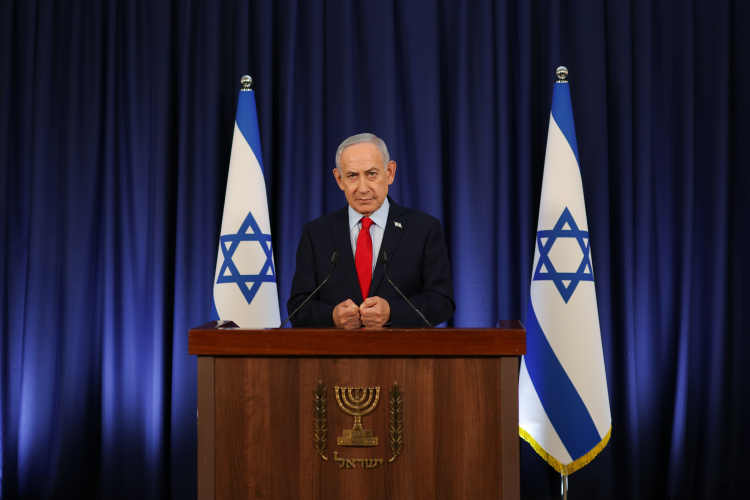
Just as soon as the missiles stopped falling in Israel due to the two-week ceasefire, prosecutors are dragging Prime Minister Benjamin Netanyahu back to court to watch his endless criminal trial. This will surely vex President Donald Trump, who has recently called Israeli President Isaac Herzog a “weak and pathetic guy” for not exercising his pardon power to end the Kafkaesque proceedings.
Trump slammed Herzog for claiming that he had to wait for a recommendation from government lawyers before issuing a pardon. Shortly after Trump’s comments, the lawyers recommended Herzog deny the pardon. President Trump is not an expert on the Israeli constitution – but he understands this issue better than Herzog and his lawyers; there is no legal barrier to pardoning Netanyahu, only a lack of will.
As someone who endured multiple politically-motivated prosecutions and legal proceedings, Trump probably relates to Netanyahu’s predicament. But he has made clear why he has taken an interest in Netanyahu’s legal fortunes. “I want Bibi to be focused on the war — not on bulls--t,” he told an Israeli reporter. Americans' security is damaged when the head of America's frontline ally sits for weeks in court, rather than preparing for a likely resumption of the fighting.
Indeed, the trial has been a major distraction, dragging on for six years, far longer than any American criminal case in history. While judges in Trump’s trials made concessions to the president’s necessarily busy schedule, the very purpose of the proceedings in Israel has been to keep Netanyahu away from his office. Even during the past two years of intense war with Gaza, the PM has had to appear three days a week, eight hours a day. Bibi only got some relief when the courthouse closed due to falling missiles.
The process is the punishment. Many Israelis believe that the entire trial and prosecution is a politically-motivated attempt by the Left, using its power and control of the judiciary, to eliminate Netanyahu, after repeatedly failing to defeat him through the accepted routs of democratic elections. Indeed, anti-Bibi activists have argued that the trial keeps him so busy, he should be removed from office because of “incapacitation.”
On the legal merits, the central bribery charge against Bibi has encountered significant evidentiary difficulties, by the judges’ own account. Serious investigative failures have come to light. State witnesses were put under massive pressure to incriminate Bibi – and some of them recanted their accusations on the stand. In the U.S., a judge would have thrown the case out for such prosecutorial shenanigans.
In Israel, the President is the only one who can close this circus. The President’s authority to pardon offenders is enshrined in Israel’s quasi-constitutional Basic Laws and ranks among his most fundamental constitutional powers. The Supreme Court has interpreted this authority broadly, tracing its origins to the sweeping prerogative historically vested in the English Crown and the American Presidency. It extends not only to those convicted of a crime but also to those who have been charged or merely suspected.
Pardons are one of the few real discretionary powers of the Israeli Presidency, a largely ceremonial position. The Justice Ministry’s Pardons Division recently issued an opinion for Herzog, cataloguing a long list of “difficulties” with granting a pardon, but it stopped short of concluding that it can’t be done. Even had it said so, that would not diminish the President’s ultimate responsibility and authority to act according to his own best judgment, not that of the government lawyers lacking any democratic pedigree.
A major point of pardons is to have some safeguard against government overreaching abuse. By giving the government lawyers the final say-so on pardons, Herzog short-circuits this protection and puts the fox in charge of the henhouse.
Israeli officials typically cower before the “advice” of the civil service. That is because Israel’s Supreme Court has invented a doctrine that makes it presumptively illegal for elected officials to disregard the wishes of “professionals,” i.e., the Deep State. “Professional advice” serves as a veto against right-wing politicians and a way to avoid responsibility for those on the Left, like Herzog.
Herzog was previously the head of the Labor Party, and a pardon would surely cause him endless grief in his social circles. Much of the politics of the Israeli opposition is now built not on a rejection of Netanyahu’s largely popular governance, but his alleged criminality.
Yet Herzog himself has recently said that protracted prosecution “weighs heavily on Israeli society” and is having a “very negative impact on the country.” It would be consistent with the president’s role as a neutral, unifying figure to lift this weight in wartime. The court closure is scheduled to end this week, and Trump has announced plans to visit Israel in a month to receive a prize typically awarded by the President – suggesting that without action by Herzog, the crisis will escalate.
Mr. Ben-Shemesh is a senior lecturer at Ono Academic College; Mr. Kontorovich is a professor at George Mason University Scalia Law School, and a senior research fellow at the Heritage Foundation.
