




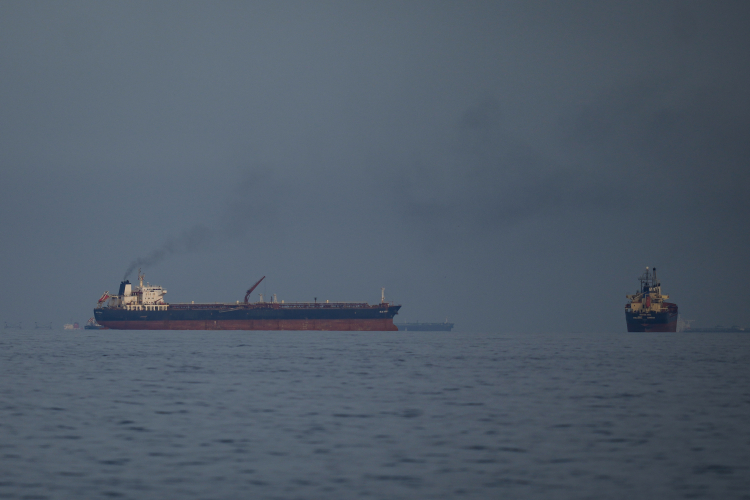
As President Donald Trump convenes a Situation Room meeting over tensions in the Strait of Hormuz, the language of “risk” no longer applies. Events have already crossed into active confrontation.
The U.S. seizure of an Iranian-flagged vessel in the Strait marks a clear shift from signaling to enforcement. What was framed as a potential flashpoint is now an unfolding reality. Tehran’s threats of retaliation and its hesitation to remain engaged in diplomatic channels suggest that this escalation may not be easily contained.
Yet Washington’s response remains anchored in a familiar framework.
Policy discussions continue to focus on immediate concerns: securing shipping lanes, calibrating military posture, and managing escalation scenarios. These are necessary steps. But they are being treated as though the crisis begins and ends at sea. It does not.
The Strait of Hormuz is not just a strategic chokepoint. It is an extension of a broader political system whose external behavior is closely tied to internal dynamics. Periods of confrontation abroad are often accompanied by intensified control at home. Pressure outward is matched by consolidation inward.
This pattern is visible again. As attention turns to maritime tensions, political space inside Iran continues to narrow. Reports of executions tied to opposition activity persist even as external pressure builds. Organized resistance faces mounting constraints, and repression sharpens under the cover of crisis. These developments rarely factor into policy debates, yet they are central to understanding the regime’s trajectory.
Meanwhile, the Strait itself is no longer simply at risk of disruption. It is already under strain. Commercial shipping has slowed, uncertainty is spreading across global energy markets, and the economic consequences are beginning to register. What was once hypothetical is now measurable.
Despite this, U.S. policy remains largely reactive. Each escalation produces tactical adjustments, but not a broader shift in strategy. The focus stays on managing the immediate, while the underlying drivers of repeated confrontation remain unaddressed.
For decades, Washington has oscillated between pressure and restraint without resolving this gap. The result is a cycle of recurring crises, each demanding urgent attention but rarely prompting a change in approach.
There is, however, an alternative to this pattern. It lies between military escalation and the familiar deterrence framework that has defined policy for years. It begins with recognizing that the Iranian people are not a passive backdrop but an active political force.
In practical terms, that means prioritizing access to information, protecting communication channels, and ensuring that efforts to expose and document repression strengthen, rather than substitute for, internal agency. It also requires acknowledging a basic reality: durable political change is unlikely to be imposed from outside, but neither will it emerge if internal dynamics are ignored. A strategy that aligns external policy with internal agency is more complex than the current playbook, but it is also more consistent with how political change has historically unfolded.
The current moment makes this disconnect harder to ignore. Escalation is already underway, yet the framework guiding policy has not meaningfully changed.
Washington is responding to events as they unfold. It is still not aligning its strategy with the forces that could change how they unfold.
Dr. Sofey Saidi is a scholar-practitioner specializing in international relations, democratic transitions, and global governance. She holds a PhD from the Geneva School of Diplomacy, with doctoral research focused on political transition dynamics in Iran, and advanced degrees from George Mason University and Duke University. Fluent in Farsi and Spanish, she has taught global politics and international relations at the University of Baltimore.
