




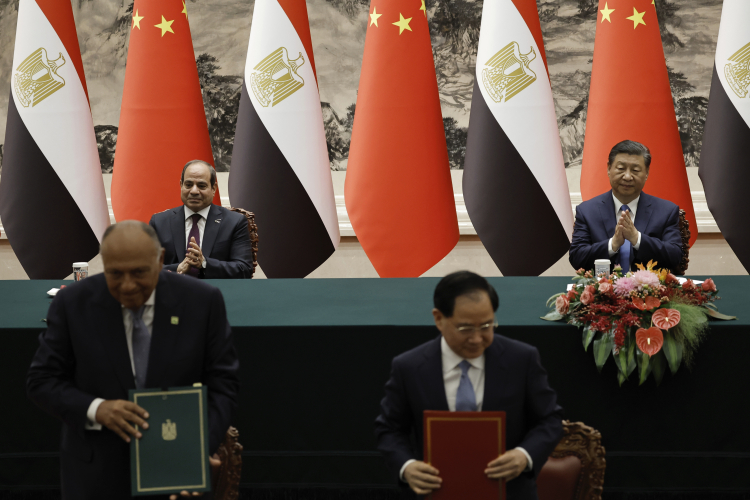
China’s growing bid for global economic dominance is increasingly visible in its deepening investments across Africa, with Egypt emerging as a strategic focal point. Beginning May 1, Beijing will extend zero-tariff treatment on imports from 53 African countries, further strengthening its commercial position across the continent. Egypt, which joined the intergovernmental organization, BRICS+ (Brazil, Russia, India, China, and South Africa) in 2024, is quickly emerging as one of the group’s most important trade nodes, further cementing the country’s growing relationship with Beijing.
These policies do more than open Chinese markets. They deepen trade ties, secure supply chains, and expand China’s industrial foothold in countries that sit astride critical routes of global commerce, like Egypt with its Suez Canal.
The Suez Canal opening to the Red Sea, one of the world’s premier maritime chokepoints, facilitates roughly 12% of global trade. About 30% of global container traffic moves through the broader Suez corridor. That commercial influence gives Egypt both profit and leverage over the movement of goods, energy, and military logistics between Europe, Asia, and the Middle East.
China understands this well. Beijing’s growing role in Egypt’s Suez Canal Economic Zone, or SCZone, is not an isolated investment story. It is part of China’s broader Belt and Road Initiative, in which state-linked firms anchor Chinese industry in countries that keep global trade moving.
From 2022 to 2025, the SCZone has attracted $11.6 billion in investment, with Chinese investors accounting for approximately half. Between 2017 and 2022, Chinese investment in Egypt surged 317%, attracting 180 companies to invest over $3 billion in manufacturing and industrial development to build out export capacity in one of the most strategically located industrial corridors in the world.
Chinese firms like Xinfengming Group, Chaoyang Langma Tire, and Tongling Jieya Biotechnology have invested $800 million in polyester fiber, $190 million in vehicular tires, and $160 million in medical products, respectively. These do not seem to be symbolic investments; instead, they appear as concrete bets on Egypt as a credible manufacturing and logistics vehicle.
Beijing’s maritime position is even more revealing. COSCO Shipping Ports, a Chinese state-owned enterprise, holds a 20% stake in the Suez Canal Container Terminal at East Port Said near the canal’s Mediterranean entrance. It also holds a 25% stake in the new terminal at Ain Sokhna near the Red Sea entrance.
Strategic access to this global chokepoint is facilitating approximately 60% of China’s Europe-bound exports. While that does not give China sovereign control over the canal, it places Chinese state-linked commercial power at both ends of one of the world’s most important shipping arteries.
Additionally, Chinese investment goes beyond industrial zones. In 2025, Egypt’s prime minister Mostafa Madbouly signed an agreement with Chinese state contractor China State Construction Engineering Corporation to begin construction on a central business district in Egypt’s new administrative capital. This matters because Beijing is not merely expanding Egypt’s trade infrastructure; it is embedding itself in all aspects of Egypt’s flagship projects including financing, signaling a deep, long-term relationship.
In fact, China was Egypt’s largest trading partner in 2024, with Chinese exports to Egypt reaching $16.9 billion while imports from Egypt remained well below $1 billion. For comparison, Egypt’s trade relationship with the United States was far less significant, only importing $7.2 billion and exporting $2.9 billion.
Meanwhile, Egypt continues to shoulder a heavy burden relative to the size of its economy. The Northeast African nation’s total government debt reached $330.4 billion in September 2025, up from $301.7 billion the previous quarter. This increase puts Egypt’s current debt to GDP ratio at 85%
However, China holds a relatively modest proportion of Egypt’s outstanding external debt burden at 5%, limiting concerns about potential Chinese “Debt-trap Diplomacy” reminiscent of Beijing’s seizure of a Sri Lankan port in 2017. Yet, China’s growing industrial, maritime, and financing presence leaves Cairo more exposed to Beijing’s commercial pull than some in Washington find comfortable.
The broader lesson is simple. China does not need to own the Suez Canal to benefit from influence around it. It only needs to continue embedding its firms, its capital, and its logistics networks into the commercial ecosystems surrounding the canal. Over time, that can shift port operations, supply chains, and regional economic alignments in ways that may favor Beijing and marginalize others.
Policymakers should not treat Egypt as a peripheral case. Egypt is a pivotal state sitting atop a global chokepoint, facing deeper Chinese economic entrenchment. If Washington wants to preserve its economic and security position in the region, it should treat China’s deepening relationship with Egypt as a strategic concern now, before that leverage is employed.
Miles Pollard is a Policy Analyst for the Thomas A. Roe Institute for Economic Policy Studies at the Heritage Foundation. Nicole Huyer is a Senior Research Associate in Heritage’s Thomas A. Roe Institute for Economic Policy Studies. Peyton Kleidon is a former member of Heritage’s Young Leaders Program.
