




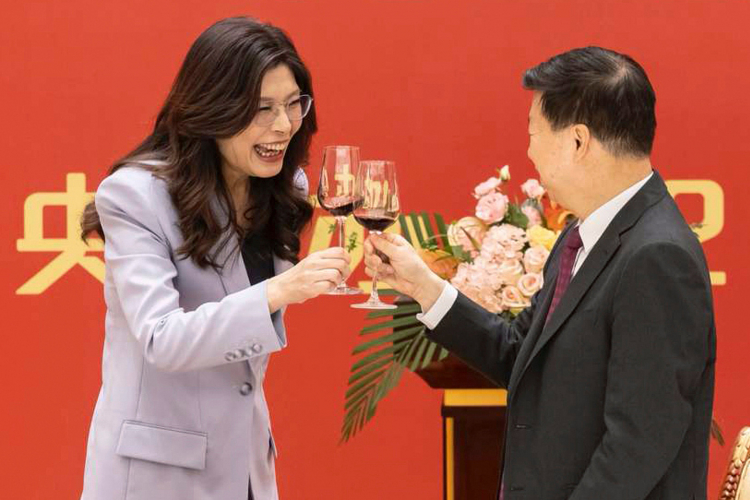
At the invitation of Chinese President Xi Jinping, Chairwoman Cheng Li-wun, the head of Taiwan’s opposition Kuomintang (KMT) party, led a rare delegation to China early this month, evoking mixed reactions from leaders in Taipei and Washington. During the six-day visit, Cheng met top Chinese officials in Shanghai and Nanjing before concluding with a landmark meeting with Xi in Beijing.
Some KMT members have supported Cheng’s trip, including former KMT Chairwoman Hung Hsiu-chu, who remarked that it demonstrates Taipei’s willingness to build and strengthen mutual trust. But the visit has also drawn fierce backlash, with Taiwan’s Mainland Affairs Council casting it as “pro-unification propaganda.” An opinion poll found that most Taiwanese viewed the trip as a net negative, believing that it could harm the KMT’s election prospects this year.
The visit certainly comes at a precarious moment. Cross-strait relations have gradually deteriorated since 2016, and even more so after 2022, when then U.S. Speaker of the House Nancy Pelosi visited Taipei. After the Democratic Progressive Party’s (DPP) Lai Ching-te was elected Taiwan’s president in 2024, Beijing conveyed its dissatisfaction with the DPP, which it views as a separatist force, by severing high-level contact and ratcheting up its air and naval presence in the Taiwan Strait—going so far as to practice invasion scenarios around the island.
Meanwhile, political differences between the KMT and DPP have frustrated efforts in Taiwan’s Legislative Yuan, resulting in gridlock over the special defense budget. Taiwanese lawmakers remain sharply divided on how best to handle engagement with Beijing.
Against this backdrop, the political stakes of Cheng’s trip are extraordinary. But critics and supporters, alike, predominantly focus on the diplomatic optics of the visit—that is, what message does it send? Both groups, however, miss something more significant in Cheng’s push to restart cross-strait talks: her reaffirmation of the “1992 Consensus.”
The 1992 Consensus holds that both sides are part of “one China,” though there is disagreement over which entity is sovereign. As Alyssa Resar argues in a previous article for The Diplomat, the framework is intended to manage rather than resolve or paper over differences. Nowadays, it is commonly understood to mean “One China, Two Interpretations.”
When the DPP came to power in 2016 under Tsai Ing-wen, the party refused to recognize the 1992 Consensus, which resulted in China suspending diplomatic contact. The Consensus is now Beijing’s precondition to reinitiating cross-strait talks. During Cheng’s trip, Chinese officials emphasized “upholding the 1992 Consensus” and criticized the DPP’s refusal to do so. That point was echoed by Cheng, who remarked that “this visit once again demonstrates the 1992 Consensus remains…a stabilizing anchor for current cross-strait relations.”
If the KMT, in its bid to restart talks with Beijing, reaffirms support for the 1992 Consensus, it could face political headwinds ahead of the local elections in November. One poll found that 84.4% of Taiwanese respondents support no political preconditions imposed on cross-strait exchanges. The 1992 Consensus was formulated and agreed to before Taiwan fully transitioned to democracy, which has led some critics to argue that it does not reflect the will of the Taiwanese populace.
Cheng’s trip raises more fundamental questions about the utility of the 1992 Consensus. While long a cornerstone of the KMT’s platform, the framework has failed to meaningfully resolve disagreements. Beijing is still intent on reunifying with Taiwan by 2049, the centenary of communist rule. This was reaffirmed during the meeting between Xi and Cheng, as Xi explicitly reiterated that “uniting…is a historical inevitability” and that China “has full confidence” in that aim.
Observers may contend that the real utility of the 1992 Consensus lies in establishing parameters under which negotiations can take place. However, Beijing has begun to seek a more ambitious and rigid interpretation of the Consensus, slowly reducing that objective to little more than an ideal. Derek Grossman and Brandon Alexander Millianpreviously argued in an article for The Diplomat that Beijing has over time become less receptive to ambiguity—that is, recognizing there are two different interpretations of the Consensus.
In Xi’s 2019 Speech marking the 40th anniversary of the Message to Compatriots in Taiwan, Xi used the 1992 Consensus interchangeably with the “One China Principle,” which recognizes “One Country, Two Systems.” That, in effect, equated Taiwan’s political status to that of Hong Kong’s: it retains some degree of autonomy but recognizes Beijing as the sovereign.
Taiwan’s interpretation of the Consensus runs counter to that notion, rejecting the proposition that it is subordinate to Beijing. Indeed, for Taiwan, the core connotation of the 1992 Consensus is that there are differing interpretations of “One China.” Just months after Xi’s speech, graphic scenes of protesters being brutally beaten emerged out of Hong Kong, reminding Taipei of what such a political alternative could entail and prompting many KMT legislators to publicly rebuke the One China Principle.
Cross-strait dialogue is not inherently undesirable—in fact, it may offer a viable path toward easing current tensions. However, if Beijing insists on the 1992 Consensus as a political precondition, that puts the KMT in a politically difficult position. Public opinion in Taiwan remains staunchly opposed to accepting Beijing’s terms. KMT leaders will have to carefully weigh the electoral costs of such an endorsement ahead of the local elections.
Still, the deeper problem lies in Beijing's increasingly rigid interpretation of the Consensus, which conflates the reached mutual understanding with Beijing’s preferred interpretation. Already, Xi’s speeches have demonstrated a willingness to obfuscate the Consensus. That raises legitimate questions about whether the framework retains any practical utility for sustaining stable cross-strait relations, or whether reaffirming it could instead delegitimize the island’s very political foundations.
Allen Zhang is a Research Assistant in The Heritage Foundation’s Asian Studies Center.
