




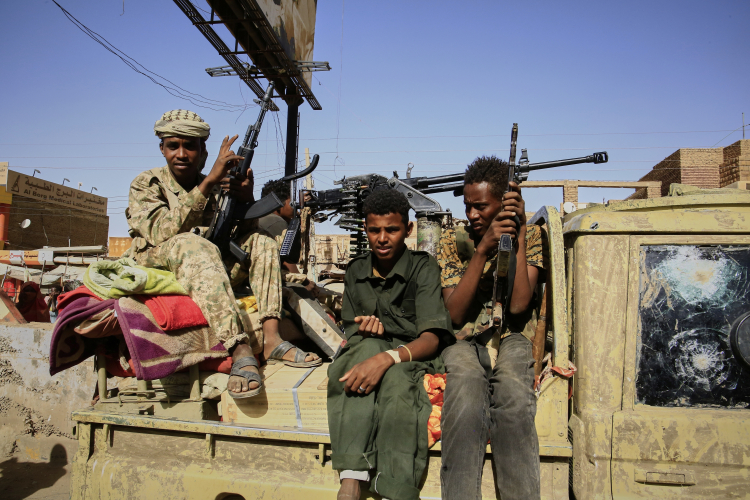
The Sudanese Civil War that began on April 15, 2023 always seemed to be in some other conflict's shadow. Early on, Western pundits wrote about which side was pro-Russia and which was pro-Ukraine (Russia actually helped both). Later in 2023 and beyond, the world's worst humanitarian crisis taking place in Sudan was buried by news from Gaza. It is not surprising that the one Sudanese event to break through the world's indifference was the bloody fall, after a long siege, of the North Darfur capital of El Fasher in October 2025. This came during a global lull in conflicts elsewhere – after Gaza but before the current Iran War. The upcoming April 15, 2026, Berlin Conference on humanitarian aid for Sudan is an effort to try to redirect the world's attention back to the conflict.
Land Of Perpetual War
Some of the indifference is, no doubt, due to the place. Africa almost always gets short shrift when it comes to global attention. Sudan is also a country that has been at war for almost its entire 70-year history, war against its own people. The first war – the so-called First Sudanese Civil War – broke out even before independence on January 1, 1956. That war, fought against South Sudanese, lasted from 1955 to 1972.
The Second Sudanese Civil War, also mostly against the South Sudanese but spreading elsewhere, raged from 1983 to 2005. The Darfur War, largely a brutal counter-insurgency, raged from 2003 to 2020. The latest war, between the Sudanese Armed Forces (SAF) and the Rapid Support Forces (RSF) has been the most destructive of Sudan's internal wars because much of it has been fought in areas that had avoided the other conflicts.
According to UN agencies, two-thirds of the country's population – 33.7 million people – need humanitarian assistance in 2026. That dwarfs anything seen in Gaza, Lebanon, or Iran. Almost 14 million Sudanese have been uprooted by the fighting, becoming either refugees or internally displaced.
The war has raged back and forth with one side and then another making dramatic advances over a large country (15th-largest in the world). Inserted over a map of the Central United States, Sudan ranges from Chicago in the East to Albuquerque in the South West.
In a September 2023 analytical piece for MEMRI, I predicted that SAF, the Sudanese Army, would eventually gain the upper hand and that has seemed to happen slowly. After almost two years of fighting, in March 2025, SAF succeeded in finally expelling RSF from the greater Khartoum area, reclaiming a battered and deeply scarred capital.
Deeply Flawed Adversaries
More than 500 civilians, especially in Darfur and Kordofan, have been killed in drone strikes in early 2026 carried out by both factions. Both SAF and RSF are deeply flawed organizations, both guilty of many human rights abuses going back years. This is not surprising given that the two worked closely together (SAF plus the Janjaweed who form the core of the RSF) for decades, fighting rebels – and abusing locals – in Darfur, Kordofan and other areas. But the reason I thought that SAF would gain the upper hand was that even a bad institution, like the SAF, is better than no institution, i.e., RSF. Tyranny, some sort of order, will almost always trump chaos and the RSF have mostly been agents of chaos.
Often capable fighters, in the end the RSF have been nothing more than ambitious, rapacious raiders. Command and control among the RSF's widely dispersed units, made up of different ethnic groups, has never been fully solved. While Sudan's de facto ruler since 2019 General Abdel Fattah Al-Burhan has been able to project some sort of statesman-like figure on the global stage, his rival, the RSF commander General Muhammad Hamdan Dagalo (AKA "Hemedti") has often been invisible. There are plenty of videos of Al-Burhan celebrating with his victorious troops, I know of only one – early on in the war – of Hemedti in the field with his men.
RSF then can be said to have failed twice. First, after April 2023 they failed to present a credible alternative to SAF (or even to SAF-Islamist) rule. One can accept or reject it, but the Sudan People's Liberation Movement/Army (SPLM/A) under Dr. John Garang offered a plausible alternative program or worldview to that of Khartoum's Islamist rulers of the day.
That absence of both a real RSF program and an actual, positive lived reality on the ground was – regardless of events on the battlefield – the RSF's "original sin." Looting, slaughter, and depredation are not a program of governance and overwhelm anything that press releases and social media networks can churn out. The Ta'sees political coalition, dating from February 2025, is a late RSF effort – very late in the war – to provide just such an alternative political framework.
But even after this basic political failure, Hemedti could still have built a different persona by being a larger-than-life field commander. All the world loves a bold and victorious general even if his men turned out to be scoundrels. But, if anything, Hemedti's persona – or that which is managed by his handlers – seems to have shrunk. It is no surprise that, despite him appearing in various African capitals over the past years, some Sudanese believed that he was dead.
No Substitute For Military Victory
But what is to happen now in Sudan's fourth year of conflict? SAF wants victory by means of military conquest while RSF – which certainly would have liked the same thing – seeks to survive, to outlast SAF offensives and, at least, carve out a pseudo-state in Western Sudan. For RSF, a peace agreement or a ceasefire is a step toward recognition of a Janjaweed-dominated desert state. For SAF, a ceasefire or humanitarian pause risks depriving them of the fruits of victory they expect to ultimately win on the battlefield. They will never accept a further partition of Sudan.
Amb. Fernandez, who was Charge d'Affaires at the U.S. Embassy in Khartoum from 2007 to 2009.
Read the full piece on MEMRI.org here.
