




In April’s Fortune issue, Sylvia Corbett quotes President Trump as “Accusing NATO of being useless when needed, a Paper Tiger.”
Since Carter, the track record of most presidents regarding Iran has been questionable at best
The Islamist regime in Iran declared war on America 47 years ago. Trump is attempting to end that war, once and for all. With most Iranian leaders and military capabilities gone, this should be easy to accomplish, right? Wrong. Despite having the most powerful army in history, Trump faces two major challenges: A national debt approaching $40 trillion and a fractured relationship with NATO, as too many U.S. legislators put party above country. Unless we address the latter problem, solving the former will not be enough.
From Day One of Operation Epic Fury, America quickly established aerial domination. However, to be successful, the Iranian people must participate in regime change. While crippled, Iran is still capable of terrorizing the region. Conversely, U.S. defensive-missiles are very expensive, and munitions stockpiles are running low. How long can we engage Iran without compromising our ability to deter other threats?
While replenishing key weapons systems is important, we have a more fundamental problem in Washington and Brussels: The political dysfunction of entrenched elitists in our legislative branch undermines our military credibility. Our prowessis not solely a function of combat training, hardware, and AI advances. It depends on the perceived reliability of NATO commitments. However, both Europe and America are showing troubling signs of discord and weakness.
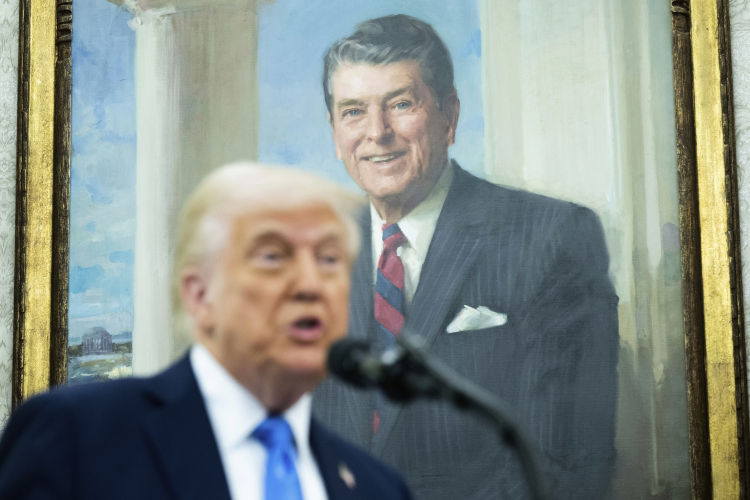
The West lived through a similar convergence of doubt and danger in the last stages of the Cold War, some 40 years ago. Reagan bankrupted Moscow and made it almost impossible for Gorbachev to intervene when the Berlin Wall fell. Most important to our victory is that President Reagan understood that alliances, if properly handled, could multiply American power.
The North Atlantic Treaty Organization (NATO) was founded in 1949 to deter Soviet expansion and integrate former rivals into a cooperative economic, political, and military system. NATO transformed a historically volatile region into one of unprecedented stability. NATO’s early success led to the illusion that threats were gone forever, a view that caused European militaries to atrophy. Strategic dependence on the American taxpayer and soldier deepened.
What once was a unified front against evil increasingly resembled a coalition of convenience. When crises erupt beyond Europe’s borders, coordination falters. Allies debate financial costs and procedural norms while adversaries expand their global influences. Without credible commitments, NATO risks becoming a liability.
Comparing Reagan and Trump
The Detroit News editorial page editor Nolan Finley, in a November 2025 editorial “Reagan ad reminder of what we’re missing” states he admired an earlier 2025 ad campaign by Canada which exposes 54% of today’s Americans born after the Reagan Administration to Reagan’s true feelings on economics and trade policy.
Finley noted the ad harkened him back to “a wave of warm nostalgia. I don’t care if his words were rear ranged by the Canadians or even if Reagan’s record on trade didn’t always match his rhetoric. It was still wistful to hear a president espouse policy grounded in the clear principles of free markets, free minds and free men that once defined the conservative movement.”
Finley further opined, “Reagan understood that to be respected a president must behave respectfully. He exuded decency and dignity, even when under attack.” Finley points out that Reagan’s conservative philosophy with its firm belief in constrained government “stretches back to James Madison and Thomas Jefferson. They wouldn’t recognize the brand of conservatism being practiced today.”
Finley contends that Reagan’s use of “Make America Great Again” as his 1980 campaign slogan was used to unite the country rather than divide it, as he maintains it is being used today.
How might Reagan handle today’s situation with Iran?
January 20, 1981, 444 days after the U.S. Embassy in Tehran was seized and minutes after President Reagan took his oath of office, the hostages were released.
President Reagan was a sports broadcaster and a noted actor before becoming Governor of California and eventually President of the United States. Reagan took 50.7% of the popular vote and 90.89% of the electoral vote in 1980. He increased his margin to 58.8% of the popular vote and 97.58% of the electoral vote when he secured his second term as president in 1984. Reagan came to office during the worst economic downturn since the Great Depression. When he left office eight years later, the U.S. economy was once again the envy of the world.
As president, Reagan believed free economies that promote growth and prosperity were more productive than less-free economies. He was suspicious of big government and firmly believed in the American competitive free enterprise system.
Consider the Economy under Reagan
Reagan was a democrat for much of his life and admired President Kennedy. In fact, policy makers today should look at the fiscal policies of John F. Kennedy and Ronald W. Reagan and relearn the stimulative effect of tax cuts during difficult times. President Kennedy’s tax cut was implemented by President Johnson in 1964. Personal income tax rates for top earners declined 23.1% and 30% for the lowest. Corporate income tax rates were reduced by 9.6%. The economy responded with an average annual real growth rate of 4.65% through 1968, and unemployment dropped from 6.6% in 1961 to 3.7% in 1968. Inspired by Kennedy, Reagan’s across-the-board tax cut of 25% was phased in from 1981-1983 and helped bring the U.S. economy out of the severe recession of 1981-82, which saw the prime interest rate peak at 21.5% in 1981 (the highest since the Civil War), real GDP decline by 2.2% and unemployment reach 10.8% in 1982. The Reagan economy responded with average annual real GDP growth of 3.87% from 1982-88, unemployment declined to 5.4% by 1988, and real tax revenue grew from 19% in 1981 to 28% in 1988.
By 1989, growth in GDP increased 31%, manufacturing output increased 48%, American labor productivity increased 10.6% per hour, U.S. exports increased 92.6%, gross private investment increased 32%, real disposable income per capita increased 18% and U.S. standards of living were about 40% higher than the average for Europe and Japan when Reagan left office.
Consider foreign policy under Reagan
Perhaps Reagan’s best use of his Sociology minor is evidenced in the 2006 book by John O’Sullivan, entitled, The President, the Pope, and the Prime Minister, in which O’Sullivan reveals how Reagan, Thatcher and Pope John Paul II developed as strong individual leaders and friends, “perfectly suited to take power when liberalism failed.” This troika of world leaders, later along with Brian Mulroney and Helmut Kohl caused the relatively newly elected head of the Soviet Politburo, Mikhail Gorbachev, to reconsider his relationship with the West, eventually ending the Cold War.
Conclusion
If President Trump were more engaging and congenial like Reagan, there would be less distance between the political philosophies of the Republican and Democrat parties, and his economic programs would likely be deeper and more effective.
We believe if President Trump treated NATO leaders with more respect, not only would he have achieved the breakthrough in NATO members paying their fair share of the alliance (which he is to be congratulated for), he would have achieved better cooperation with the NATO membership regarding Iran.
Dr. Timothy G. Nash is director of The Northwood University Center for the Advancement of Freedom, Free Enterprise and Entrepreneurship. Dr. Alex Tokarev is Associate Professor of Economics at Northwood University. Ms. Kristin Tokarev is a producer for John Stossel TV and a graduate of Northwood University.
