




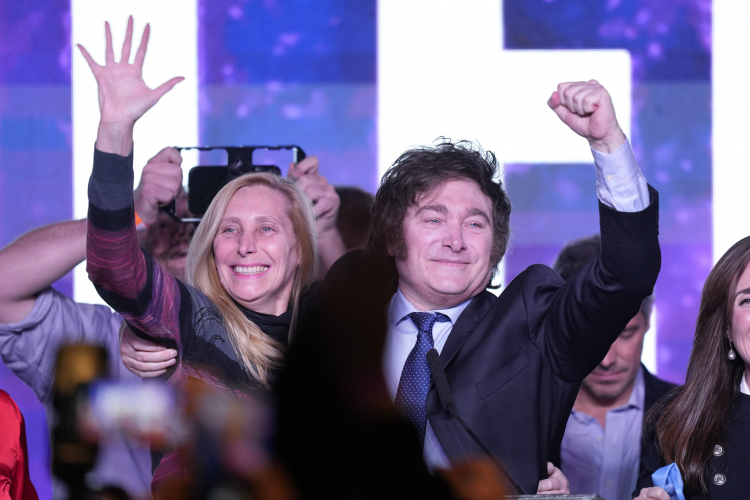
When entering politics as an eccentric, garage-band-haired TV personality and economics professor, Javier Milei became famous for opening Argentina’s political landscape to libertarianism. He was elected with a clear mandate of dismantling the state apparatus and governing according to the principles laid out by Rothbard, Mises, Hayek, and right-libertarians.
Yet, as president, the near-entirety of Milei’s political capital has been spent on making Argentina more regressive, more authoritarian, and less free. He is arguably the most authoritarian president since the start of the country’s democratic period.
Milei has pushed protest laws that ban public demonstrations, deployed militarized police against peaceful protesters, and declared states of emergency in response to protests – including those expressing legitimate public anger over massive job cuts and extreme austerity.
Human rights organizations have documented dozens of cases where peaceful demonstrators, including journalists and student activists, were beaten and arrested simply for assembling in public squares.
Rather than distinguishing between violent rioting and peaceful assembly, Milei’s administration has treated all protest as a potential insurrection, calling some terrorists.
He has also led a militarized “war on narcoterrorism”, expanded the carceral state, and allied with authoritarians elsewhere in Latin America, such as wannabe-dictators Nayib Bukele and Jair Bolsonaro. He has increased the powers of the security state and shown no interest in addressing the root economic and health causes of the drug crisis, including the possibility of legalizing drugs. Milei even banned medical marijuana permits in Argentina.
Under his “zero tolerance” criminal policy, prison populations have surged, with new mandatory minimum sentences for nonviolent drug possession that fill jails with low-level addicts rather than cartel leaders.
In December 2025, Milei issued a decree enabling the intelligence apparatus to apprehend individuals without prior judicial order. His administration has appointed active-duty military officials, such as army chief Carlos Presti, to key security roles, breaking with a post-dictatorship tradition of strict civilian control.
Milei has publicly praised Bukele’s mass detention tactics in El Salvador, where constitutional rights have been suspended and thousands of innocents have been swept up without trial or access to a lawyer, in prisons where torture and death are common.
His administration has been rife with corruption scandals. Milei promoted a cryptocurrency token, $LIBRA, that was accused of conducting a rug pull on his own supporters, costing them over $250 million. He used his political supporters and state power to promote it.
He has also placed friends and family members in positions of power while cutting thousands of public jobs – most notably his sister, Karina, whom he hired as General Secretary to the Presidency and other cabinet positions. Meanwhile, during an economic crisis, Milei has likely used millions of dollars in public funds to stage rock concerts.
The president has pursued a sweeping anti-immigration agenda, tightening restrictions and militarizing the border, particularly with Paraguay, Bolivia, and Chile. His federal police have begun conducting “papers please” random immigration checks in various cities, relying on stereotypical profiles to target suspected migrants.
These checkpoints have been set up at subway entrances, bus terminals, and even outside supermarkets, with officers stopping anyone whose appearance or accent they deem foreign.
Migrant rights lawyers report that individuals have been held for days without charges simply for lacking documentation, and deportation proceedings now occur without meaningful judicial review.
Milei has also started deportations and ordered the construction of detention facilities near the northern border, modeled after Trump-era family separation centers, and has authorized police to enter private residences without warrants if they suspect a migrant is present.
Milei has made universities and civil society targets of state reprisal. His administration has changed curricula, gone after activists and unions, attacked professors and academic institutions as “Marxists”, and weaponized state institutions against leftists. He has also associated the left with terrorism, calling leftists enemies of the state.
While Milei campaigned on judicial independence, his administration has packed lower courts with loyalists who served as his campaign lawyers. He has also issued executive decrees that bypass congressional oversight and judicial review, claiming emergency powers.
Milei has repeatedly threatened to shut down news outlets that report critically on his administration, has used state security forces to attack press workers, obstructed journalistic work, and harassed critical media. Grants for critical independent media have also been defunded.
His security forces have raided the offices of investigative journalists who exposed corruption within his cabinet, seizing computers and notes under vague national security justifications. Several prominent reporters have faced libel suits filed by government ministries, suits that legal observers say are designed not to win but to drain defendants’ resources and intimidate others.
These policies, which reveal a pattern of using state power for political coercion, should all be called out unequivocally.
We need to have a serious conversation about what “liberty” even means, and how someone claiming to champion it, could govern in exact subversion of liberal principles, while receiving immense support from right-libertarians.
There has been little attempt from Milei or his government to defend these policies. Instead, his instinct has been to double down, label all opposition as extremist, and further clamp down on dissent. If Milei wants to salvage his governance project, he will need to stop being a populist autocrat, and focus on actually advancing freedom.
Joseph Bouchard is a journalist and researcher from Québec covering security and democracy in Latin America. His articles have appeared in Responsible Statecraft, Reason, The Diplomat, Le Devoir, and RealClearPolitics, among others. He is a PhD student in Politics at the University of Virginia and a SSHRC doctoral fellow on Latin American Politics.
