




Racism has long been a feature of American life; many call it America’s original sin. Even after decades of progress because of the Civil Rights Act, some continue to insist that America is systemically racist. This crusade has extended to nations across the West, vandalism and the denunciation of historic figures being common. However, despite the magnitude of this campaign, one nation has escaped the scrutiny of anti-racist crusaders: China. Many of the accusations of systemic racism that critics denounce in the West are undeniable in the People’s Republic of China.
In mid-March, the National People’s Congress, China’s legislative body, passed a law that it says emphasizes national unity. In reality, it prioritizes Mandarin Chinese over other dialects and languages in official settings such as education and government business. Supporters say it will promote greater cohesion among China’s ethnic groups. Critics say it is a move to marginalize China’s 56 recognized minority groups, who make up less than 10% of the population.
The truth is, this law is the latest attempt by the Chinese Communist Party (CCP) to affirm the dominance of the majority Han ethnic group, who speak Mandarin. The CCP has long seen language as a political act, moving to stamp out the use of non-Mandarin dialects. Hong Kong is a notable example where Cantonese is the most widely spoken language. Since the handover of the city back to China, Mandarin's popularity has increased over the past few decades. However, many Hong Kongers view China as an oppressor, and thereby Mandarin is viewed negatively. The government is investigating some Cantonese linguistic groups in what some view as a politicized prosecution.
While there is some politicization of language in Hong Kong, other minority languages have not been as lucky. The most chilling example is that of the Uyghurs, a muslim group who live in China’s northwestern province of Xinjiang. The CCP has long viewed the Uyghurs with suspicion. In an effort to erase Uyghur identity, China banned the use of the Uyghur language in schools in 2017.
The institutional racism against the Uyghurs does not end with language. China is engaged in a decades-long quest to erase the Uyghur identity. Millions of Uyghurs are locked in internment camps in Xinjiang. Those on the outside are subject to forced marriages, sterilizations, and a police state throughout Uyghur areas. Thus demonstrating a systemic attempt to oppress Uyghurs and erase their identity.
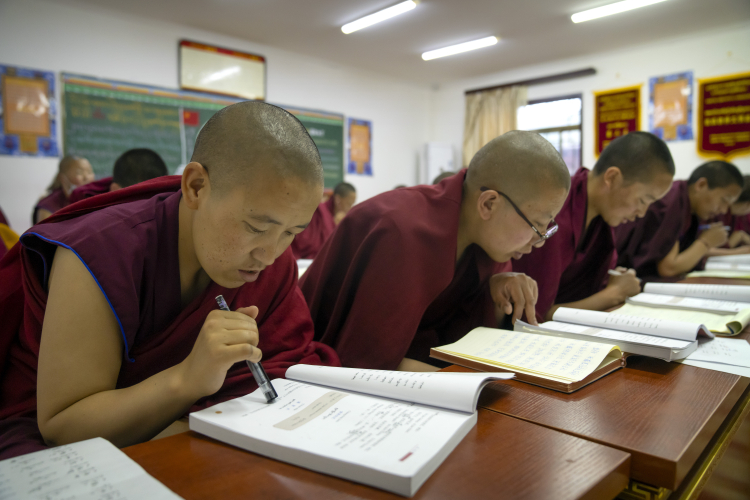
China’s state-imposed racism is not limited to the Uyghurs. Tibetans are also a prime target for repression by the CCP. Also facing linguistic and cultural discrimination, the CCP uniquely interferes in Tibet’s religious affairs. Buddhism is central to Tibetan identity, particularly through the Dalai Lama, their spiritual leader. According to their beliefs, each Dalai Lama is the reincarnated spirit of an enlightened being. Tibetan monks are tasked with identifying the next Dalai Lama.
However, the current Dalai Lama is in his 90s, and there is already controversy over how his successor will be selected. Despite the tradition of monks identifying the next one, the CCP has said it has the final say over who will be the next Dalai Lama, violating centuries of Tibetan Buddhist tradition. This unprecedented interference in the religious life of Tibetans is the latest example of the discriminatory nature of the CCP.
The racism of the Chinese regime extends to any group that diverges from the majority, largely atheist, Han. Mongols, Christians, and Falun Gong practitioners are some of the many other groups subject to the CCP’s discrimination. Language erasure, arbitrary detention, and forced organ harvesting are just some of the practices these groups are subject to. The CCP is determined to eradicate any cultural and linguistic differences between what it views as the truly Chinese Han and dissenting minorities.
Why does the CCP care so much about forced integration? They claim it is for the benefit of the minority groups themselves. While it is true that learning the majority language is helpful, banning the use of these languages is not. The truth is that the CCP views any alternative identities as a threat to its system, which requires conformity, especially in thought. If people are allowed a separate cultural identity, it’s a threat to the power of the regime.
What makes the racism in China all the worse is the fact that no one is allowed to talk about it. China enforces strict censorship laws and is quick to break up any protests against its oppression. Posts on political issues are regularly censored on Chinese social media sites, with Uyghurs in particular feeling the wrath of the censorship apparatus. The Chinese government has detained thousands of journalists and other prisoners of conscience for what they wrote or believed in. Advocates of minority language rights face similar danger if they speak out against the ethnic unity law.
Racism is described as a systemic problem in the United States due to disparities in things like economics, crime, and education. While the US has its problems, the situation in China is far worse for minorities. With the recently passed law, minority groups in China will face further discrimination and cultural erasure. If the Western media is serious about racism, it needs to turn the microscope on the Chinese Communist Party.
