




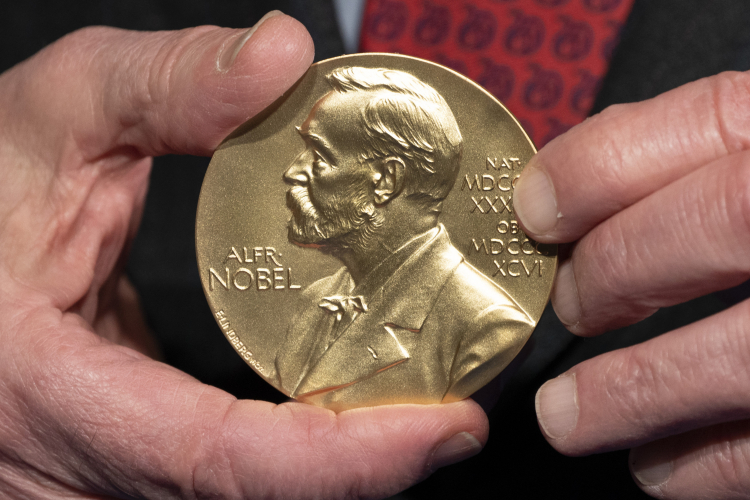
Autocratic leaders – from Beijing to Kabul, Tehran to Moscow, Havana to Caracas – seek to silence those who challenge their authority and promote freedom, democracy, and human rights. And these leaders are becoming more emboldened in their attacks on civil society, blatantly targeting the most prominent of activists, as seen in the fate of several recent Nobel laureates.
It’s time that democracies become similarly vocal, speaking out about the imprisonment, harassment, and torture of democracy defenders.
We should clearly align ourselves with those who support and fight for freedom, the rule of law that underpins free societies, and democratic rights like those we enjoy in the United States. One clear place to start – but most certainly not end – is the most visible of democracy advocates, Nobel Peace Prize winners.
Several of these notable activists currently find themselves in the crosshairs of dictators seeking to discredit and silence their work. While the repression of democracy activists extends far beyond these prominent individuals, the fact that autocratic governments have no hesitation in targeting the most well-known activists should be an alarm bell to those concerned about the rising power and brazenness of these dictators. By targeting the most prominent, they also seek to send a strong message to democracy advocates whose names are less well known.
The 2022 Nobel Prize winning organization Memorial is a longstanding Russian group founded during the fall of the Soviet Union to chronicle human rights abuses from the Stalin era to the present and it remains one of the most reputable organizations in this field.
On April 9, the Russian Supreme Court designated Memorial an “extremist movement,” immediately banning all of its activity within Russia. According to an April 9th NBC News article, the designation “provides a new legal mechanism for authorities to prosecute anyone who contributes to the work of the Nobel Prize-winning organisation, donates to it or shares material that it publishes.”
The Russian government also ransacked the offices of Novaya Gazeta, a leading independent newspaper in Russia. Its editor-in-chief is Dmitri Muratov, who won the Nobel Peace Prize in 2021. One of its top editors, Oleg Roldugin, was arrested on spurious charges. Meanwhile, lawyers for the newspaper weren’t allowed to enter the office.
In Iran, 2023 Nobel laureate Nargas Mohammadi continues to languish in the infamous Evin prison, unjustly detained for her advocacy for women’s rights and against the death penalty. Since 1998, she has been arrested 13 times and sentenced to 31 years in prison and 154 lashes. Mohammadi was awarded her peace prize in absentia, as she was imprisoned in Iran at the time of its presentation.
María Corina Machado – who won the 2025 Nobel Peace Prize for her work to restore democracy in Venezuela – remains in exile, unwelcome by the temporary Maduro-successor regime. Machado remains the face of the democratic opposition and a well-respected political leader who was unfairly disqualified from a presidential run she would have likely won.
Autocrats who seek to undermine universal values have targeted each of these prominent activists, emboldened in their continuing attacks on civil society. These Nobel Prize winners were feted internationally, showcased in national media, and nonetheless faced persecution. At the same time, hundreds of thousands of other innocent democracy defenders face imprisonment, harassment, and torture, with far less awareness about their cases. Each should concern those who believe in freedom.
Democracies have an opportunity to counter autocrats’ efforts to silence dissidents, particularly by targeting the most prominent activists and organizations. The United States and other democracies should both publicly and privately condemn the imprisonment of activists, including but not limited to the Nobel laureates, and denounce the repression of democracy groups.
Democratic governments should also seek meetings with the families of these activists or the group leaders directly. Likewise, these countries should condemn administrative or regulatory efforts, such as those taken in Russia, to limit the operations of democracy organizations and movements.
The failure of democracies to respond in a demonstrable fashion to the continued imprisonment, repression and harassment of these courageous activists and their many lesser-known colleagues doesn’t demonstrate neutrality. As Desmond Tutu, the South African archbishop and Nobel Peace Prize winner, once said, “If you are neutral in situations of injustice, you have chosen the side of the oppressor.”
It’s a notable signal to autocrats when they can take action with no pushback – that they can continue to expand their repression, including in ways that will directly undermine American interests.
Autocratic leaders have clearly declared their opposition to those who fight for freedom. Democratic leaders have the opportunity to express their support for those struggling for liberty.
Nicole Bibbins Sedaca is the Kelly and David Pfeil Fellow at the George W. Bush Institute.
