




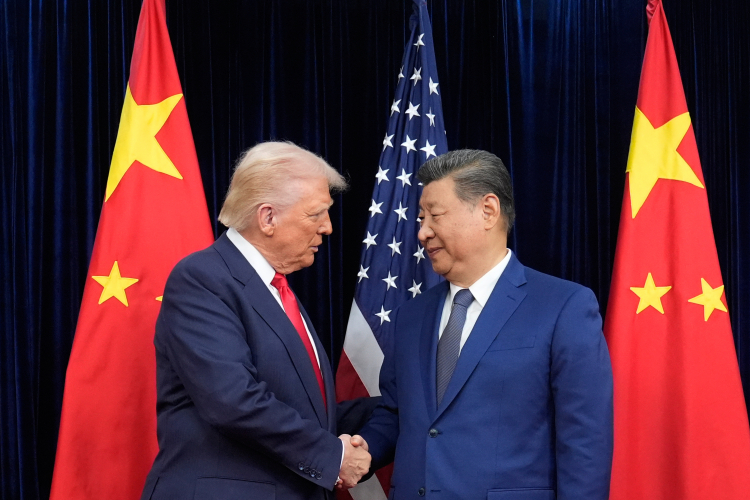
President Trump’s mid-May trip to Beijing is a high-profile reminder that U.S.–China relations will be a major factor in shaping markets, supply chains, and security dynamics this year.
The geopolitical environment is markedly different than in 2025. Trade, geopolitics, and national security are now fully intertwined in U.S. economic policy. The widening conflict with Iran adds a new layer of uncertainty, particularly for global energy markets and economic growth.
Competition with China remains the organizing principle of President Trump’s statecraft. He is focused on securing a deal on a variety of issues, especially commercial matters, and in that way deliver a successful meeting with Chinese President Xi Jinping.
Nonetheless, American business leaders should expect 2026 to feature tactical de-escalation and selective confrontation between the two powers.
Trump and Xi avoided the worst-case scenario in 2025 by extending a trade truce. But the underlying disputes remained unresolved. Export controls, investment screening, Chinese industrial subsidies, and various trade barriers are still firmly in place.
The U.S.’s tariff framework is scheduled to lapse on November 10, 2026, setting the stage for a important negotiations later this year. Trump and Xi are expected to address that deadline during their summit in Beijing. Until then, markets will be volatile, particularly as disruptions continue in the Strait of Hormuz, a corridor that carries a 20 percent of global oil much of it to Asia.
Another way to look at President Trump’s upcoming state visit is this: 2026 will be a year of execution, implementation, and dealmaking between the U.S. and China.
Recent developments also make clear that third-country relationships, from the Middle East to the Western Hemisphere and Europe, are greatly impacted by Washington’s China strategy. The Iran conflict is a prime example of this dynamic. Pressure on Gulf energy flows disproportionately affects Asia, particularly China, the largest buyer of Iranian oil, and raises the stakes in Washington’s economic engagement with Beijing.
Here are three guideposts to watch in the year ahead.
First, leader-level diplomacy will set the tone. The upcoming Beijing summit will be a key inflection point of 2026. Trade will shape the tone and the substance of the meeting. Both leaders seek stability in the bilateral relationship amid domestic economic pressures. Discussions around a potential “Board of Trade” are a sign that both sides are aiming for practical outcomes, including expanded transactions in agriculture, energy, and aerospace. Business leaders should view the summit as the foundation for long-term trade negotiations ahead of President Xi’s planned visit to the U.S. later this year.
Second, tariffs and export controls are not going away. President Trump does not view tariffs or export controls as temporary. Even after the Supreme Court limited the Trump administration’s tariff authority, the White House moved quickly to increase global tariff levels from 10 percent to 15 percent. The executive branch focus is on how these tools are deployed, including in sensitive areas like technology, artificial intelligence, and supply chains, rather than whether they will be used.
Finally, third-country ties to China will influence U.S. policy. The Iran conflict, disputes with Canada, tensions in Europe, and developments in Venezuela demonstrate that Washington views China policy through a hemispheric and a global lens. Relationships with Beijing — even indirect ones — can impact the access to the U.S. market that the Trump administration will allow.
Trade and industrial policy are at the center of U.S. economic strategy, which is controlled by President Trump. The main question is how Washington balances dealmaking with deterrence in its approach to China. The Iran conflict adds another layer of market volatility and geopolitical instability. Business leaders who understand Trump’s effort to balance his approach will be well prepared for what lies ahead.
Joseph Lai served as a special assistant to President Trump for legislative affairs from 2017 to 2019. He is a principal at the BGR Group, a government affairs and communications firm based in Washington, D.C.
