




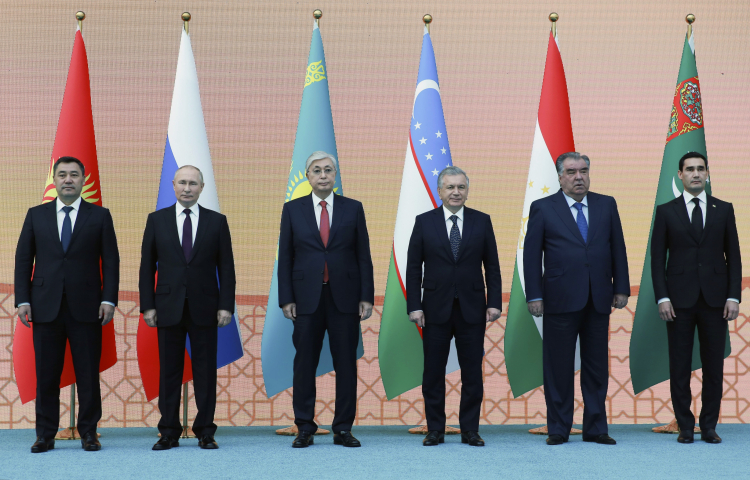
Western sanctions were designed to isolate Moscow. Instead, trade routes running through Central Asia are quietly helping keep Russia economically connected.
Rather than severing Russia from global markets, sanctions have often redirected commerce through intermediary states. The result is not a closed system, but a reshaped one. Goods that once flowed directly from Europe and Asia into Russia now move through a network of intermediaries. At the center of that network sits Central Asia.
This shift is not theoretical. Trade data shows sharp increases in exports from countries such as Kazakhstan, Kyrgyzstan, and Uzbekistan to Russia since 2022. Many of these goods—machinery, electronics, dual-use components—mirror the categories restricted under Western sanctions. The pattern is clear. Where direct trade closed, indirect trade expanded.
Central Asia has become one of the sanctions regime’s most important blind spots.
The reasons are structural. The region shares long borders, deep transport links, and decades of economic integration with Russia. Customs systems remain uneven. Financial oversight varies widely. For firms seeking access to Russian markets, Central Asia offers a practical solution: proximity, familiarity, and fewer controls.
This dynamic does not require coordinated defiance. It requires incentives, weak oversight, and opportunity.
Local businesses see opportunity in arbitrage. Governments see rising trade volumes and economic growth. Russia sees a lifeline. Western policymakers see leakage—but struggle to respond without alienating the very states they hope to influence.
The European Union has begun to act. Recent restrictions on certain exports to Kyrgyzstan signal growing concern that sanctions are being circumvented through the region. But these measures remain limited. The United States has taken a cautious approach, wary of pushing Central Asian governments closer to Moscow or Beijing.
That caution now carries strategic consequences.
Sanctions are only as effective as their weakest link. In Central Asia, that link is not intent—it is capacity. Many states in the region lack the regulatory systems, enforcement mechanisms, and financial transparency needed to monitor complex trade flows. Customs authorities are often under-resourced. Financial intelligence units struggle to track layered transactions across borders.
This is not new. It is the predictable outcome of underinvestment in institutions.
For three decades, Western engagement in Central Asia has been episodic. Security cooperation has dominated at times. Energy has driven interest at others. Development assistance has been modest and often fragmented. The result is a region that is strategically vital but institutionally uneven.
That gap is now visible in the sanctions regime.
China has moved to fill part of that space. Trade between China and Central Asia has surged in recent years, surpassing $100 billion. Infrastructure investments under the Belt and Road Initiative have expanded transport corridors, logistics hubs, and digital networks. These projects increase connectivity—but they do not strengthen regulatory oversight. China builds roads and railways. It does not build customs integrity or financial transparency.
Russia, for its part, reinforces dependence. Its economic ties with Central Asia remain deep. Labor migration, energy networks, and legacy systems bind the region to Moscow. In this environment, sanctions evasion does not appear as defiance. It appears as continuity.
This is the strategic dilemma.
Western policymakers often frame Central Asia as a field of great power competition. China invests. Russia influences. The United States observes. But this framing misses a central point. The region is not simply a passive arena. It is an active participant, pursuing what its leaders call “multi-vector” diplomacy—balancing relations among competing powers while protecting sovereignty.
From that perspective, sanctions enforcement is not a priority. Stability is.
Central Asian governments do not seek to undermine Western policy. But neither will they sacrifice economic growth or political stability to enforce it. They will act where it aligns with their interests. They will hesitate where it does not.
This creates a persistent gap between policy design and policy outcome.
Closing that gap requires a shift in approach. More pressure alone will not work. Secondary sanctions risk backlash. Public criticism risks pushing governments toward alternative partners. What is needed instead is capacity—practical, sustained investment in the systems that make enforcement possible.
That means modern customs systems. It means financial transparency tools. It means training for regulators, auditors, and border officials. It means partnerships that help governments track complex trade flows without crippling legitimate commerce.
In short, sanctions enforcement must be treated as both a national security imperative and an institutional governance challenge.
The United States has decades of experience strengthening customs systems, financial oversight, and institutional resilience in strategically vulnerable regions. Over decades, it has supported institutional reform in regions far more fragile than Central Asia. It has built tax systems, strengthened courts, and modernized financial oversight. Those same tools apply here. But they require focus and resources that have been largely absent since the withdrawal from Afghanistan.
That absence is now a geopolitical liability.
Central Asia sits at the intersection of major global systems—energy, trade, migration, and security. It is a corridor between China and Europe. It is a buffer between Russia and the broader world. And increasingly, it is a node in the global sanctions regime.
Ignoring that reality does not make it disappear. It makes it harder to manage.
There is also a longer-term risk. If Central Asia becomes entrenched as a sanctions backdoor, the practice will normalize. Networks built to bypass restrictions on Russia today can be repurposed tomorrow—for other sanctioned states, for illicit finance, or for strategic competitors seeking to erode Western influence.
Once sanctions-evasion systems mature, they rarely remain limited to one conflict.
The goal, therefore, should not be to shut Central Asia out of global trade. It should be to bring it more fully into a rules-based system where transparency and accountability are the norm. That requires engagement, not disengagement. It requires partnership, not pressure alone.
The current trajectory points in the opposite direction.
As Washington debates priorities, Central Asia is adjusting to a new reality. Trade flows are shifting. Infrastructure is expanding. Regional cooperation is improving. The region is becoming more connected, more confident, and more central to global dynamics.
But it is doing so largely without the United States.
That may be the most important fact of all.
Sanctions, like strategy, depend on presence. Where the United States is absent, others shape the system. In Central Asia, that system now includes a growing backdoor—one that sustains Russia’s economy and weakens Western leverage.
Closing this gap will require more than sanctions declarations or diplomatic warnings. It will require sustained strategic engagement in customs integrity, financial transparency, and regional institutional capacity.
Central Asia is no longer a peripheral theater. It is an increasingly important arena where economic statecraft, sanctions credibility, and geopolitical influence now intersect. If Washington fails to recognize that reality, others will continue shaping it to their advantage.
Steven E. Hendrix is a former senior U.S. diplomat who served as the United States Agency for International Development (USAID) Coordinator for Foreign Assistance at the Department of State and as the State Department Managing Director for Planning, Performance, and Systems. Follow him on X at @hendrixse and on LinkedIn at linkedin.com/in/stevenhendrix/.
