




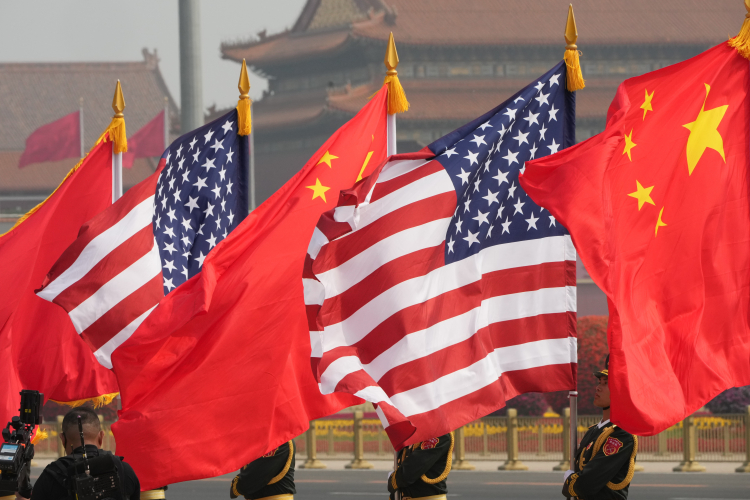
When President Trump and President Xi Jinping concluded their May 14-15 summit in Beijing, the headline outcomes were familiar: discussion of a new U.S.-China “Board of Trade,” expectations of major new Chinese purchases of American agricultural products and indications that some tariffs on non-sensitive goods could eventually be reduced. Markets welcomed the renewed dialogue and continuation of the tariff truce. But the summit produced no meaningful commitments on industrial subsidies, state-directed overcapacity or the broader distortions embedded in China’s economic system.
That matters because managed trade can buy time, but it cannot fix the source of conflict. The U.S. problem with China is not simply that it sells too much to America and buys too little in return. It is that Beijing’s state-directed economy turns capital, credit, land, energy and regulation into instruments of industrial policy. The result is chronic overcapacity in industries such as steel, aluminum, solar panels, shipbuilding, electric vehicles and batteries, with the surplus pushed abroad at prices market competitors cannot match. China’s steel capacity alone is roughly half the global total.
American manufacturers are not losing only to Chinese firms. They are losing to Chinese state policy. A U.S. company can become more productive and innovative, but it cannot outcompete a rival whose financing, inputs and survival are underwritten by the state.
This is why the Beijing summit must not become a sequel to the 2020 Phase One deal. Early reports suggest the administration may secure large Chinese purchase commitments for U.S. farm goods while creating a new bilateral trade mechanism. Those steps may reduce short-term tensions, but purchase targets are politically attractive precisely because they are easier than structural reform.
Washington has seen this before. In the 1980s, U.S.-Japan trade tensions produced the Structural Impediments Initiative, which addressed Japanese distribution systems and anticompetitive practices. The talks generated reports and working groups, but structural change proved far harder. The lesson for China is straightforward: negotiations should be judged by changed incentives inside the Chinese economy, not by the number of meetings or communiqués they produce.
U.S. Trade Representative Jamieson Greer’s proposed U.S.-China “Board of Trade” could still be useful if it focuses on market distortions rather than managed trade. Its first task should be distinguishing ordinary commerce from commerce sustained by nonmarket support or tied to national-security concerns. Goods in the first category should trade more freely. Goods in the second should face transparency requirements, countervailing remedies and enforceable benchmarks. Goods in the third should be restricted.
The U.S. should press China to publish a comprehensive accounting of subsidies and support measures in priority sectors, including provincial subsidies, state-bank lending, land grants, energy discounts, tax preferences and state-backed investment funds. Beijing should commit to sector-by-sector capacity discipline where production far exceeds demand, end discriminatory local-content requirements and allow loss-making firms to exit instead of preserving them as instruments of industrial policy.
These are not ideological demands. They are the minimum conditions for markets to function. If Chinese steel mills, shipyards or battery producers can compete because they are efficient, American firms should compete with them. If they compete because state support absorbs losses, tariffs and trade remedies are defenses of market competition, not protectionism.
Enforcement matters more than atmospherics. Any agreement should include deadlines, sector-specific benchmarks and automatic consequences for noncompliance. If subsidy disclosures are incomplete, if capacity reductions are reversed or if exports surge from sectors that promised discipline, tariff relief should snap back automatically and countervailing-duty cases should accelerate.
The U.S. should also coordinate with allies. Chinese overcapacity distorts global prices and displaces producers not only in America, but also in Europe, Japan, Canada, Mexico and emerging markets. A bilateral mechanism will fail if excess capacity is simply rerouted through third countries.
The danger after the Beijing summit is that both governments may settle for tactical stabilization instead of market reform. Purchase agreements, tariff pauses and consultative mechanisms may calm markets temporarily, but they will not restore industrial competitiveness or prevent future trade conflicts if state-backed overcapacity remains intact.
The central question after the Trump-Xi meeting is not how much China will buy. It is whether China will stop producing excess capacity that the rest of the world is expected to absorb.
The U.S. should welcome purchases, but it should not settle for purchase orders. A durable trade peace requires structural reform: fewer distortions, greater transparency, enforceable limits on state-backed overcapacity and equal competitive conditions for American producers. Anything less is another temporary truce on the way to another crisis.
Shanker A. Singham is CEO of the Competere Group and Chairman of the Growth Commission. Alden F. Abbott is Former General Counsel of the Federal Trade Commission and currently serves as a Member of the Growth Commission.
