




The view of warfare today is grounded in our early 20th-century experience of the logic of mass. Victory in the First and Second World Wars hinged on scale: armies in the millions, fleets in the hundreds, and industrial output that could outproduce, outlast, and grind the enemy into submission. Endurance mattered.
The Cold War added to that approach the concept of overmatch. Superior technology, stealth, precision-guided munitions, and networked command and control augmented the need for mass. The specter of nuclear war kept that mix from being fully tested. But the Gulf War appeared to validate the idea that smaller, more advanced forces could dominate through precision and information superiority.
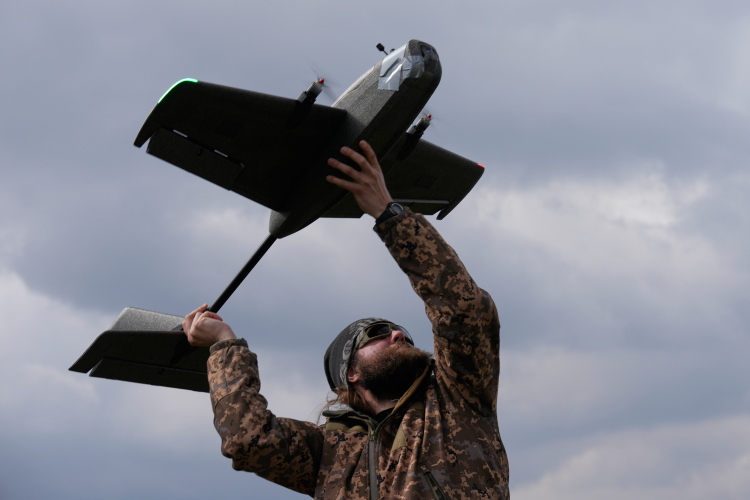
Today, that assumption is breaking down as the war in Ukraine has made clear. Weapons and systems are identified, countered, and rendered less effective in weeks and sometimes days. The advantage no longer belongs to the largest force or to the most sophisticated. It belongs to the side that learns faster, iterates in real time, and redeploys a new variant before the enemy can respond. Warfare has become a contest of adaptation cycles.
In this model, neither mass nor technological superiority is decisive on its own. What matters is the speed at which a military force and the relevant industrial base can move through a continuous loop of deploy, observe, learn, update, and redeploy. The side that compresses the time between innovation and battlefield effect will shape and dominate the battlefield.
Traditional munitions are effectively locked when they leave the factory. A meaningful upgrade requires redesign, recertification, and typically years of delay. That cadence is misaligned with the demands of today’s battlefield.
The fixed-at-birth model is beginning to change. The standard 155mm artillery round, long a staple of land warfare, is being re-engineered into a precision, extended-range munition capable of traveling well beyond 100 kilometers at supersonic speeds and striking within meters of its target. The precision that once required complex and more costly missile systems can be delivered from legacy platforms already in service, expanding reach, volume, and intensity at much lower cost.
Weapons can no longer be static. Like software, they must be seen and approached as modular and updatable. Payloads, guidance systems, targeting logic, infrastructure, and processes must be rapidly adaptable without requiring system reengineering.
Calls for containerization to support that shift point in the right direction, but it is not the solution. A container filled with static capability is a more flexible way to deploy yesterday’s solution. Its relevance begins to decay the moment that the old solution in the container is countered. The real opportunity lies in innovation and production.
A weapon without an agile industrial base is not a deterrent. It is a prototype. For decades, defense manufacturing has been centralized, capital-intensive, and bureaucratically shaped, monitored, and controlled. That model made sense in the age of overmatch and slower innovation cycles. Fewer systems, exquisite performance, and long timelines do not work in an era defined by continuous adaptation.
The future is distributed manufacturing and modification networks, ideally located near where the weapons are employed, digitally coordinated in real time, and capable of rapidly scaling production across a wide base of suppliers. Design changes must propagate across the network instantly. Surety and safety certification must keep pace with iteration. Production is no longer downstream of innovation. It’s integrated into it. This must be the industrial model of our time.
But even that is not enough. The true advantage does not come from any single aspect, whether containerization, modular weapons, or distributed manufacturing. The advantage is the system that connects them and where a new dimension of meaningful weapon effectiveness is beginning to take shape.
Platforms like GRAIL operationalize the adaptation loop that links frontline operator demands, software-defined systems, and a distributed industrial base into a single, continuously learning and delivering architecture. It turns defense procurement from a linear, multi-year, bureaucratic process into a dynamic, data-driven system that allocates capital and capability based on real-time operational need. It will epitomize the weaponry of our time.
Today’s wars will not belong to the side with the largest force or the most advanced systems. National will and public endurance still matter. But the force that consistently owns the loop of learning, reacting, adapting, and producing faster than its opponent will increase the probability of victory.
Admiral Gary Roughead (Ret.) is the former Chief of Naval Operations and former Commander of the U.S. Pacific Fleet.
