




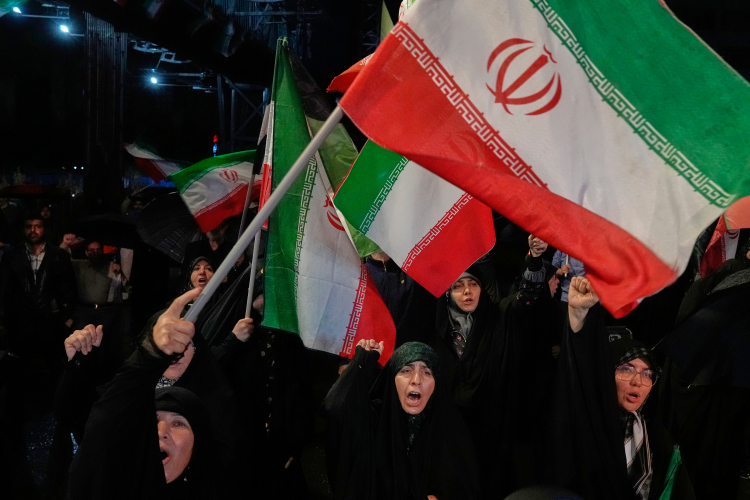
Since before Iran’s 1979 revolution, Western policy toward that country has been shaped less by realities on the ground than by what foreign policymakers found convenient to believe about them. The myths have changed over the decades. The cost of believing them has not.
In late 1977, Jimmy Carter famously toasted the Shah’s Iran as “an island of stability.”Within fifteen months, the monarchy had collapsed, and the foreign-policy establishment that had built its assumptions around the Shah was left scrambling to comprehend a revolution it had utterly failed to foresee. The lesson should have been unmistakable: never again mistake repression for permanence, or assume that the political order in Iran is immune to upheaval. But the lesson was never truly learned.
After Ayatollah Khomeini hijacked a broad-based popular revolution and erected a theocratic dictatorship upon its ruins, Washington and many of its allies gradually embraced the same fallacy in a different form. The clerical regime, they concluded, could perhaps be moderated, pressured, negotiated with, or contained—but never fundamentally challenged from within. Diplomacy could be attempted; sanctions could be imposed; tactical pressure could fluctuate. Yet the regime itself came to be treated as an enduring fact of the regional landscape.
That assumption was always wrong.
It was wrong in 1979. And it was catastrophically wrong in 1988, when the regime, in the weeks following the ceasefire in the Iran-Iraq War, carried out the systematic execution of approximately 30,000 political prisoners—overwhelmingly members and supporters of the country’s principal democratic opposition, the People’s Mojahedin Organization of Iran (PMOI/MEK). Regimes do not commit a crime against humanity in a matter of weeks to eliminate a movement they consider irrelevant. The 1988 massacre was, in effect, the regime’s own confession, written in mass graves, of which force it truly feared.
I have spent more than two decades studying that regime, have written books about it, briefed members of Congress on its internal dynamics, and met men and women of the Resistance whose courage profoundly humbled me—several of whom, I later learned, were murdered by the regime they opposed. I am, by profession, a scholar. But I am also a father. I do not write what follows from the safety of detached abstraction. I write because, by the spring of 2026, the widening gap between what is now known about Iran and what Western policy is willing to acknowledge, let alone act upon, has become morally and strategically intolerable.
Beginning in late March, the regime executed eight political prisoners—Vahid Bani-Amerian, Abolhassan Montazar, Mohammad Taghavi, Akbar Daneshvarkar, Babak Alipour, Pouya Ghobadi, Hamed Validi, and Mohammad (Nima) Massoum-Shahi—all condemned solely for their alleged membership in the PMOI. Their executions were intended not merely as punishment, but as a message: a warning to a restless society that resistance would be met with the gallows.
Yet the executions did not stop there.
On May 4, three young workers in Mashhad were hanged in connection with the December 2025 uprising. Two days earlier, in Urmia, two more young dissidents were executed following proceedings conducted by video conference—an almost grotesque parody of due process. On April 30, a 21-year-old karate champion from Isfahan was hanged after enduring severe torture in detention. And on May 12, a Baluchi dissident met the same fate.
Meanwhile, the regime’s judiciary chief, Gholam-Hossein Mohseni-Eje'i, has openly instructed the judiciary to operate in what he called a “combat formation” against protesters and dissidents.
These are not the actions of a government confident in its legitimacy or secure in its hold on power.
They are the actions of a regime governed by fear—fear of its own people, fear of organized resistance, and fear of a society that is steadily losing its fear of the regime itself.
The international press is beginning, at long last, to catch up with realities the Iranian Resistance has articulated for decades. On April 23, 2026, The New York Times reported that the Islamic Revolutionary Guard Corps had effectively assumed collective governance of Iran. In May, The Atlantic dismantled the carefully cultivated public-relations façade surrounding the exile figure the regime appears most willing to tolerate: the son of the deposed Shah. Meanwhile, the leading Arabic daily, Asharq Al-Awsat, wrote that Tehran’s long-standing policy of brinkmanship had “collapsed and lost its validity.” Even the regime’s own IRGC-affiliated Fars News Agency acknowledged that organized cells of five to ten individuals are leading protests across the country.
It is within this context that the National Council of Resistance of Iran (NCRI) will hold its Freedom March in Paris on June 20, 2026. More than 100,000 participants from sixty countries are expected to attend, joined by parliamentarians, jurists, former heads of state, and prominent international figures. They will gather around a singular and urgent proposition: that the international community must finally recognize the provisional government announced by the NCRI following the death of Ali Khamenei, grounded in Maryam Rajavi’s Ten-Point Plan for a democratic republic.
I am familiar with the argument that will inevitably be advanced in response. It is the claim that the regime is simultaneously too weakened to endure and yet too entrenched to be replaced; that while the Islamic Republic is decaying, no organized democratic alternative exists. The first half of that argument offers comfort to those unwilling to act. The second half is demonstrably false.
The PMOI’s network of Resistance Units has played a central role in each of the four nationwide uprisings since 2017. Between January and February 2026, that network evolved into a National Liberation Army, which carried out more than 630 documented operations. On February 23, five days before the first airstrikes, 250 PMOI fighters stormed the Pasteur Street complex in Tehran, housing the residence and offices of the Supreme Leader. They engaged a substantially larger defending force in a battle that lasted several hours before 150 of them successfully withdrawing.
We made that mistake once in 1979, and again in 1988: accepting the regime’s narrative of its own permanence, inevitability, and invincibility. We mistook repression for stability and terror for durability. We convinced ourselves that no viable democratic alternative existed, and in doing so, we helped prolong one of the most brutal dictatorships of the modern era.
A third repetition would not be an error born of uncertainty or lack of evidence.
It would be a conscious choice.
The Freedom Rally in Paris on June 20, 2026, is many things: a gathering of conscience, a demonstration of solidarity, and a declaration that the Iranian people refuse to surrender their future to either religious fascism or the return of monarchy. But it is also something more consequential. It is a public test of whether the West is finally prepared to recognize reality: that an organized, resilient, democratic alternative to the ruling theocracy does exist, and has existed for decades.
The question before Western governments is no longer whether such an alternative exists.
The question is whether they are prepared to acknowledge it. That answer is long overdue.
