




Earlier this month, thousands of miles from Washington, an important meeting that few U.S. policymakers noticed took place in the historic Silk Road city of Turkistan in southern Kazakhstan. Leaders of the Organization of Turkic States (OTS) gathered to discuss a wide range of geopolitical, technology, and economic issues. Washington should take notice.
The OTS is an intergovernmental grouping linking the ethnically Turkic countries of Eurasia. The idea of closer Turkic cooperation was championed by then-Kazakh President Nursultan Nazarbayev in 2006. It was institutionalized in 2009 as the Turkic Council and renamed the Organization of Turkic States in 2021. Today, its full members are Turkey, Azerbaijan, Kazakhstan, Kyrgyzstan, and Uzbekistan. Turkmenistan, Hungary, and the de facto Turkish Republic of Northern Cyprus are observers.
At first glance, the significance of this grouping may not be obvious. A closer look tells a different story. OTS members sit in the heart of the Eurasian landmass, astride some of the world’s most important trade and transit routes. They also hold major oil, gas, and critical mineral reserves. Together, the OTS countries and observers represent roughly 175 million people and more than $2.4 trillion in combined GDP, placing the Turkic world in the same economic weight class as several G20 economies.
Even this does not capture the full scope of the OTS’s potential influence. Beyond OTS members and observers, tens of millions of additional Turkic peoples, stretching from the Balkans to western China and Russia’s Arctic, look to these states for cultural inspiration and political influence.
The desire for closer cooperation among Turkic states is not surprising. For decades, and in some cases centuries, much of the Turkic world saw its language, culture, and identity restricted by the Russian Empire and later the Soviet Union. Russification was used as a tool of political control across much of the Turkic world, suppressing local languages, histories, and cultures in places where Turkic identity had existed for centuries.
Since regaining independence in 1991, the ethnically Turkic former Soviet states, with support from Turkey, have rediscovered and elevated their Turkic identities. This includes ongoing efforts in some countries to move from Cyrillic to Latin-based alphabets, as well as agreement on a 34-letter common Turkic alphabet. It also includes restoring the dominance of native Turkic languages in government and business and deepening cooperation with other Turkic countries.
Until recently, cooperation among Turkic states was relatively modest, focusing mainly on cultural and economic ties. But the agenda is becoming more ambitious. The OTS is now discussing artificial intelligence, streamlined customs and trade processes, regional connectivity, and transportation links. Even in security, Azerbaijan has proposed hosting joint military exercises for OTS member states later this year.
This matters to the United States in an era of great power competition. With the Trump administration prioritizing diverse and reliable sources of critical minerals, the Turkic world is becoming more important to U.S. interests. Across the Eurasian landmass, Russia, China, Iran, and India are maximizing their influence. Meanwhile, the Turkic countries at the heart of Eurasia are trying to balance their relations with these larger powers while preserving their sovereignty. Washington should see the OTS as an increasingly important pole of power that can help dilute the influence of Beijing and Moscow.
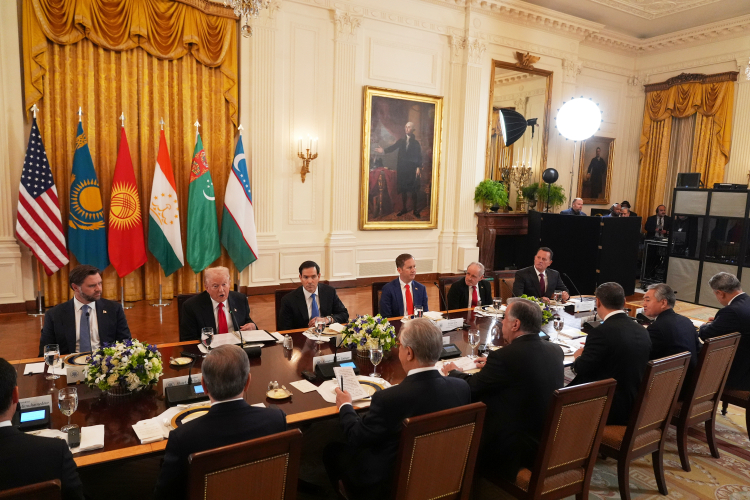
Fortunately, the Trump administration is well placed to seize the opportunity. In November 2025, President Trump hosted the first-ever C5+1 presidential summit at the White House with the leaders of the five Central Asian states (four of which are Turkic). He has expanded economic ties with countries like Kazakhstan and Uzbekistan and invited both to the upcoming G20 Summit. His administration helped broker a peace agreement between Azerbaijan and Armenia, which could open new trade routes through the Middle Corridor and deeper into the Turkic world. He also has a close relationship with President Recep Tayyip Erdoğan, whose country remains the current driving force behind deeper Turkic cooperation.
Secretary of State Marco Rubio should build on this momentum by hosting a U.S.-OTS Summit. At a minimum, he should invite OTS Secretary General Kubanychbek Omuraliev to Washington for high-level meetings with U.S. officials.
As America competes in a new era of great power rivalry, it needs dependable partners, reliable access to energy and critical minerals, and secure trade routes across Eurasia. The Organization of Turkic States can help provide all three. Washington can no longer afford to ignore it.
Luke Coffey is a senior fellow at Hudson Institute. His work at Hudson analyzes national security and foreign policy, with a focus on Europe, Eurasia, NATO, and transatlantic relations.
