




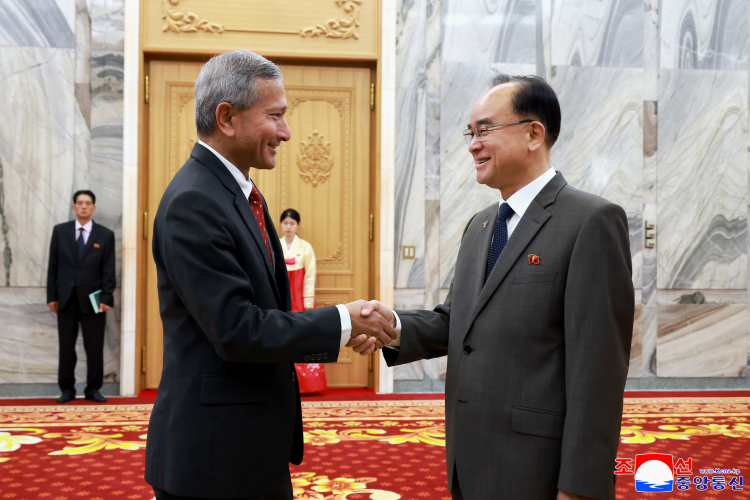
Just days before this year's Shangri-La Dialogue, Singapore did something that deserved far more attention in Washington than it received.
Foreign Minister Vivian Balakrishnan traveled to North Korea for a rare high-level meeting with Foreign Minister Choe Son Hui, during which Singapore extended an invitation for Pyongyang to participate in the ASEAN Regional Forum — one of the last functioning multilateral security channels where North Korea still engages. Almost immediately afterward, Balakrishnan flew directly to Seoul, where he met South Korean Foreign Minister Cho Hyun, National Security Director Wi Sung-lac, and Unification Minister Chung Dong-young.
The sequence: China, then North Korea, then South Korea.
That was not accidental. And it tells us something important about where Southeast Asia stands — and what American strategy must account for.
The Trump administration has been direct about its expectations for allies and partners: step up, contribute, and stop free-riding on American power. That posture is right. But applying it effectively in Southeast Asia requires understanding what these countries actually are — and what they are not.
ASEAN nations are not adversaries hedging against America. They are pragmatic operators in a genuinely complex neighborhood, one where China is not simply a distant rival but an immediate geographic and economic reality. Across Southeast Asia, Chinese commercial networks are deeply embedded in finance, logistics, manufacturing, and trade. For countries like Singapore, Vietnam, and Indonesia, managing Beijing is not optional — it is unavoidable.
That is precisely why the Trump administration's maximum-pressure instincts, effective as leverage tools, need to be paired with something these countries can say yes to. Demanding that Southeast Asian partners cut economic ties with China entirely is not a realistic ask. But offering them better alternatives — in manufacturing investment, technology infrastructure, defense cooperation, and supply-chain resilience — is a strategy that can actually win.
Singapore's Korea diplomacy illustrates the opportunity. By maintaining thin but real channels with Pyongyang, Singapore is not undermining American interests. It is providing something the region badly needs: a mechanism for crisis management on a peninsula that is growing more dangerous, not less. North Korea's expanding missile arsenal, its deepening military partnership with Russia, and the collapse of any serious denuclearization framework have created genuine escalation risk. In that environment, even limited diplomatic channels have strategic value.
The Trump administration has shown it understands this intuitively. President Trump's own willingness to engage Kim Jong-un directly — something his predecessors refused to attempt — reflected a similar logic: that dialogue, conducted from a position of strength, is not weakness. Singapore is applying the same principle at a regional level.
There is also a harder competitive reality that Washington should keep firmly in view. ASEAN is not a unified bloc with a single foreign policy. Singapore, Vietnam, Indonesia, Malaysia, and Thailand are actively competing against each other for semiconductor investment, AI infrastructure contracts, advanced manufacturing, defense partnerships, and financial hub status. The United States has enormous leverage in every one of those competitions — if it chooses to use it.
That is where the Trump administration's deal-making orientation can translate directly into strategic wins. Countries that align more closely with American economic and security frameworks should receive tangible benefits: preferential access to U.S. investment, technology transfer agreements, defense partnerships, and trade arrangements. Countries that drift toward Beijing's orbit should feel that choice in concrete ways.
This is not Cold War-style ideological sorting. It is smart power with clear incentives attached — which is exactly what the region responds to.
Singapore's quiet diplomatic choreography before Shangri-La is ultimately a signal, not a threat. It reflects a region that wants to remain engaged with the United States, wants the security guarantees America provides, and wants Washington to remain the indispensable partner in the Indo-Pacific. But it is also a region that will not subordinate its entire economic architecture to geopolitical demands it cannot survive.
The Trump administration is right to press partners for more. The question is whether it will also offer enough to make alignment worth choosing. In Southeast Asia, that choice is still very much available. But it will not stay open indefinitely.
Washington has the leverage, the economic weight, and the security credibility to lead in this region. The moment calls for deploying all three — strategically, selectively, and with clear purpose.
James Carter is a policy advisor with America's Economy First. He previously served as director of the Center for American Prosperity at the America First Policy Institute and as deputy undersecretary at the U.S. Department of Labor where he oversaw international affairs. Jacob Choe is an international strategist specializing in Africa, emerging markets, and critical minerals supply chains. He is a member of the Bretton Woods Committee and a Ben Franklin Fellow.
