




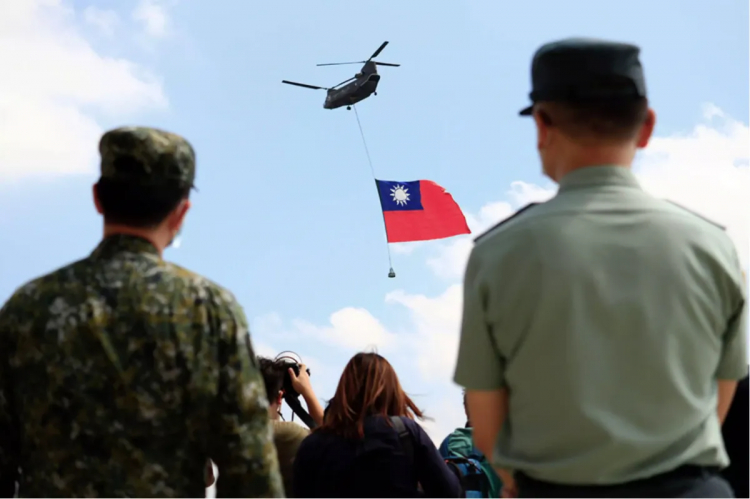
Following his summit with Chinese President Xi Jinping, President Trump demonstrated his penchant for a transactional foreign policy when he remarked that arms sales to Taiwan constitute a useful “bargaining chip” in America’s dealings with Beijing.
That comment did not go down well inside the Beltway, to put it mildly. But Trump’s habit of straying from the customary script, at least in this case, is wholly justified.
The controversy began when a Fox News interviewer in Beijing asked Trump whether he was ready to approve a major arms sales package for Taiwan this year. Trump replied, “No, I’m holding that in abeyance and it depends on China… It’s a very good negotiating chip for us, frankly.”
Trump then went further, repeating his gripe that Taiwan “stole” the U.S. semiconductor industry and castigating Taiwan’s leaders as “dangerous separatists who are trying to drag the United States into a bruising war.”
But it was the arms sale remark that touched off a fury. Retired Admiral Mark Montgomery called Trump’s remarks “a strategic blunder of historic proportions… [that would] weaken U.S. credibility globally.” Beltway sinologist Ryan Hass proclaimed, “Trump did not reduce the risk of conflict. He raised it… [with his] visible sympathy for Xi’s framing.”
These critiques illustrate how detached the foreign policy establishment is from emergent global power realities. At a minimum, they overestimate both U.S. interests in the small island 90 miles off China’s shores and the American military’s capabilities to intervene successfully in any Taiwan scenario. Fortunately, Trump appears to have a more sober understanding of the cross-strait reality.
It's customary to cite three reasons why the U.S. should come to Taiwan’s defense: Taiwan is a democracy; it has a major role in the fabrication of high-tech semiconductors; and it serves as a strategic “cork in the bottle” that prevents Chinese aggression across the Asia-Pacific region. None of these arguments are persuasive and they certainly aren’t compelling enough to risk a catastrophic war with a nuclear-armed peer competitor.
On the matter of protecting Taiwanese democracy, it should be kept in mind that the U.S. partners pragmatically with non-democracies all the time, from Egypt to Saudi Arabia to Vietnam. Washington’s attempts to install and uphold democracy around the world, such as in Afghanistan, have often ended in fiasco. And when Hong Kong’s nascent democracy was regrettably snuffed out by Beijing after protests in 2019–20, there were no discernible adverse consequences for the U.S. and its democratic allies.
Nor are semi-conductors a strong rationale for risking war over Taiwan. Japan, Malaysia, Singapore, and South Korea are also major semiconductor producers, while most of the chips from the vaunted TSMC corporation go into phones and laptops. True, the world benefits from this technology, but having to wait a bit longer or pay a bit more for the next model seems far preferable to risking a U.S.-China war.
Perhaps the strongest argument for the U.S. defending Taiwan is the strategic “cork in the bottle” argument, but this too falls short. While Taiwan’s position close to China affords it some intelligence value for monitoring China’s skies with powerful radars and acoustic arrays for tracking Chinese submarines, such advantages are hardly worth risking a war.
China’s close proximity to Taiwan suggests that it could bring immense firepower from all of its armed forces, whereas U.S. forces defending the island would be operating at the precarious end of a lengthy and vulnerable logistics supply line. It’s little wonder that war games suggest that U.S. losses would likely be horrendous in just the opening days of such a conflict and that’s not even accounting for the all too real nuclear risks.
Even the often hawkish Wall Street Journal editorial page admitted: “Would Americans tolerate a war with a nuclear superpower over a territory we don’t even recognize as an independent country? The seeming reluctance of Americans to tolerate the costs of war with Iran… suggests the answer is no.”
Trump’s recent candor on Taiwan does not amount to an attempt to trade the island for more Chinese purchases of soybeans, as some have alleged. It’s rather a good-faith effort to step back from the cliff we have imprudently edged up to in recent decades.
Everyone knows well, including the Chinese, that U.S. armaments will continue to flow to Taiwan, in one form or another but our commitment to the island is limited and diminishing. This was Trump’s main point, even if he is still apparently willing to throw Taipei the occasional bone. The simple truth is that the U.S.-China relationship far outweighs a small island in any rational calculation of our national interests.
Lyle Goldstein is director of Asia engagement at Defense Priorities. Goldstein serves concurrently as director of the China Initiative and senior fellow at the Watson Institute for International and Public Affairs at Brown University.
