




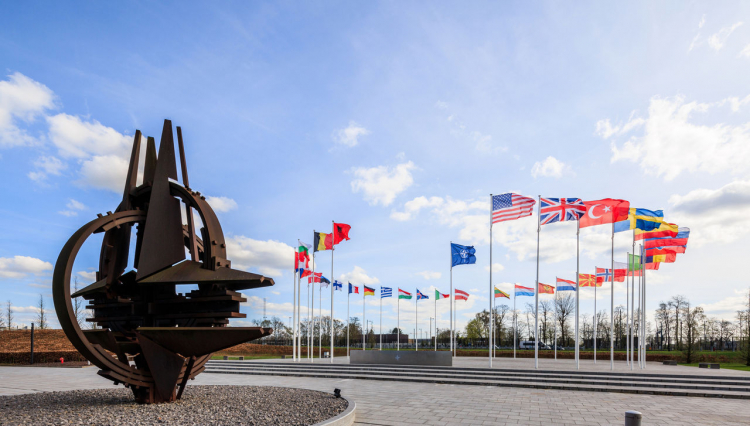
Friday’s impact of a Russian drone in the Romanian town of Galati — a drone that, while intended to murder Ukrainians, went astray and slammed into an apartment building in a NATO state — capped a jittery week for the alliance.
NATO is still processing the message delivered the week prior by a mid-level U.S. official that the United States plans to significantly reduce the military capabilities it would make available to the alliance in the event of a future crisis.
According to reports, the U.S. plans to cut the number of fighter jets available to NATO in a hypothetical future conflict by one third and the number of strategic bombers by half. Armed UAVs and refueling aircraft would also face steep reductions, while the U.S. would no longer make additional reconnaissance drones available.
Likewise at sea, the U.S. informed allies that no American submarines would be made available in a crisis, and that the number of destroyers entering the fray would be limited.
The decision, on the eve of the July Summit in Ankara, appears to have caught European allies and Congress off guard.
It comes on the heels of the announcement of a 5,000-troop withdrawal from Germany and news that a planned rotational deployment of 4,000 troops to Poland and other eastern European nations was being rescinded, only to be superseded days later by President Trump’s decision to send an additional 5,000 American soldiers to Poland.
These consecutive announcements have led to unease in Europe and raised the danger that, by telegraphing clear limits on America’s commitment to NATO allies in a future war with Russia, the credibility of NATO’s deterrence could be weakened at a precarious time.
Russia, facing its first territorial losses in Ukraine in nearly two years, is also grappling with casualty levels that have surpassed its ability to generate replacements. Feeling squeezed, Moscow is lashing out. Last weekend, Kyiv was subjected to one of the largest Russian bombardments since the start of the war.
In the Baltics, Russia has turned to increasingly bellicose rhetoric and is reportedly planning to appeal to the International Court of Justice over fabricated allegations that “Russian minorities” living in those nations are being discriminated against.
The accusations, while bogus, are worrisome because they signal a renewed focus on a familiar Russian propaganda narrative — one that could be used as a pretext for a future attack against NATO states.
Which brings us back to the recent announcement regarding cuts to U.S. capabilities in times of crisis.
At issue are American contributions to NATO’s Force Model, the beefed-up high-readiness force plan adopted in 2022, which would see up to 500,000 troops mobilized within 180 days of hostilities commencing.
A component of the Force Model is for member states to voluntarily identify “a larger pool of available forces that can be deployed if they are needed during a crisis or conflict.”
This does not pertain to U.S. forces currently deployed to Europe, but rather to additional troops and capabilities that could be surged forward swiftly should a future conflict break out.
As the U.S. pares back its potential future contributions, the Administration has asked allies to present replacement plans at the Ankara Summit — now little more than a month away — detailing how those capabilities will be replaced.
It will be a tall order; the changes amount to the U.S. cutting “by half the deep strike forces allocated to Europe.”
Sources in Europe note that whatever plan allies can put in place, “it is unlikely to result in a like-for-like replacement of U.S. assets.”
The reason is straightforward: many of the platforms being pared back by the U.S. are precisely those that Europe currently lacks.
While European rearmament is real, replacing key American capabilities will not happen overnight. An American military disengagement that proceeds too quickly risks leaving allies dangerously exposed and could convince Putin that a window of opportunity exists to test NATO by attempting to seize the territory of a member state while the baton of conventional deterrence is being handed from the U.S. to Europe.
The United States may ultimately expect Europe to shoulder more of the burden for its own defense, but it should take care not to create the perception — in Moscow or elsewhere — that NATO’s shield is weakening before Europe is fully prepared to hold the line.
Daniel Kochis is a Senior Fellow in the Center on Europe and Eurasia at the Hudson Institute
