




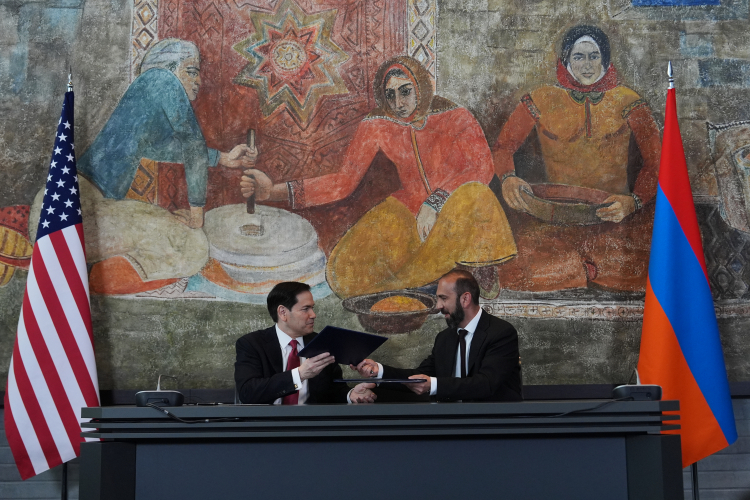
Secretary of State Marco Rubio’s visit to Armenia last week showed that Washington is seriously invested in the South Caucasus. In Yerevan, he and Foreign Minister Ararat Mirzoyan signed the Charter on Comprehensive Strategic Partnership and an agreement on critical minerals, and initialed a framework agreement for the Trump Route for International Peace and Prosperity project, or TRIPP. The timing is significant. Armenia’s June 7 election will help determine whether this partnership maintains its momentum.
The stakes are clear. Armenia’s strategic position at the intersection of Europe, the Middle East, and Central Asia, together with its skilled workforce and growing commercial and tech potential, presents valuable opportunities for mutually beneficial cooperation with American companies.
Last August, President Trump recognized that opportunity when he hosted Armenia’s Prime Minister Nikol Pashinyan and Azerbaijan’s President Ilham Aliyev at the White House. The meeting established a practical framework to advance peace in one of the post-Soviet world’s longest-running conflicts and opened new opportunities for trade and regional connectivity. Last week’s TRIPP agreement begins turning that framework into reality, underscoring that peace is the foundation for prosperity.
For Armenia, TRIPP offers an opportunity to turn peace into expanded economic development, trade, infrastructure, and long-term stability. For the United States, it provides strategic value and commercial benefits while supporting constructive engagement in shaping the future of the South Caucasus region. The framework creates a shared interest for both governments in TRIPP’s long-term success.
TRIPP will develop new networks of roads, railways, energy links, and fiber-optic connections across Armenian territory, under Armenian sovereignty and jurisdiction. In fact, as a vital component of Armenia’s broader “Crossroads of Peace” initiative, TRIPP will create an important link in the Trans-Caspian Trade Route, connecting Central Asia to the South Caucasus and Europe, with Armenia at the center. The implications are significant. Armenia will become a trading gateway connecting the Caspian, Turkey, and Europe. This creates new American opportunities in infrastructure, energy, technology, and minerals. Washington’s expanded engagement through commerce and partnership can help reinforce long-term regional stability, while open trade and growing economic ties create shared incentives that support a more sustainable peace.
For too long, the South Caucasus was shaped by closed borders and the interests of larger powers. President Trump shifted this dynamic by giving American leadership a practical role in helping create a future in which trade and investment strengthen peace. This is American leadership at its best, connecting diplomacy with tangible results.
Armenia brings more than geography to this opportunity. As the first nation to adopt Christianity as a state religion in 301 AD, it has preserved its identity through centuries of upheaval. Christian values also provide a shared foundation for partnership with the United States. Notably, just hours before the arrival of U.S. Secretary of State Marco Rubio, Armenia’s Minister of Education, Science, Culture and Sport, Minister Andreasyan, and the President and CEO of the Museum of the Bible, Dr. Campo, signed a memorandum of understanding establishing a long-term partnership. Under this MoU, the Museum of the Bible will host a permanent exhibition dedicated to Armenian Christian heritage.
Today, under Prime Minister Nikol Pashinyan, Armenia has moved closer to the United States and Europe while pursuing peace with Azerbaijan.
For Armenia, such progress has required political courage. For Washington, that makes Armenia more useful, not less: a reliable partner with working relationships across a difficult region.
American business is already acting on this opportunity. Firebird, a U.S.-based AI cloud and infrastructure company, is scaling its Armenia AI project to $4 billion and more than 50,000 GPUs, using advanced Nvidia chips approved for export to Armenia. During the historic visit of U.S. Vice President JD Vance earlier this year, he and Armenian Prime Minister Nikol Pashinyan signed a joint statement finalizing the U.S.–Armenia “123 Agreement” on peaceful civil nuclear cooperation, a step that could open the door to billions of dollars in U.S. exports and long-term support contracts.
Armenia has deposits of copper, molybdenum, gold, zinc, and other minerals used in advanced manufacturing and energy systems. With the right investment and standards, Armenia can become a more important partner in the trusted supply chains American companies need. Together, these examples show that Armenia has the talent and resources to support major global commercial initiatives, with U.S. businesses playing a key role in that engagement.
This is why Armenia’s June 7 election matters beyond its borders. The outcome will determine whether Armenia continues the peace and partnership agenda initiated with President Trump’s support, or loses momentum just as implementation begins.
The government’s message to the electorate is clear: vote to protect peace and secure lasting prosperity. TRIPP turns last year’s diplomatic progress into practical results and makes peace tangible. Its success depends on respecting Armenia’s territorial integrity and sovereignty, including Armenian jurisdiction over the route, borders, and customs operations. With American engagement, the project can advance regional commerce while protecting Armenian independence.
Secretary Rubio’s visit also reinforced the message sent earlier this year by Vice President JD Vance that the Trump administration sees Armenia as a serious partner. TRIPP is not a request for open-ended aid. It is a platform for commerce, infrastructure, technology, and peace. As the route develops, the South Caucasus is expected to become increasingly stable and better integrated. American companies will gain access to a better-connected regional economy, providing a return on strategic investment. That is good for Armenia and also a win for the United States.
Narek Mkrtchyan is Armenia’s Ambassador to the United States. He previously served as Armenia’s Minister of Labor and Social Affairs from 2021 to 2025, after serving as Deputy Minister earlier in 2021. He was a Member of Parliament from 2018 to 2021 and has held academic roles at the American University of Armenia and Yerevan State University.
