




The U.S.-China rivalry has produced neither full economic separation nor ordinary commercial goodwill. It has created an intermediate condition in which lawful exchange continues under persistent security pressure. That condition needs a name: Cold Peace.
Just as the phrase “Cold War” taught the twentieth century how US-Soviet rivalry could be kept from becoming catastrophe, “Cold Peace” may be the phrase that teaches the twenty-first century about U.S.-China relations. The Cold War described a world divided into armed ideological camps, restrained above all by nuclear fear. Today’s U.S.-China competition unfolds inside a deeply connected world economy. Its instruments are tariffs, export controls, investment screens, sanctions, supply-chain restrictions, technology chokepoints, financial controls, and regulatory pressure.
Both governments have learned that they can impose costs without firing a shot. The United States can raise tariffs, tighten export controls, restrict outbound and inbound investment, and coordinate pressure with allies. China can restrict rare-earth exports, slow licenses and regulatory approvals, disrupt supply chains, find new trade partners, and raise manufacturing costs. These measures fall short of war, but they are not ordinary commerce. They are instruments of strategic bargaining. Their power creates the need for disciplines that prevent tactical pressure from becoming systemic rupture.
Cold Peace describes a relationship in which war has been avoided, but confidence in the durability of peace has eroded. Commerce continues, but it is no longer politically neutral. Markets remain open in some sectors and fenced in others. Firms trade, invest, and produce under the shadow of security policy. The practical question is how the United States and China can govern their rivalry inside this interdependent commercial system. A Cold Peace framework would keep commercial disputes within predictable channels, preserving lawful exchange while giving both governments procedures for absorbing sectoral conflicts before they widen into strategic crises.
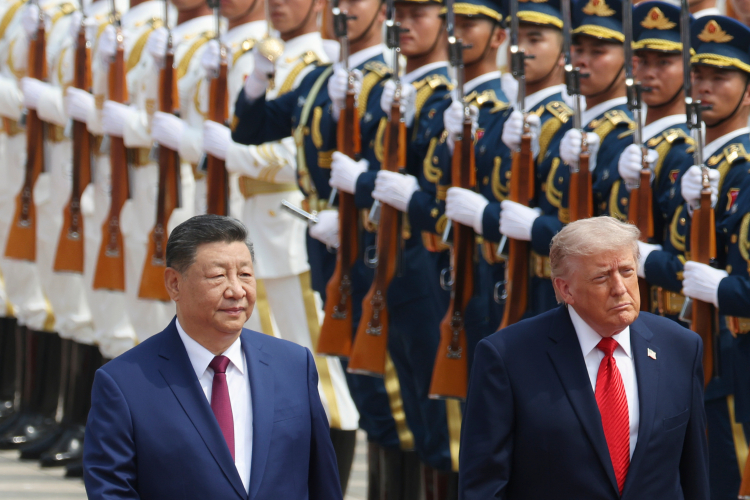
Recent U.S.-China diplomacy suggests that both governments have begun to recognize this problem. The language of “constructive strategic stability” matters less as a summit phrase than as evidence of a search for a framework. Beijing defines stability as a relationship in which cooperation remains central, competition stays within limits, differences are manageable, and peace remains foreseeable. Washington has framed the same problem in terms of fairness, reciprocity, and mechanisms to handle trade and investment disputes. These formulations are not identical, but their overlap is significant. Both sides acknowledge that rivalry requires rules, channels, and repeated procedures.
That recognition should be the beginning, not the conclusion, of a Cold Peace framework. No diplomatic phrase can resolve disputes over tariffs, technology controls, critical minerals, investment restrictions, market access, industrial subsidies, Taiwan, or military risk. What matters is whether diplomatic language can be translated into operating institutions. Trade and investment boards could serve that function if they are treated not as symbolic dialogue mechanisms, but as standing instruments of restraint.
A U.S.-China Board of Trade and Investment should have a limited and practical mission: to protect ordinary commerce from avoidable escalation. It should identify non-sensitive goods, where trade can continue under predictable rules, create advance-notice procedures for new restrictions, establish channels for firms to report disruptions, and require both governments to distinguish between legitimate security concerns and routine bargaining leverage. For Washington, that means discipline before using tariffs or national-security authorities as first resorts. For Beijing, it means credible commitments to keep critical inputs moving and licensing rules transparent enough that firms can plan.
An investment board would face the problem of distinguishing security-sensitive capital from ordinary investment without turning review into an open-ended veto. Investment now touches data, infrastructure, advanced manufacturing, energy systems, and dual-use technologies. Neither side will abandon security screening, but screening need not be arbitrary. Its purpose would be institutional predictability. Clear procedures would tell firms and governments which forms of capital are welcome, which require review, what counts as control, and how vetting decisions will be made, justified, and reconsidered.
The logic of Cold Peace is to prevent rivalry from becoming mutual economic disruption. It is less dramatic than nuclear deterrence, but its effects are felt immediately by companies, investors, workers, and consumers. Economic interdependence no longer guarantees peace; nor does it make separation costless. It creates a dense field of vulnerability in which each side can harm the other and both sides can harm themselves. Instead of preventing conflict, commerce raises the price of escalation. It creates demand for procedures that define the basis and scope of restrictions, keep responses proportionate, and preserve exits before one measure triggers another.
China has its own reasons to prefer a more predictable framework that could emerge from Trade and Investment boards. Its domestic investment environment has become more difficult, while Chinese firms have become more exposed to foreign markets, overseas production, foreign regulatory regimes, and supply-chain politics. As Chinese capital moves outward, Beijing has a larger stake in rules that prevent retaliation, politicized screening, and sudden exclusion from becoming normal practice. Cold Peace is therefore not merely a concession to American concerns. It also serves China’s interest in keeping access to markets and capital from depending entirely on political mood.
The same logic applies beyond bilateral trade matters. Crises in the Middle East, disruptions to energy flows, conflicts over shipping lanes, and instability in global demand all remind Beijing and Washington that disorder can punish both rivals at once. China can oppose American power and still need open sea lanes, functioning energy markets, and steady external demand. The United States can compete with China and still need disciplined channels to avoid global shocks. Cold Peace recognizes the shared stake both powers have in preserving the systems on which their economies depend, including energy flows, shipping lanes, investment channels, and global demand.
The design problem for policy makers is whether diplomatic language can be translated into operating institutions. Diplomatic formulas can signal restraint, but markets respond to procedures that make restraint observable and repeatable. Both systems already rely on licensing, administrative review, sectoral carve-outs, compliance guidance, consultation channels, and dispute procedures. The hard part is designing instruments that can function predictably at the point of contact between rival systems. Firms need clearer signals about when restrictions are likely to apply, how applications will be reviewed, which sectors or transactions are less exposed to political escalation, and where disputes can be raised before they harden into retaliation. Governments need working channels that allow complaint, warning, verification, and bargaining without converting every disagreement into public confrontation.
This is the practical meaning of Cold Peace. It accepts that the United States and China will remain strategic rivals. It rejects the comforting fiction that commercial exchange alone can restrain that rivalry. It also rejects the fatalism of a new cold war. The choice is not between naïve integration and total separation. The more realistic choice is between disciplined rivalry and unmanaged economic coercion.
A Cold Peace will be tense, imperfect, and often frustrating. It will not end competition over technology, influence, markets, or political order. Its value lies in making rivalry governable by turning restraint into practice. For the U.S.-China relationship, the most durable peace currently attainable is not the end of conflict but a disciplined structure of rules, procedures, and habits that keeps competition bounded, cooperation possible, and crises manageable.
Hilton Root is a professor of public policy at George Mason University, a former senior adviser at the U.S. Treasury Department, and the author of ten books on international political economy. https://schar.gmu.edu/profiles/hroot2#ftn1
