




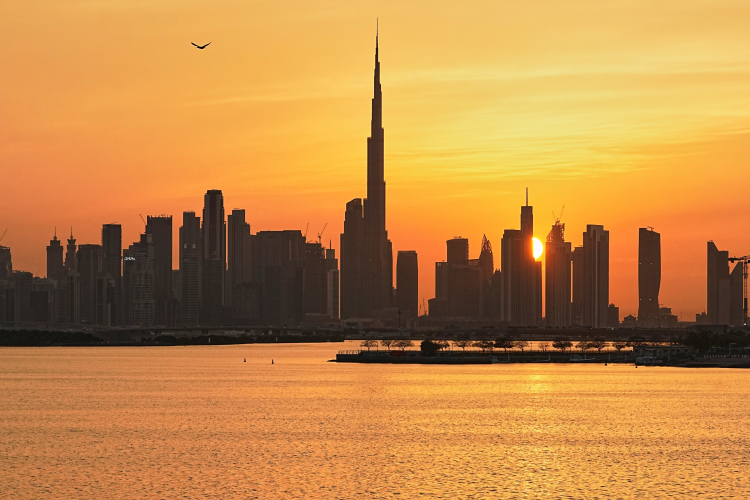
In recent months, residents in Dubai’s Marina and Palm Jumeirah stood on their balconies filming missile interceptions overhead. These striking videos show one of the Gulf’s most valuable assets puncturing in real time: the perception that cities like Doha and Dubai are sanctuaries insulated from the instability of the wider region. Iranian Shahed drones shattered that illusion and showed that no amount of steel, glass or luxury can protect against what is simultaneously the region’s biggest asset, but also greatest liability: its geography.
This psychological shift matters far beyond any damage to buildings or bases. Gulf cities have, for years, traded on the currency of safety, security and prosperity. An estimated 300,000 British citizens live in Gulf countries, with the majority concentrated in the UAE. Their economic model, beyond hydrocarbons, is centred around tourism, aviation and real estate - sectors particularly vulnerable to instances of instability. The rise of Gulf cities was as much down to an ability to convince investors and expatriates alike that their future was secure and lucrative as it was down to oil.
This development model is not unique. Parallels can be drawn to Lee Kuan Yew’s transformation of Singapore from ‘mud-flat’ to ‘metropolis’ from 1959 to 1990. Its development centred around building a new type of nation - centred around the attraction of international capital. Just as Singapore did, Gulf countries understood that central to this was convincing investors that Gulf cities represented a lucrative but insulated bet. Without that stability, the bet becomes too risky, and investors may well look elsewhere.
In February, the UAE Ministry of Defense reported that Iranian ballistic missiles had struck the country. As of the 10th May, UAE air defences had engaged a total of 551 ballistic missiles, 29 cruise missiles, and 2,265 UAV’s. For residents in these neighbourhoods, the conflict ceased to be something spectated from the comfort of their devices - instead, they became subject to the same rhythmic beat of regional insecurity familiar to many in adjacent nations. Missile alerts now flash on their phones and contrails from missile defence systems litter the sky.
Once this confidence is broken, it does not automatically return through reassurance alone, and whilst a ceasefire may stop missiles, it does not mean people will start flooding back to their luxury hotels.
Doubtless, Gulf cities have developed strong international offerings that make each country more resilient: Doha transformed itself into a key diplomatic and media powerhouse; Abu Dhabi cultivated an image as a linchpin of global finance; Dubai built its brand on luxury tourism.
Yet history serves as an uncomfortable reminder. Beirut was once known as the ‘Paris of the Middle East’ - a bustling hub that attracted foreign capital and expatriates. Its decline was due to a slow breakdown of trust in its security, with investors realising its image or stability was thinner than it seemed.
The Gulf is not Beirut. They have significant hydrocarbon wealth and formidable authoritarian governments. But Beirut nonetheless serves as a germane example of the fact that reputation, once eroded, does not automatically restore.
The immediate numbers show this clearly: Dubai hotel occupancy rates are projected to plummet to 10% and roughly 250,000 hotel bookings were cancelled in March alone. As Jim Krane, a fellow at Rice University’s Baker Institute, noted: the conflict is ‘upending the crucial aura of security in Dubai’. Hundreds of thousands of Indian workers have fled back home, many unsure of their future. The once iron-clad trust they had in Gulf countries as a source of dependable work has been upended, and it remains to be seen how many will return.
Gulf cities have worked effectively to craft this careful image of a bubble of security in an otherwise frenetic region. They built it out of a genuine ambition and for many years made it real. But we are seeing decades of work being methodically undone, missile by missile - drone by drone. Every projectile reminds the world that branding is not the same as geography, and that ultimately, the Middle East, however gilded it has become, remains the Middle East.
Oliver Dawson is a finalist at Durham University, reading Politics & International Relations. He is also a Policy Fellow at the Pinsker Centre Fellow and a former Treasurer of the Durham Union Society.
