




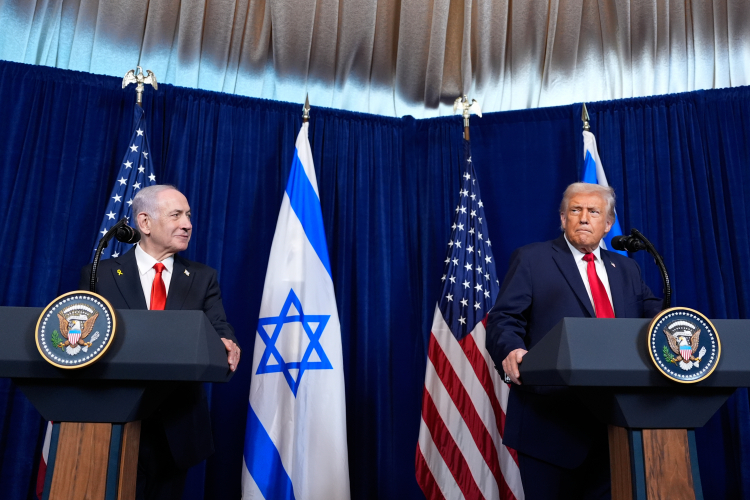
President Trump's abrupt U-turn in the Iran war and acceptance of the Iran regime's outlandish demands are unsettling. Look at his declarations that Iran's leaders are reasonable, that Israel's actions in response to Iran and Hizbullah's attacks are irresponsible, and that the "Master of the Deal" is infallible. Is it time to check the applicability of the 25th Amendment on replacing a medically disabled octogenarian president?
No. For decades, U.S. policy toward Israel has followed a consistent, if sometimes awkward, pattern: affirm Israel's security and capacity to deter, while resisting efforts that would produce an outright, transformative Israeli military victory. This approach has recurred across administrations from Dwight Eisenhower through Ronald Reagan, George H.W. Bush, Bill Clinton, George W. Bush, Barack Obama, Donald Trump, and Joe Biden. It reflects a sometimes-awkward strategic calculus that attempts to balance bilateral loyalties with broader regional and global concerns.
That balancing act is not the same as favoring Israeli defeat. Rather, successive U.S. governments have judged that a decisive Israeli triumph can generate serious strategic costs: alienating Arab states, provoking regional destabilization, enhancing the leverage of rival powers such as the Soviet Union or Iran, disrupting energy markets, and undermining U.S.-led diplomatic initiatives. In short, Washington has often concluded that a managed military outcome better serves long-term American and regional interests than an unqualified victory on the battlefield. In the search for the golden rule of U.S. diplomacy dating back to before Israel's founding, the U.S. government pursued "even-handed" policies. Unfortunately, uneven even-handedness was sometimes defined as "the palm of the hand to the Arabs and the back of the hand to Israel," a U.S. Senator charged decades ago.
Historical episodes illustrate the pattern:
In the 1956–57 Suez crisis, President Eisenhower and Secretary of State Dulles forced Israel to withdraw from Sinai and Gaza under threat of sanctions and UN pressure. Eisenhower publicly demanded withdrawal behind the armistice lines in February 1957. Did the Israeli withdrawal lead to Egypt closing the Straits of Tiran and expelling UN peacekeeping troops from the Sinai a decade later? At a meeting at Eisenhower's Gettysburg home in October 1965, the president told his close friend Max Fisher, "You know, Max, looking back at Suez, I regret what I did. I never should have pressured Israel to evacuate the Sinai."
In the crisis leading up to Israel's June 1967 war against Egypt, Syria, and Jordan, little international effort or diplomatic action was taken to reopen the Red Sea or keep peacekeeping troops in the Sinai. President Lyndon Johnson's pro-Israel pronouncements made little difference, and the speed and scale of Israel's success outpaced diplomatic efforts. Israel's military victories were so fast that big power intervention was out of the question. The United Nations' Security Council eventually framed the postwar settlement, but the rapid military outcome left little room for external orchestration during the fighting.
In the 1973 Yom Kippur War, Egyptian and Syrian military forces attacked Israel. Initially, the Israelis suffered military defeats on both fronts. President Richard Nixon ordered an emergency airlift of weapons for Israel. The Israelis recovered from the surprise attack, crossed the Suez Canal, and encircled the Egyptian Third Army. United States Secretary of State Henry Kissinger's goal was not total Israeli victory; it was a controlled Israeli victory that left Sadat able to negotiate. A Washington Institute analysis puts it plainly: Kissinger needed a "limited Israeli victory" to preserve the possibility of Egypt entering negotiations. The American objective was a calibrated outcome: Israel strong enough to survive, Egypt intact enough to negotiate, and the United States—not Israel—controlling the diplomatic endgame.
In the 1991 Gulf War, Iraqi Scud rockets were raining down on Israel. Israel had no anti-missile defense and planned to send Special Forces and its F-15s and F-16s to destroy the rocket launchers in western Iraq. The George H.W. Bush Administration feared that Israeli action would jeopardize the Arab coalition assembled to expel Iraq from Kuwait and urged Israel to stand down. In return, the United States airlifted Patriot anti-aircraft missiles to protect Israel. Despite a huge media buildup over the Patriots, post-war analyses concluded that the Patriots destroyed very few warheads and may have destroyed none outright in several engagements. Israeli trust in the United States was damaged, and, ironically, may have contributed to Israel's decision to develop the Arrow anti-missile system.
Israel's destruction of Iraq's Osirak reactor in 1981 was met with American condemnation at the United Nations and a suspension of the supply of F-16 fighter jets. Did the negative U.S.-Israel atmosphere encourage Syria to build its own nuclear reactor years later in Deir ez-Zor with North Korean and Iranian aid? In his memoir, President George W. Bush wrote that Prime Minister Olmert requested that the U.S. bomb the Syrian site, but Bush refused. In 2007, Israel destroyed the plutonium production installation.
Skip to Israel's war against Hamas in Gaza. In the 2014 fighting, the Obama administration blocked a transfer of AGM-114 Hellfire missiles to Israel out of concern inside the White House and State Department over civilian casualties in Gaza. Eventually, the missiles were released, and deliveries resumed in September 2014.
After Hamas's October 7, 2023, invasion and massacre of 1,200 Israelis, the Biden Administration showed similar concerns over civilian casualties. It cautioned "don't" retaliate. It warned Israel against capturing the Philadelphi Corridor along the Egyptian border, under and through which Hamas smuggled weaponry and fighters. Expansive operations against Hamas in the Rafah area were opposed, and in 2024, Biden blocked the sale of heavy munitions to Israel. Washington claimed the humanitarian and diplomatic costs outweighed the military gains. (Six Israeli hostages were executed in Rafah's tunnels, and Hamas leader Yahya Sinwar was killed there.)
Again and again, Washington has supported Israel's security while opposing Israeli efforts to achieve what Israeli leaders regarded as a decisive victory. American presidents often viewed complete Israeli victory as creating larger strategic problems.
The Trump Administration's recent diplomatic decisions are puzzling. Maybe Israeli planners and international affairs analysts should accept as axiomatic that American strategic priorities and diplomatic objectives may override Israeli military preferences even in the friendliest of Administrations. This reality should be treated as a practical constant rather than a surprise. Recognizing that constraint enables more realistic planning, clearer communication with allies, and a better understanding of how military options translate into diplomatic outcomes. Accepting the persistent tension between near-term military aims and longer-term geopolitical calculations will help frame policies that advance both Israeli security and regional stability.
In sum, the recurrent "rule" of American diplomacy toward Israel is a dual commitment: sustain Israel's security and capacity to deter, while exercising influence to prevent outcomes Washington judges deleterious to broader regional or global interests. That rule, exercised differently by each administration, remains central to understanding U.S.-Israeli relations and the limits within which Israeli military choices are likely to operate.
Lenny Ben-David has been analyzing Middle East affairs for more than 50 years as an AIPAC official, Israeli diplomat, and research fellow at the Jerusalem Center for Strategic Affairs. He published American Interests in the Holy Land Revealed in Early Photographs 1840-1940 and is writing Secrets of World War I in the Holy Land.
