




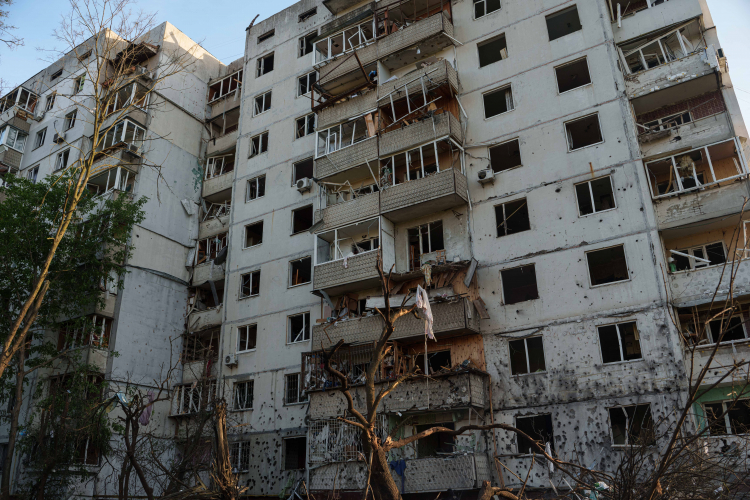
At 3:00 a.m. on June 2, a young mother fled her burning Kyiv apartment, one small hand in each of hers. Her children were five and three. Around them, hundreds of terrified residents were running too, pouring into the dark from apartment blocks that moments earlier had been homes. Three Russian Iskander-M rockets had struck the neighborhood, turning ordinary bedrooms, kitchens, and stairwells into fire, smoke, and rubble.
Then came what Ukrainians have learned to dread: the “double tap.”
According to Ihor Padiuk, head of the Shevchenkivskyi Police Department, the tactic is deliberate. The first missiles drive people out of their apartments and bring firefighters, medics, and police rushing to the scene. Then, when the streets are crowded with survivors and first responders, the Russians strike again.
This time, Padiuk said, they fired another Iskander-M missile, loaded with shrapnel pellets. Its payload can scatter as many as 30,000 pea-sized metal fragments across the open ground. The timing is the point. It is designed to catch the maximum number of people outside, exposed and defenseless, and to kill not only civilians fleeing their homes, but the men and women trying to rescue them.
The mother was killed. Her five-year-old was seriously injured and, as Padiuk said, will be disabled for life. The three-year-old survived with a concussion.
The small boy’s survival was partly because of his size. “He wasn’t a big target,” Padiuk said. But what haunted the police officer was not only the death of the mother. It was the innocence of the child.
“The three-year-old was smiling and grinning at me,” Padiuk said. "He didn't understand what was happening and thought we were playing a game. This is even though he had his mother's blood on him."
Padiuk is not a man easily shocked. He has a salt-and-pepper beard and the practiced steadiness of someone who has seen too much. “In my life as a police officer I have seen many corpses,” he said, “but I can’t get used to seeing a young child being hurt.”
At this point, Padiuk injects a moment of reality: “If we were standing right here when the cluster munitions exploded, we would be dead,” he said. “There’s no chance to survive when you get hit by the spray of these pea-sized shrapnel traveling at the speed of a bullet,” Padiuk said.
The walls around him showed what he meant. Windows even blocks away were boarded up. Metal pipes and fixtures were pocked by shrapnel. Some holes in steel pipes were deep enough that I could fit my fingertip more almost 1/2 inch deep into the hole in the hardened steel.
It's the steel-penetrating velocity that makes the pea-size shrapnel so devastating. At that speed, the fragment tears through muscle, nerves, arteries, lungs, and bone. Close enough to the blast, one tiny fragment can take off a limb.
The ambulances began arriving about 15 minutes after the first attack. Normally, Padiuk explained, each ambulance carries one seriously wounded person. That night, there were too many injured. Three people had to fit in each ambulance.
Padiuk said that the medics wanted to follow their normal protocol, stabilize the patient before leaving the scene. Padiuk ordered them to leave as soon as the wounded were inside. The had to leave immediately because another strike might come.
Padiuk's district had been hit more than almost any other. I tried to find out why the Russians are targeting the Shevchenkivskyi district. One theory I heard is that with a lot of new apartment buildings, the goal was simply to attack an area with a high density of residents. In that case, the goal would be demoralization.
Another intriguing theory is the Russians may be using maps from 30 or 40 years ago, when there was a lot of manufacturing in the area. Possibly, they thought they were attacking industrial targets.
I looked at buildings reduced to rubble and at others, blocks away, still pockmarked by shrapnel, their windows boarded over. I thought of the people who had been killed and injured on the very ground where we were standing. And I wondered how Padiuk could keep doing this work, day after day, with suffering so close he has literally touched it.
His answer was moving.
“For me, it is the best work in the world,” he said. “As police officers, we meet people at the worst moments of their lives. They are frightened, wounded, grieving, or in danger. And when our training gives us the ability to help them, then there is no more meaningful work.”
Later, amid streets where shops had been reduced to rubble, there were two signs of normal life. A McDonald’s had been flattened and rebuilt, and there amidst the rubble, cars were lining up at the rebuilt drive-through. It felt like a small sliver of normalcy.
And there was also something else that seemed to me particularly Ukrainian. Near a subway entrance that had survived, I saw a flower shop. At first, it seemed almost impossibly out of place. Around it were buildings too wrecked to rebuild. But inside, there were shelves of flowers: pink and purple peonies, red and white roses, and what I think were pink hydrangeas. In the middle of ruins, someone was keeping beauty alive.
Beauty is one of the things that makes life worth living. Putin’s bombs may be meant to crush the Ukrainian spirit, but amid the shattered glass and broken concrete, people are still choosing roses, peonies, and hydrangeas.
Mitzi Perdue is a journalist and war correspondent. She has reported extensively from Ukraine and is the co-founder of Mental Help Global, an initiative using AI to expand access to mental health support in conflict-affected regions.
