




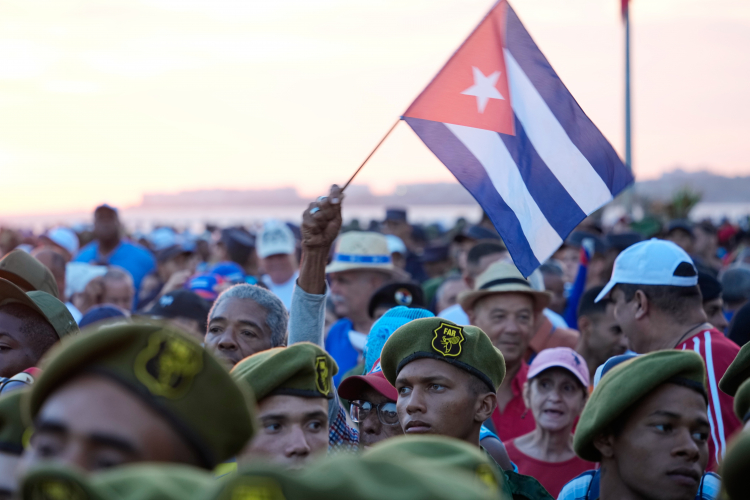
On June 19th, Cuba's National Assembly unanimously approved 176 measures that privatize a vast swath of its socialist economy, the single largest change to the Cuban model since Fidel Castro took power in 1959. Private real estate development, joint-stock companies, private banks, foreign ownership stakes in state enterprises, fast-food chains, all of it approved in a single session by a Communist Party that spent sixty-five years treating private capital as ideological poison.
The coverage framed it as economic desperation, which is accurate but incomplete. Cuba did not privatize its economy because it discovered the virtues of markets. It privatized because a web of dependencies that kept the regime solvent for two decades reached the point where the cost of maintaining it exceeded the value, and the only actor capable of absorbing that cost decided it was no longer worth paying.
Start with the energy. Cuba ran on Venezuelan oil, roughly 27,000 to 35,000 barrels per day, moved through a shadow fleet of aging tankers operating under false flags and dark transponders, exchanged for Cuban doctors and intelligence personnel. That arrangement collapsed this year. Since December 2025, U.S. forces have seized at least seven tankers tied to the Venezuelan oil trade, holding roughly seven million barrels. France intercepted a shadow fleet tanker in the Mediterranean. India seized three more. European authorities, by their own account inspired by the American Caribbean blockade, escalated their own interdictions. The result on the ground in Havana is stark. Since the beginning of 2026, exactly one oil tanker from Russia has docked on the island. Blackouts now run up to twenty hours a day.
The energy collapse is not an isolated misfortune. It is one node in an architecture. Venezuela supplied the oil and the cash. Cuba supplied the intelligence infrastructure, including signals collection facilities the Center for Strategic and International Studies has identified ninety miles off the Florida coast, monitoring American military sites including Cape Canaveral. Iran supplied the proxy network and the global reach. And China financed the whole structure, lending Venezuela roughly sixty billion dollars across a decade, building surveillance systems for Havana, and converting Iranian oil into a discounted energy supply through the same shadow fleet now being interdicted.
That architecture had a purpose beyond any single country. It was designed to make American pressure on any one node absorbable by the others. Squeeze Venezuela and Chinese credit kept it afloat. Pressure Iran and Cuban intelligence cooperation gave it hemispheric cover. The web routed around pressure. That was the entire point.
What changed is that the pressure stopped being survivable. The Venezuelan oil blockade cut the financial engine. Maduro was captured in January. The Iranian campaign cut Tehran's exports by ninety-three percent in its final month. And the shadow fleet, the connective tissue moving sanctioned oil between all three nodes, came under coordinated interdiction by the United States and a widening coalition of partners willing to seize ships. Each severed connection raised the cost of keeping Cuba solvent, and that cost landed on Beijing.
China kept Cuba alive as long as the platform was worth the subsidy. A signals intelligence facility ninety miles from the American mainland is a strategic asset of real value, and Beijing dispatched a 60,000-ton rice shipment to Havana in May to keep the lights on a little longer. But subsidy has a ceiling. When the energy supply collapsed and the broader architecture came under sustained interdiction, the cost of propping up the Cuban state outran the intelligence value of the platform, and Havana was left to find another way to survive. Privatization is that way. It is the survival calculation of a regime that ran out of patrons willing to cover the gap.
This matters well beyond Cuba, because the hemisphere is the entire premise of American supply chain security. The case for reshoring manufacturing to North America is not primarily economic. It is geographic. Supply chains that run through the South China Sea and the Strait of Malacca run through chokepoints adversaries can threaten. Supply chains that run through the Western Hemisphere run through territory the United States can defend completely, but only if that hemisphere is not already penetrated by adversary infrastructure, adversary debt leverage, and adversary intelligence platforms operating ninety miles off the coast. Cuba's privatization is the first visible sign of that penetration receding under pressure.
The honest complication is that approval is not implementation. Cuban officials cautioned the reforms will not function unless the United States eases the embargo, and analysts note that sanctions will deter many investors regardless of what the National Assembly approves. The regime has announced sweeping reforms before and watched them die in the bureaucracy. The architecture is bending, not broken. The intelligence facilities outside Havana did not stop collecting signals because the Assembly voted, and Beijing has not abandoned its strategic objectives in the hemisphere.
But the direction is now visible, and it confirms something the architecture's critics have argued for years. The trifecta of Venezuela, Cuba, and Iran was never three separate problems. It was one structure with a single architect, and structures under coordinated pressure fail at their weakest node first. Cuba was the weakest node. It just blinked.
The board is still moving. The players who were never named in the coverage never stopped playing. But for the first time in this long game, one of the pieces is moving in the direction American strategy needed it to move.
Jacob Childress is a retired Army Master Sergeant with four combat deployments and four years supporting presidential operations from inside the White House Communications Agency across two administrations. He is a Senior TSCM Technician supporting the National Nuclear Security Administration and writes geopolitical analysis at jacobchildress.com.
