




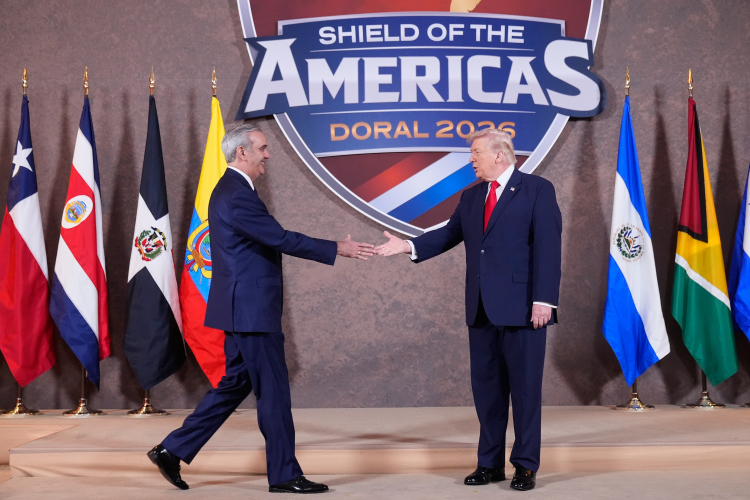
A political shift to the right in Latin America provides the first Hispanic U.S. Secretary of State and President Donald Trump a real chance not only to create alliances to break China’s foothold in Central and South America but it creates a new bloc to rollback radical policies at the UN and to break the European Union’s grip on international organizations.
Latin American governments have been a reliable ally of the left at the United Nations for the better part of the last two decades. Democrats and the EU bureaucracy have used their networks in America’s backyard to lock-in leftist priorities like climate, gender, and abortion at the UN and other regional bodies.
A recent spate of conservative victories in Colombia, Bolivia, Chile, Costa Rica, Ecuador, Honduras, and other Latin American nations presents a great opportunity for the U.S. to replace those policies. Up to ten, and possibly more, governments in the region would support conservative policies, including border security, free speech, as well as pro-life and pro-family policies.
Latin American governments play an important role in UN debates on social and economic policy because many are members of the G77, a voting bloc that represents 127 developing nations at the United Nations.
Until the 2010s, the G77 had a generally conservative posture on energy, migration, and life and family issues in UN debates. A succession of left-wing elections in the early 2010’s handed the Latin American vote at the UN to the left on every major UN agreement since then, including the 2030 Agenda, the Paris Climate Agreement, the Pact for the Future and many others.
The Trump administration has been mostly alone in its attempts to repudiate these agreements.
Only Argentina and Paraguay have voted with the U.S. The recent spate of conservative wins in Latin America raises the possibility of the U.S. finding more support.
Yet, changes to the positions of UN delegations don’t happen overnight. The fight tends to be with entrenched bureaucrats, something that is not unique to the U.S. Just because a Latin American nation elects a conservative government does not mean that its UN delegation will speak and vote accordingly. We know this from long experience, most recently from Hungary’s continued alliance with the EU at the UN during all of the sixteen years of Viktor Orbán’s rule. Delegations in the General Assembly and other UN bodies often do not reflect the political realities back home, especially when their governments are conservative.
The greatest obstacle to capitalizing on conservative political realities in the Western Hemisphere, however, will come from the European left and the EU bureaucracy. The EU has built multiple layers of control over UN policy debates through political and economic agreements in Latin America and funding for a vast network of left-wing organizations in the region. Most recently, the EU has been behind the global censorship apparatus attempting to silence conservatives. Conservatives, in contrast, are largely disengaged and ignore international mechanisms as a waste of time.
Defeating the woke agenda at the UN will require a renewed emphasis on the central tenet of the Monroe Doctrine, namely, to end all European colonialism in the Western Hemisphere. John Quincy Adams understood that so long as European powers were exerting political influence in America’s backyard, security would never be achieved.
The growing influence of the European Union in the Western Hemisphere reflects the failure of successive U.S administrations of both parties to understand the importance of this central tenet of the Monroe Doctrine. Today, Europeans provide over $4 billion annually to Latin American nations in official development assistance, which is significantly higher than the U.S. contribution . And the EU aid does not come for free, as the Europeans specifically focus all their international aid to build political mechanisms and institutions that they can control and influence.
One might think Europeans are U.S. allies. But that would require ignoring the bad EU policies that make Europeans our geopolitical rivals, including open borders, climate alarmism, legal drug use and prostitution, censorship, gender ideology, and abortion rights, just to name a few.
Allowing the EU bureaucracy to have a continued foothold in the Western Hemisphere is a threat to U.S. security. Europeans promote policies that harm societies and destabilize the region. It’s time to recognize that defeating these policies will require more than winning national elections. It will require changing the geopolitical reality of the entire Western Hemisphere and beyond.
Stefano Gennarini is the Vice President for Legal Studies at the Center for Family and Human Rights (C-Fam) a research institute dedicated to protecting national sovereignty and the dignity of the human person at the UN.
