




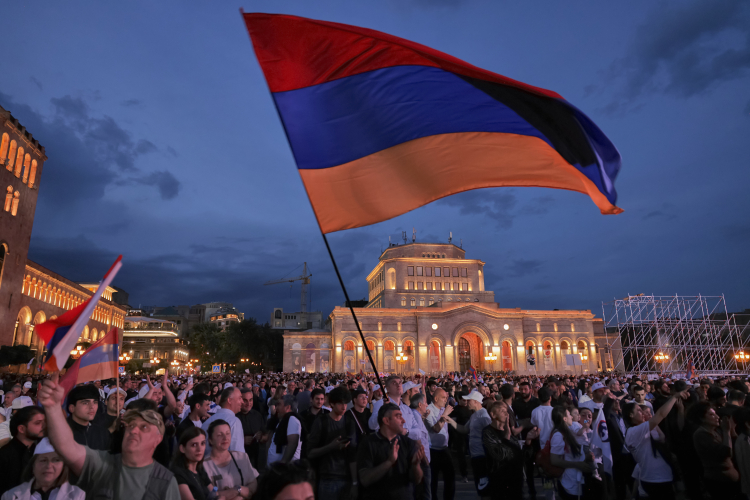
When the final ballots were counted in Armenia’s June 7 parliamentary elections, international observers breathed a familiar sigh of relief. The mechanical apparatus of democracy was held; votes were cast, tallies were processed, and initial reports suggested there was no foul play involved.
But to view this election merely through the lens of technical compliance is to miss a far more sobering reality. Armenia’s latest vote was fundamentally hollowed out by competing pressures from Washington, Brussels, and Moscow, transforming domestic self-determination into a high-stakes proxy contest between global powers.
In this hyper-polarized environment, genuine democratic choice became an illusion. Armenian voters were not choosing between competing domestic policies or civic visions. Instead, they were forced into an existential triage, navigating a playing field warped by external economic embargoes, security threats, and competing foreign assistance packages. As a result, Armenia offers a cautionary tale for the modern era: when democracy is reduced to a geopolitical battlefield, domestic political agency is the first casualty.
In recent years, Western analysts have increasingly categorized Armenia as a pivotal "swing state" in the South Caucasus—a nascent democracy attempting to break free from decades of Russian dependence to align with the West. This narrative, while appealing to democratic purists in Washington and Brussels, has had a deeply distorting effect on the ground.
During the 2026 campaign, the framing of the election became aggressively binary and transactional. On one side stood the West, offering packages like the EU’s strategic resilience funds and Washington’s Trump Route for International Peace and Prosperity (TRIPP) initiative to anchor Yerevan’s pivot. On the other side was Moscow, which openly weaponized its leverage, threatening devastating trade embargoes and explicitly warning of a "Ukraine scenario” for Armenia.
This intense foreign interference also allowed flawed, compromised candidates including Prime Minister Nikol Pashinyan to be elevated and legitimized by external backers, ultimately denying voters a true voice for their actual, everyday needs. When a sovereign election is framed by global powers as an all-or-nothing referendum on strategic alignment, local legitimacy collapses. The choices presented to the public are no longer about governance, but about power and political survival. The electoral playing field is distorted not by stuffed ballot boxes, but by the overwhelming structural weight of external actors.
This modern battle for Armenia’s democratic soul is stained by a profound and painful double standard—one that Armenian voters understand all too well. Today, global powers speak loudly about protecting democratic values in Yerevan, yet both Europe and Washington utterly failed Armenia when those values mattered most.
During the devastating wars with Azerbaijan, Western capitals offered little more than toothless statements of "deep concern." This collective paralysis culminated in a humanitarian catastrophe with a grueling ten-month blockade followed by a lightning military offensive that allowed Azerbaijan—an autocratic regime—to ethnically cleanse 120,000 indigenous Armenians from their ancestral homeland of Artsakh (Nagorno-Karabakh).
The fact that the international community has failed to hold Baku accountable for documented war crimes or the total erasure of Artsakh’s Armenian presence exposes the hollow nature of today’s geopolitical rhetoric. For the West, Azerbaijan’s Caspian gas and strategic positioning outweighed any commitment to human rights. To preach the virtues of the ballot box to a traumatized population while letting a neighboring dictator act with total impunity is a masterclass in global hypocrisy. It reveals that to the major powers, Armenian democracy is only worth defending when it serves as a weapon against a rival bloc.
This dynamic creates a profound democratic paradox. To withstand aggressive external coercion—such as the massive covert disinformation campaigns and economic blockades deployed by Moscow—a small state often relies on intense counter-balancing support from Western capitals.
Yet, this very reliance deepens the perception that local leadership is acting as an agent of foreign interests, fueling domestic polarization and alienating large swaths of the electorate.
The result is a quiet erosion of democracy that leaves no paper trail for election monitors to flag. When the fundamental debate is reduced to whether a nation will be suffocated by its traditional ally or protected by distant partners, the needs of the populace are completely drowned out.
Armenia’s predicament is not unique; it is a preview of a broader systemic crisis facing small democracies worldwide. As the global order fractures into rigid, competing blocs, smaller nations find themselves squeezed in the middle.
If global powers genuinely wish to support democracy, they must stop treating small nations as chessboards. Until the international community allows small states the strategic breathing room to govern based on domestic agency rather than geopolitical survival, the ballot box will continue to serve as a mirror for global rivalries, rather than a voice for the people.
Stephan Pechdimaldji is a communications strategist living in the San Francisco Bay Area. He is a first-generation Armenian American and grandson of survivors of the Armenian genocide. You can follow him on X at @spechdimaldji
