




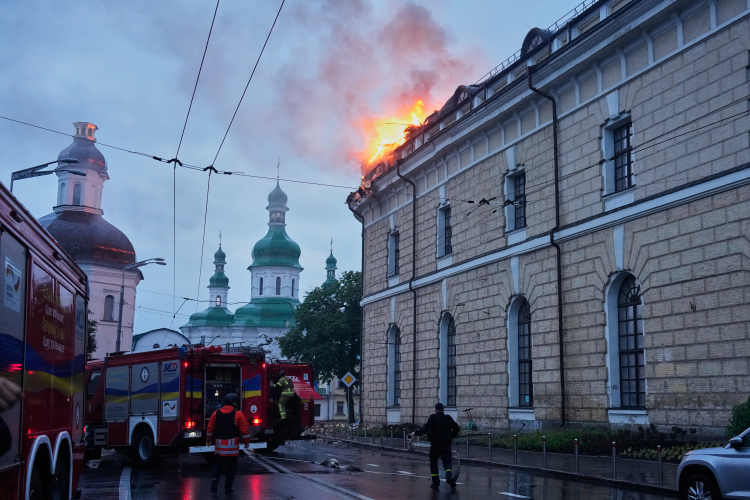
This week, my train from Warsaw to Kyiv arrived five hours late. We had to pause because of the threat of Russian drone attacks on Ukraine’s railroads.
For me, this meant inconvenience. For Ukrainians, it is part of something much larger: a war that reaches into the machinery of ordinary life: rail lines, power systems, schools, apartment buildings and bedrooms. The same Russian campaign that can stop a train in daylight can, after midnight, send families into the corridor because a drone with a 100 kg payload may cause the outside windows to shatter. That is why Vadym Pavlovsky, a Kyiv social worker, and his family pull a mattress into the corridor of their apartment building when the sirens begin.
Wars are usually measured in territory gained, missiles launched, dead and wounded. But Russia is also waging a war on sleep. It is trying to exhaust a nation.
“In previous years,” Pavlovsky told me, attacks on Kyiv often came in “onesies and twosies.” Now it can be what happened on June 2, when Russia launched 656 drones and 73 missiles overnight. The strikes killed at least 22 people and injured more than 130. The targets included Kyiv and other cities, and it meant millions of individuals facing the workday, sleep-deprived and exhausted.
Pavlovsky talks about what those sleepless nights are like. "First there is the siren. Then the sound of drones or missiles. Then the bangs. The windows shake. The shock waves get closer together. You hear “bang, bang” and then the one that feels as if it is right above your head."
The attacks most often come between midnight and 5 a.m. The Russians design these attacks to cause maximum sleeplessness. Pavalovsky and his wife used to go to bed around 11:00 pm but now they go to bed at 9:00 pm, knowing that this way they might get an extra couple of hours of sleep before the bombing begins.
His wife teaches school. At her school, he reports, some teachers are having panic attacks two or three times a day.
"It's different from even a year ago," Pavlovsky told me. "Before when there were one or two bombs, their payload was only 10 kilograms. Today with waves of drones, 100 at a time, and with payloads of 100 kilograms, it creates a different level of anxiousness, and it's getting to people."
He went on to explain, "When drones carried a smaller payload, the damage they caused was mostly cosmetic, like shattered windows or cracked walls. Now with 100 kg payloads (thats 221 pounds of explosive material) they can collpse walls and floors. We used to have 'two walls rule.' that is, first wall takes the explosion, and the second wall shelters you from it. Now, this rule no longer works because with this amount of explosives, it can knock down rows of walls."
Pavlovsky is sure the Russians' goal is to exhaust and demoralize the people. “When you haven't slept, productivity falls and this damages the economy. The Russians are not doing anything randomly or stupidly.”
A missile strike is not over when the fire is out. It continues in the next day’s classroom, where a teacher is trying not to unravel. It continues in the office where a sleep-deprived worker stares blankly at a screen. It continues on the train where everyone misses their appointments because the train arrived five hours late
After years of war, many Ukrainians no longer run to shelters every time the alarm sounds. It's fatigue plus with ballistic missiles, there may be only minutes of warning anyway. It's surprisingly common to develop the attitude, “What happens, happens.”
Yet Pavlovsky is not describing a defeated country. He is describing a country that is fraying and functioning at the same time. People still go to work. Children still go to school. Trains still run, even if late.
Still, everywhere I went, I saw something else.
Almost every Ukrainian woman I saw seemed to have a manicure. Often the colors were blue and yellow, the colors of the Ukrainian flag. In neighborhoods scarred by bombardment, I passed flower shops still selling roses, peonies and bouquets to people who still treasured beauty.
It seemed like an element of defiance. Putin can bomb buildings, delay trains and force families onto mattresses in corridors. He can steal sleep and try to make tomorrow feel unbearable. But in Kyiv, the flowers are still for sale, the nails are still painted blue and yellow, and the people carry on.
Mitzi Perdue is a journalist and war correspondent. She has reported extensively from Ukraine and is the co-founder of Mental Help Global, an initiative using AI to expand access to mental health support in conflict-affected regions.
