




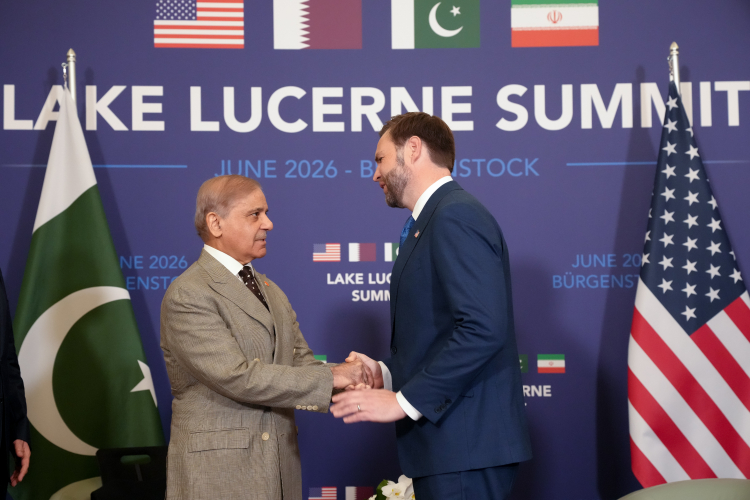
The United States and Iran confrontation has been among one of the most volatile and complex rivalry in international politics. Started from 1979, decades of mistrust which expanded to bilateral tension and eventually to a multi-layered strategic contest that involves nuclear issue, regional instability, economic sanctions, and the security of one of the most significant trading passage of the world, Strait of Hormuz. In such a challenging environment, a little miscalculation or escalation could involve multiple regional and global actors who are at stake.
Pakistan’s role in mediating the U.S.-Iran crisis gains significance. Pakistan's strategic positioning has made it a “Connective State” between adversarial blocs that rarely communicate directly. Its role is not only about diplomacy, but also structural suitability. India has a greater economic advantage and stronger recent alliance with U.S., Pakistan’s network positioning and multi-vector relationship with West and gulf countries made it more suitable in most challenging and high-risk negotiations. Mediation between Iran and U.S. depends more on connectivity rather than strength and economy. Pakistan has long maintained its relationship with U.S. on the basis of security and counterterrorism cooperation. Whereas it shares border with Iran and having strong coordination on energy and security. Similarly, Pakistan has maintained working channels with other actors involved in the conflict such as it has strategic partnership with China and good economic and defense terms with gulf countries.
India is an emerging power and has a high stake in its global partnerships. It has strategic alliances with U.S. and is part of QUAD. On other fronts, it is in state of competition with China and it has major energy dependence of gulf stability. Diplomatic failure for India can cost its image of so-called emerging power. Failure in mediation could damage its claimed narrative of global leadership. So mediation between U.S.-Iran crisis was less attractive for India as it has no border sharing with Iran or any other major dependency over them.
In mediation theory, legitimacy typically trumps power; Pakistan benefits from being perceived as an intermediate player rather than a hegemon. The conflict between Iran and U.S. signify the overlooked reality of modern diplomacy where mediation is not dependent on economic power and military size, but it relay on state’s diplomatic connectivity and ability to communicate in a better way even among most rival states. Pakistan has proven that how diplomatic connectivity become the strategic assets for a state.
On geopolitical front, Pakistan geography makes it more suitable for a mediator role as it shares 900 kilometer long border with Iran, any instability in Iran could trigger Pakistan into a crisis whether it is political, economic, or geographical. Pakistan has already long paid the price of huge refugee reflex from Afghanistan in result of instability and war in Afghanistan. So, any escalation in a neighbouring state once again can push Pakistan into border insecurity and refugee pressure. This could be the one reason behind Islamabad’s motivation to de-escalate the crisis.
A successful mediation requires the trust from all parties involved in the crisis. Pakistan has maintained functional relations with U.S. and diplomatic engagements with Iran despite regional tensions. This makes Pakistan more credible to play a neutral role without being perceived as fully aligned with either side. Pakistan's suitability was strengthened by its special relationship with China. Despite its vast economic and diplomatic might, Beijing did not strive to supplant Pakistan as a mediator. Instead, Chinese officials frequently praised Islamabad's mediation efforts and urged Pakistan to further up its role in fostering communication between Washington and Tehran. Chinese Foreign Minister Wang Yi openly applauded Pakistan's mediation efforts and reiterated his support for dialogue and regional stability.
Pakistan's position is better understood through the prism of middle-power diplomacy. According to international relations literature, good mediators are frequently individuals who can establish working ties across different geopolitical groups rather than the strongest powers. States like Qatar, Norway, and Oman have consistently proved that diplomatic importance may be derived from credibility and access rather than military or economic power. Pakistan's mediation falls within a larger trend of middle-power conflict resolution.
Another factor that might have increased Pakistan's diplomatic clout was the perceived strengthening of ties between Washington and Islamabad under President Trump. Personal connection and direct interaction channels are often important in crisis diplomacy, especially when formal diplomatic processes are under pressure. While institutional elements remained more essential than individual ties, President Trump's expanding involvement with Field Marshal Asim Munir is likely to have facilitated trust and communication during a delicate moment.
Historically, Pakistan have good military terms with U.S. but this newest show of improving ties comes after Pakistan lavished praise on President Trump's apparent attempts to negotiate a truce between India and Pakistan in May 2025. In result of that, Pakistan formally nominated Trump for the Nobel Peace Prize in a same month.
The mediation was more than just about averting military escalation. It was also about securing one of the world's most important energy corridors. The Strait of Hormuz transports approximately one-fifth of world oil trade; therefore, any interruption is a global economic concern. The reopening and stabilization of Hormuz changed Pakistan's mediation from a regional diplomatic exercise to an issue of global economic security implications.
Mediation may not fully eliminate the underlying causes of the conflict but it helps to create the diplomatic space and reduce the escalation risk during the crisis. Facilitating the dialogue during the period of devastating crisis is a meaningful diplomatic achievement. The significance of Pakistan’s mediation is not restricted to the crisis but it goes beyond the crisis as it highlights the less spoken reality in the international system where diplomatic influence can be exercised best by states capable of bridging the geopolitical divides rather than only major powers.
Ultimately, Pakistan’s role reflects a broader shift in international politics. In an era marked by strategic rivalry and limited communication between competitors, the ability to unite opposing camps may prove more useful than traditional measurements of strength. Pakistan's participation in the U.S.-Iran conflict highlights how network positioning, legitimacy, and diplomatic access may influence actions in ways that military and economic power cannot.
Sara Nazir is a researcher and scholar in Strategic Studies, currently serving in the Ministry of Defense, Pakistan. She also worked as visiting faculty in the IR department of IIUI. She holds a Gold Medal in MS degree and has a number of national and international publications. Most notably, on current issues of South Asia.
