




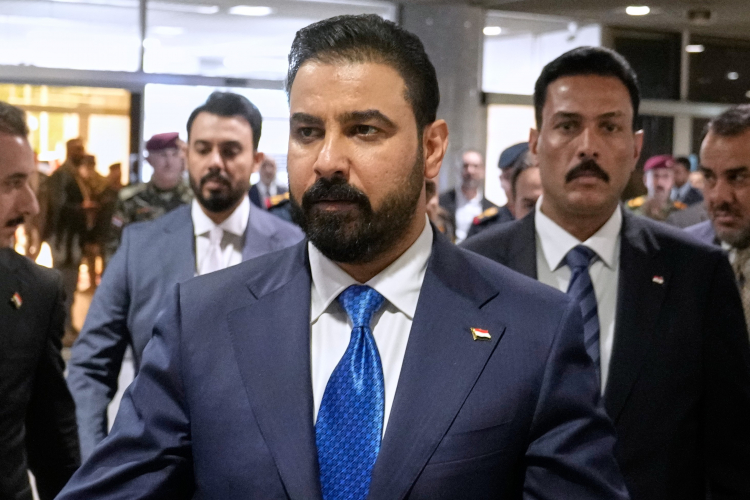
Iraqi Prime Minister Ali al-Zaidi, only two months into his term, has a busy month of foreign engagements. In early July, he received the body of slain Iranian Supreme Leader Ali Khamenei which was visiting Iraq’s holy cities, Najaf and Karbala, before burial. Meanwhile, Zaidi and his team were earnestly preparing for his first official foreign visit to Washington, scheduled for only a week after the funeral, beginning on July 13.
Ahead of his visit to the United States, Zaidi announced wins on two big priorities for Washington: militia disarmament and countering corruption. Iran-backed militias in Iraq, many designated terror groups, as well as the country’s rampant corruption have enabled Tehran’s influence—something the Trump administration is hoping to unravel. However, it’s uncertain whether these professed wins will amount to substantial progress or are merely attempts to appease Washington. As the visit of Khamenei’s body demonstrates, Iran’s influence still permeates the country.
Despite the abnormality of a leader’s body visiting a foreign country—Iran’s previous Supreme Leader Ruhollah Khomeini’s funeral didn’t include a trip abroad—this trip isn’t shocking. Iraq, like its neighbor, is a majority Shia country, and the cities on Khamenei’s funeral procession are major holy cities for the religion. But this visit is about more than Khamenei’s body taking a final trip to holy shrines. Iran is hoping to demonstrate both the strength of its popular support in Iraq and the extent of its influence in elite circles.
Meanwhile, Zaidi is attempting to prove his independence to Washington. Winning concessions from militias on arms was the first “proof” that he deserved the confidence that the Trump administration has placed in him. Next, by arresting political leaders on corruption charges, Zaidi signaled he was willing to take on the country’s systemic issues.
A month after the announcement of disarmament by three militias, major questions about how these Iran-backed armed groups will disarm and integrate into legitimate security organizations will proceed remain unanswered. Asaib Ahl al-Haq and Kataib Imam Ali, two U.S.-designated Foreign Terrorist Organizations (FTO), announced on June 2 that they would hand their arms over to the Iraqi state and integrate fighters into official security institutions. This came after Saraya al-Salam, the militia belonging to Iraqi cleric and popular leader Muqtada al-Sadr, announced that his group would integrate its fighters into the state’s security apparatus. The declarations were met with applause from the new government in Baghdad and Ambassador Tom Barrack, Washington’s Special Envoy for Syria and Iraq, but the enthusiasm may have been premature.
There are still questions about the militias’ weapons which they are supposedly handing over to the state, but which weapons? And to whom? These militias also control brigades in the Popular Mobilization Forces (PMF), an official Iraqi security institution dominated by Iran-backed militias. Despite its status as a legal security organization, the PMF’s constituent militias often conduct attacks not only without permission from the Iraqi Prime Minister, but often explicitly at odds with government statements of neutrality in regional conflicts. The groups say they will separate from the PMF, but they have yet to detail what that means. Will the militias simply stop overtly associating themselves and their brand with their PMF brigades? Will the PMF command structure or brigade commanders change?
Technicalities, though important, aside, the decision begs big picture questions about the future of the PMF, which has been a major vehicle for Iranian influence under the guise—and financing—of an Iraqi government institution. The militias may view detaching their brand from the PMF as a way to protect the institution and enable its fighters to continue as before. Qais Khazali, head of Asaib Ahl al-Haq and a Specially Designated Global Terrorist, shared an impassioned defense of the organization on June13 and reiterated calls for legislation strengthening the PMF. His statement explicitly rejected disarmament or dissolution of the PMF. This only further demonstrates the importance of questions about how disarmament will truly be meaningful if an entire official organization is permitted to operate without an effective Iraqi chain of command.
Similar to how voluntary disarmament leaves key behemoths in the militia landscape intact, the corruption campaign has not targeted Iran’s main allies in Iraq’s political or economic spheres. It has become a sort of tradition in Iraq that the new government declares it will be different and will take on the systemic graft that has robbed the Iraqi people. The announcement is followed by a wave of arrests targeting corrupt members of the previous government who are promptly replaced by allies of the new, equally willing to exploit their positions for profit. Zaidi has yet to prove that his government will be any different.
While the names of those arrested in the corruption campaign, reportedly around 70 individuals, have not all been disclosed, the targets seem to come from two main camps: former Prime Minister Mohammad Shia al-Sudani’s allies and the Sunni al-Azm Alliance. Sudani is an expected, and frankly easy, target. His administration has faced corruption allegations before, and, now out of office, he has limited power with which to protect his cronies. Likewise, the leaders and members of the Sunni al-Azm Alliance are not figures Iranians will lose sleep over.
Unless and until the corruption campaign, which in fairness to the new government is supposedly not over, targets Iran’s allies who pilfer huge sums from Iraq’s coffers for their own benefit and that of their partners in Tehran, it will be no different than past attempts to clean house. So far, some of Iran’s allies who have been the biggest contributors to the system corruption have cheered on this anti-corruption effort—not a good sign.
Only time will tell if Zaidi’s efforts are a substantive threat to Iran’s influence over its neighbor or just signaling. In his visit to Washington, President Trump should not congratulate him on a job well done but rather offer American support for a daunting mission that is only just beginning. Zaidi hopes to expand economic partnership with Washington, but President Trump should require the new government to materially demonstrate its commitment to confronting Iran’s malign influence before the transforming the U.S.-Iraq relationship.
Bridget Toomey is a research analyst at the Foundation for Defense of Democracies. Behnam Ben Taleblu is senior director of FDD’s Iran Program
Comment
Show comments
Hide Comments
