




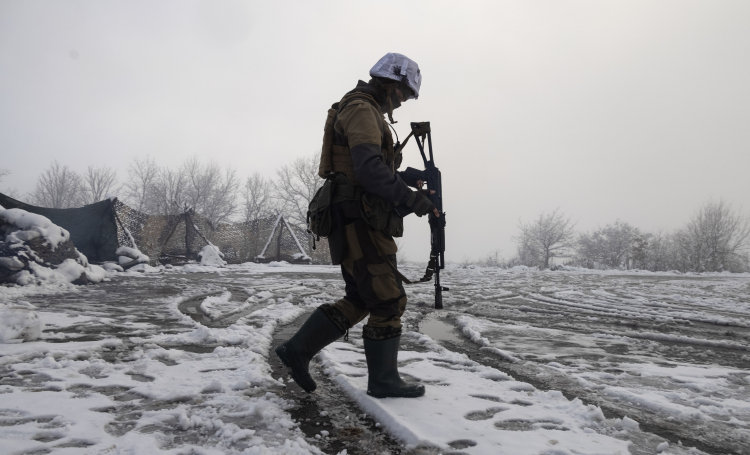
In the fields outside Donetsk, Russian soldiers have started riding into battle on horseback. Not to move supplies, though they are using donkeys and camels for that. To assault Ukrainian positions. The drone kill zone near the front has made vehicle movement so lethal that mounted men galloping across open ground is now, by the grim math of the battlefield, a rational choice. Ukrainian drones find them anyway. Russian state media has praised the tactic as a historic return of the cavalry. That sentence would have read as satire in 2022. It is documented in footage from both sides in 2026, and it is the single clearest image of what four years of war has done to the second-largest military on earth.
The numbers underneath that image are staggering. Russia has sustained roughly 1.2 million permanent losses since February 2022, including more than 500,000 dead, according to a Netherlands military intelligence assessment that carries the weight of a NATO service rather than a combatant with a reason to inflate the figure. To put that in perspective, the Soviet Union lost 27 million people over four years fighting the most mechanized military in history at the peak of its power. Russia has now lost more than a million men in the same span of time fighting a country with no meaningful air force, a fraction of its economy, and an army that four years ago existed mostly on paper.
The equipment losses tell the same story with photographs attached. Oryx, which counts only what it can visually verify, has documented more than 14,000 Russian tanks and armored vehicles destroyed or captured and over 23,000 pieces of military equipment lost across all categories, and the real totals run higher than anything a camera happened to catch. Russian production runs almost entirely on refurbished Soviet-era hulls now, a few hundred modernized vehicles a year against monthly losses that make the figure almost meaningless. A military consumes its future when it burns through inventory faster than it can build, and Russia has been doing exactly that for years.
The manpower math has become worse than the equipment math. Russia loses roughly 35,000 troops a month and recruits around 24,000, a gap that widens with every offensive. The Kremlin's answer has been to build the most elaborate covert mobilization machine in modern Russian history while carefully avoiding the word mobilization, because it remembers September 2022, when a formal call-up sent more than 260,000 men fleeing across the border in a matter of days. The new system flags draft-age men in border databases the moment a digital notice is issued, closing the exits without a decree. Street roundups in Penza this June pulled men off the sidewalk to sign contracts. A sitting member of Russia's own Duma has publicly warned of a fresh mobilization wave coming in autumn. The machine is built. The order simply has not been given, and the widening casualty gap is the reason it eventually will be.
Here is what all of that cost the United States. Zero American combat deaths and roughly $175 billion in military aid across two administrations. The number sounds enormous until you set it beside something familiar.
In the 1980s, a Texas congressman named Charlie Wilson used a seat on the defense appropriations committee to funnel covert money to the Afghans fighting Soviet occupation. The operation peaked around $750 million a year and helped humiliate the Soviet military badly enough to accelerate the collapse of the USSR itself. Adjusted for inflation the whole thing ran about $10 billion over thirteen years, with zero American combat deaths and a strategic payoff that reshaped the century. It is remembered as the most cost-effective proxy investment of the Cold War, and it came with one honest caveat worth stating plainly. The blowback was real. The insurgency we armed outlived its purpose and produced the Taliban, al Qaeda, and eventually the trillions and two decades it took to answer September 11.
Ukraine is the version of that bet without the poison built in. There is no insurgency being armed, no occupation being propped up, no nation-building bill waiting to come due. A functioning state is defending its own borders with its own soldiers, and for that $175 billion and not one American life, the conventional military power of a primary American adversary has been reduced to a shadow of its February 2022 self. Russia's ability to threaten NATO's eastern flank, to move on Europe, to be taken seriously as a peer competitor by the defense establishments that spent the Cold War planning around it, was broken in the fields of eastern Ukraine rather than on a NATO battlefield. The United States spends about $900 billion a year on defense. Ukraine has cost roughly six cents on every dollar of a single year's budget to degrade one of the two adversaries that budget exists to deter, and the political system nearly refused to keep paying it.
The battlefield outcome is only half the return, and the other half is the part Washington has been too distracted to notice. By stepping back, the United States has handed away its place at the front of the most important military technology shift since the precision-guided munition. Drone and counter-drone development is now a Ukrainian and European enterprise. More than 200 Ukrainian drone companies have stood up since 2022, and Ukrainian defense exports are climbing into the billions as partners across Europe and the Gulf compete to buy into the production. China studies every innovation cycle and folds the lessons into PLA programs. The one major power going out of its way not to keep pace is the United States.
The ripple reached a place nobody would have predicted. Japan, which wrote a ban on lethal weapons exports into its posture after the Second World War, scrapped that ban outright on April 21, 2026, clearing the way to export fighters, missiles, destroyers, and combat drones. A Tokyo drone firm had already begun fielding a jointly developed interceptor with a Ukrainian unit four days earlier. Russia summoned the Japanese ambassador to lodge a formal protest, and when the Kremlin starts complaining about a country's startup investments, the country has touched something that matters. The nation that wrote pacifism into its constitution is exporting weapons into an active war because standing still had become more dangerous than moving. Beijing watched that calculation happen in real time.
Then came Venezuela, and the lesson it taught the global arms market may outlast the operation itself. Venezuela fielded one of the more advanced layered air defense networks in Latin America, built almost entirely on Russian systems, including S-300 long-range missiles and Buk-M2E batteries, the same families of hardware Russia relies on to defend itself. On January 3, more than 150 American aircraft entered Venezuelan airspace. None were shot down. The S-300 batteries were not even linked to radar when American forces arrived, their network blinded by cyber and electronic warfare before it could mount a meaningful response. Secretary Hegseth noted afterward, dryly, that the Russian air defenses had not worked so well. Every defense ministry that has spent a decade buying Russian systems on the promise that they would hold off exactly this kind of attack now has footage suggesting otherwise, and every arms deal Moscow was counting on to stay solvent just got harder to close.
That is the thread that runs underneath the whole conflict and connects it to everything else moving across the board. Russia was supposed to be China's strategic peer, a European pressure valve that would complicate American planning in the Pacific. Instead it has become a dependent client running on Chinese factory output, North Korean infantry, and Putin's refusal to stop. When Putin flew to Beijing on May 19, days after an American president had stood in the same city, China used Moscow's weakness to press for favorable energy pricing Russia is in no position to refuse. Xi received both men the same week with the same ceremony, which tells you exactly who is managing whom. Russia, Iran, Venezuela, and Cuba were never four separate problems. They were one architecture with a single architect in Beijing, and Ukraine is where the load-bearing member of that structure is being quietly cut. What that means for China's own calculus, its closing demographic window and its read on American capability after watching Russian systems fail in Venezuela, is the subject the next pieces in this series take up.
Both parties in Washington decided none of it was worth the trouble. On May 13 a discharge petition hit its 218th signature and forced a floor vote on $1.3 billion in Ukraine aid over the Speaker's objection. All 215 Democrats signed. Two Republicans joined them, Fitzpatrick of Pennsylvania and Bacon of Nebraska. The deciding signature came from a California Republican who had already left the party to sit as an independent. The party that spent two generations building the very alliance a degraded Russia most benefits could not find three members to fund the cheapest security investment that alliance has ever been handed.
China is not ten feet tall. It is a rational state with a narrowing demographic window, a damaged primary partner, air defense systems that just failed on camera, and a real estate crisis it has not solved. The United States is not staring down an invincible rival. It is staring at a closing window, and the dysfunction holding that window open longer than it needs to stay open will eventually produce a bill. When it arrives it will not carry a zero in the casualty column, and it will cost a great deal more than $175 billion.
Jacob Childress is a retired Army Master Sergeant with four combat deployments and four years supporting presidential operations from inside the White House Communications Agency across two administrations. He is a Senior TSCM Technician supporting the National Nuclear Security Administration and writes geopolitical analysis at jacobchildress.com.
