




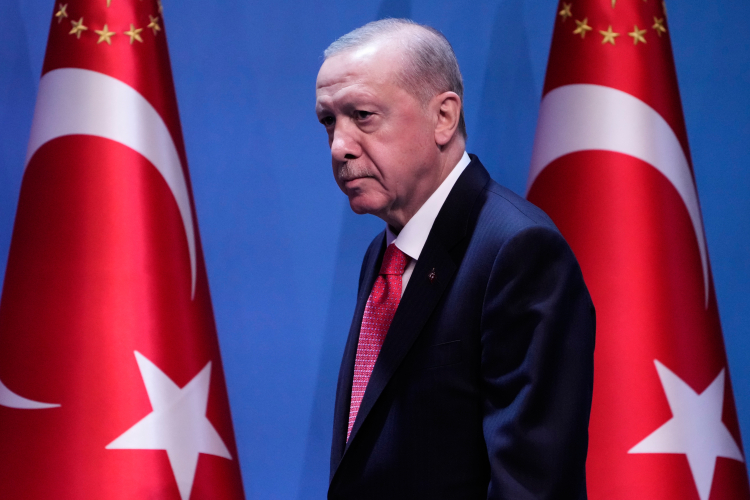
Turkish President Recep Tayyip Erdogan is no stranger to the machinery of repression. He has throttled internet providers, monitored political opponents, and folded once-independent media into a loyalist chorus. Now he is turning to China to tighten his grip on the information space—and Washington and Brussels should take notice.
Chinese telecom giants have quietly become fixtures of Turkey's digital backbone. ZTE and Huawei hold large, and in some cases controlling, stakes in Netaş, Turkcell, Türk Telekom, and Vodafone Turkey—the country's four largest carriers. China is already Turkey's biggest source of imports, supplying nearly 14% of the total, much of it telecommunications equipment and electronics. Beijing isn't dabbling in Turkish infrastructure; it is buying control of it.
The timing is not coincidental. As Chinese capital has flowed into Turkish telecom, Ankara has advanced legislation to expand government monitoring of social media and personal data. Pending proposals would force users to verify their accounts with national ID numbers, restrict access to VPNs, and grant the state the power to block individual users for political speech or to shutter entire websites outright.
This should worry anyone who has watched ZTE and Huawei operate elsewhere. Both firms have been tied to a campaign of internal repression inside China and identified as extensions of the People's Liberation Army's interests. ZTE has exported censorship tools to prop up the repression of Iranians and crackdowns in Cuba, and has separately been caught violating North Korean sanctions. Layering that track record onto Erdogan's new legislative toolkit will only accelerate Turkey's authoritarian drift.
The stakes are sharpened by Erdogan's own political clock. He is nearing the end of his current term and is constitutionally barred from running again. Speculation is rife that he intends to change that. He has two possible routes: amend Article 101's two-term limit, as he did in 2007 and 2017, or push parliament to call early elections, which would reset his term count and let him run again. AKP officials may prefer the electoral route as the more palatable option, though either path requires a three-fifths parliamentary majority that his coalition does not currently command on its own.
Whichever mechanism he chooses, Erdogan will want the appearance of a legal process rather than a bald power grab. But the result is the same either way: a one-man system in which media, courts, and now telecommunications infrastructure all answer to the presidency. A leader working to outrun his own term limits has every incentive to deepen his dependence on the very surveillance tools that keep dissent in check. Chinese technology delivers exactly that.
The risk extends well beyond Turkey's borders. Ankara is hopeful of selling more defense technology abroad—to Malaysia, Azerbaijan, Saudi Arabia, Qatar and the United Arab Emirates, among others. But Chinese firms embedded in Turkish networks will have access to data on millions of Turkish citizens and on the defense contractors themselves. China has already been linked to reverse engineering Turkish military drones; it is reasonable to assume Beijing holds other sensitive engineering data as well.
Turkey is also seeking access to the European Union's €150 billion Security Action for Europe initiative, which would channel major European investment into Turkish-made defense equipment. Given the depth of Chinese penetration into Turkey's telecom sector, that funding should be withheld until Ankara demonstrates it can curb Beijing's influence over its critical infrastructure.
Erdogan is aligning Turkey more closely with China to extend his hold on power and narrow the space for political opposition at home. That is a dangerous bargain for a NATO member to strike. Chinese censorship infrastructure has no place inside an alliance built on the premise of open societies and common secrets. Washington and European capitals need to make clear that continued defense and technology cooperation with Turkey cannot coexist with Ankara's growing reliance on Beijing's surveillance state.
Tyler Stapleton is senior director of congressional relations at FDD Action. Sinan Ciddi is a senior fellow and director of the Turkey Program at the Foundation for Defense of Democracies (FDD).Follow them on X @SinanCiddi and @Ty_D_Stapleton
