




The Golden Arches Theory of diplomacy has taught that “no two countries with a McDonald’s have ever gone to war with one another.” While that theory hasn’t held 100 percent since Thomas Friedman introduced it about 30 years ago (mostly because of Vladimir Putin), the premise is basically sound: thriving economies tend to prevent shooting.
This is something to keep in mind as we consider ways to reorient current relationships away from just military spending while finding other opportunities to strengthen allies. I was reminded of this last month when Israeli Prime Minister Benjamin Netanyahu surprised a lot of people when he told 60 Minutes he was going to wean his country off of U.S. foreign aid. He said:
“I’ve said this to President Trump and I’ve said it to our own people: their jaws drop. I want to draw down to zero the American financial support, the financial component of the military cooperation that we have. Because we receive $3.8 billion a year. I think that it’s time that we wean ourselves from the remaining military support.”
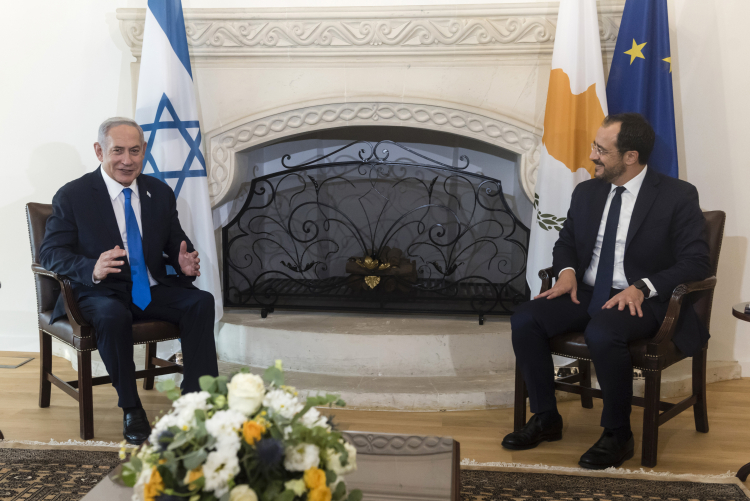
And to help Israel better stand on its own, there’s some radically sensible legislation kicking around Washington right now. The Eastern Mediterranean Gateway Act aims to deepen U.S. cooperation with key Eastern Mediterranean countries — notably Greece, Cyprus, and Israel — to strengthen energy security, transportation connectivity, and regional defense coordination tied to the India-Middle East-Europe Economic Corridor framework. IMEC promotes supply chain security, trade efficiency, and long-term growth through regionally integrated infrastructure development.
IMEC is widely seen as a way of countering China’s so-called “Belt and Road” initiative, but it would also allow for trade out of the Middle East that avoids Iran’s stranglehold on the Strait of Hormuz.
Something that’s particularly encouraging is how bipartisan the legislation is shaping up to be. The Senate bill, S.4443, was introduced by Sen. Cory Booker (D-NJ) and Sen. Dave McCormick (R-Penn). Of the remaining eight cosponsors, four are Democrats and four are Republicans. The House bill, HR.3307, introduced by Representatives Brad Schneider (D-Ill.) and Gus Bilirakis (R-Fla). Of the remaining cosponsors, 16 are Republicans and 18 are Democrats.
The bill sailed through the House Committee on Foreign Affairs by a 45 to 2 vote in January. The Senate version was advanced at a Senate Foreign Relations Committee markup in June. Looking into the details, the Eastern Mediterranean Gateway Act will:
- Highlights the “3+1 framework” – Greece, Cyprus, and Israel plus the United States – to maintain continued U.S. leadership in the region.
- Requires the Secretary of State to institutionalize dialogue among the U.S. and these three countries, while prioritizing the Eastern Mediterranean in U.S. foreign policy.
- Calls for Secretaries of State and Energy to report to Congress on regional energy projects and defense cooperation, such as the Cyprus Center for Land, Open-seas, and Port Security, which has the awesomest acronym in the history of DC acronyms: CYCLOPS.
Helping Israel become financially independent now is essential. A Gallup poll from February 2025 showed a contrast of 50 points on Israel between Democrats and Republicans: 83 percent of Republicans view Israel favorably while only 33 percent of Democrats do. Indeed, being anti-Israel seems to be a requirement for winning primaries in the modern Democrat Party. Indeed, baby-faced jihadist/New York City Mayor Zohran Mamdani pledged he would order the NYPD to arrest Netanyahu if he set foot in the city – a chilling sign of the radical direction Democrats are on right now.
Make no mistake: whoever the Republican candidate in 2028 is, he will be pro-Israel – whoever the Democrat candidate is, he, she, they, zie, or whatever will be anti-Israel.
But while President Trump is overwhelmingly pro-Israel, fringe voices on the far right are slowly eroding conservative support for the country. Anything that helps Israel now, while most of Congress still backs her, is essential for the nation’s long-term survival.
Facilitating an enduring partnership among these three Mediterranean countries is also important for curtailing Turkish aggression. Turkey is doing a wonderful job of 21st-century fence-sitting, where they say they want to help NATO one day and help Iran the next. President Recep Erdoğan has delusions of grandeur about rebuilding the Ottoman Empire, and the Eastern Mediterranean Gateway Act will help prevent his Ottomans from having a leg to stand on.
The Eastern Mediterranean Gateway Act is a long-term solution to not just Israel’s future, but the region’s stability. It needs to advance through Congress and to the President’s desk.
Jared Whitley is an award-winning writer and longtime DC politico, having worked in the US Senate, White House, and defense industry. He has an MBA from Hult business school in Dubai.
