




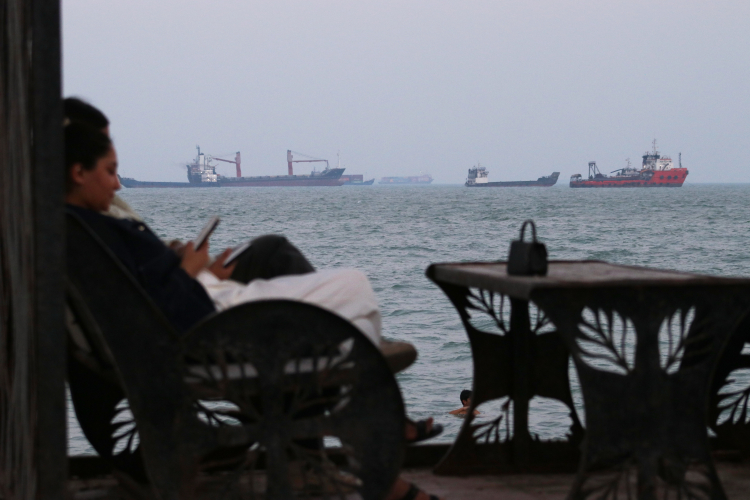
On March 4th, Iran declared the Strait of Hormuz closed. Not threatened, not contested, closed. The Islamic Revolutionary Guard Corps issued warnings over VHF radio telling vessels that no ship was permitted to pass, laid mines, boarded merchant traffic, and set up a toll system charging roughly a dollar a barrel for the ships it did allow through. Tanker traffic through the most important oil chokepoint on earth dropped more than ninety percent within days. The International Energy Agency called it the largest supply disruption in the history of the global oil market.
The conventional wisdom held for decades that Iran's ability to close Hormuz was the ultimate deterrent, the card that made military action against Tehran unthinkable, because a fifth of the world's oil moves through a waterway Iran could seal at will. That reading was correct. Iran played the card, the strait closed, and the disruption was every bit as severe as the theory predicted. What the theory missed is that closing the strait and holding it are two different problems, and the second one is what turned the strongest hand in the region into a trap.
There is an old parable about a room full of monkeys, a ladder, and a banana hung at the top. Every time one monkey climbs for the banana, all of them get sprayed with cold water, so before long they learn to stop the climb before it starts, and any monkey that reaches for the fruit gets pulled down by the others, not out of loyalty but because they are tired of getting soaked. Then a new monkey is added to the room, one that has never felt the water. It goes straight for the ladder, because nothing in its experience says otherwise, and the ones who remember have to haul it down before the hose comes back on all of them. The story is not a real experiment, whatever its many retellings claim, but it captures something true about how shared consequences produce shared enforcement, and about how little that enforcement means to whoever has not yet been sprayed.
Iran reached for the banana, and the water fell on the entire neighborhood. Missiles and drones aimed at Israel and American bases came down on Bahrain, Kuwait, Qatar, Saudi Arabia, and the UAE. The oil the Gulf states needed to sell sat trapped behind Iran's own blockade, and the fuel their economies ran on spiked in price because of a closure their neighbor imposed and they did not vote for. So the neighbors did what the parable predicts. They went after the monkey.
Saudi Arabia, which publicly refused Washington the use of its airspace and spent much of the war feuding with the White House over exactly that, quietly sent its own air force over Iranian territory in late March to strike drone and missile launch sites, the first known direct Saudi military action on Iranian soil, confirmed by Reuters through Western and Iranian officials. The United Arab Emirates ran a separate covert operation against Iran's Lavan Island oil refinery in early April, reported by the Wall Street Journal, then walked out of OPEC entirely on May 1st and fast-tracked a pipeline to move its oil around Hormuz so Iran's hand on the strait would stop mattering to Abu Dhabi. Neither country was following an American plan. Saudi Arabia was so far from taking orders that it informed Iran of its strikes in advance and let Washington twist over Hormuz airspace at the same time. These were neighbors grabbing the monkey, each for its own reasons, because the reach for the banana had soaked them too.
The move that mattered most came from the one country Iran's entire strategy depended on. China buys more oil from the Persian Gulf than any nation on earth, and roughly half of it normally transits Hormuz. When Iran closed the strait, Beijing faced an immediate shortfall of well over a million barrels a day, and the Iranian crude it had been buying at a discount could not get out. So China bought American. Xi told Washington he opposed Iran's toll scheme and signaled he would expand purchases of U.S. crude, and by May the Energy Secretary confirmed Chinese ships would be loading at terminals in Texas, Louisiana, and Alaska. The country running the pressure campaign against Iran's most important patron became that patron's supplier of last resort, because Iran had made its own crude impossible to move.
Underneath all of it the blockade did the quiet work. The United States sealed Iran's ports in mid-April, and Iranian exports collapsed from roughly 1.85 million barrels a day to about 567,000 within weeks, a drop of nearly seventy percent by Kpler's tracking. Kharg Island, which handles ninety percent of Iran's crude exports, filled toward capacity while tankers with nowhere to go clustered offshore. Iran was earning a toll on other nations' oil while unable to sell its own. The deterrent was working, the strait was closed, and every day it stayed closed cost Iran more than the countries it was trying to squeeze. Peter Zeihan spent the war making the one point that turned out to be the whole story, that no coalition could force the strait open by arms because the Iranian coastline is too long and the drones and missiles reach too far, so the only way it reopens is a political deal. Iran signed a memorandum of understanding in Islamabad on June 17th and resumed loading crude at Kharg three days later.
The memorandum lasted twenty days. On June 25th, eight days after Tehran signed, the IRGC Navy issued its own broadcast declaring that the only authorized transit routes through Hormuz were the ones Iran designated, explicitly rejecting the Oman-coordinated corridor the memorandum had enabled. On July 6th and 7th the Guard struck three commercial vessels using that corridor, including a Qatari-owned liquefied natural gas carrier, hit while Qatar was hosting the very negotiations that produced the ceasefire. Tehran never formally claimed the attacks. Iranian state television implied responsibility. Iran's parliamentary speaker and chief negotiator answered the American retaliation with threats rather than restraint. A government signed the deal and a separate armed institution refused to honor it, one that runs its own navy, its own economy, and its own foreign policy, and that has never in its history been made to feel the cost of what it reaches for.
The retaliation came fast. American forces hit roughly ninety Iranian targets across the southern coast on July 8th and 9th, including more than sixty IRGC vessels, and among the targets was Chabahar, Iran's only deep-water port on the Indian Ocean, whose maritime traffic control tower was destroyed and piers damaged. Chabahar was the one route by which Iranian oil and cargo could reach open water without passing through the strait Iran had spent four months fighting over, which means that door is now closed and Iran closed the other one itself. The president has since threatened to seize Kharg Island outright, promising to assume total control of Iran's oil and gas markets in the same way the United States has managed Venezuela's since Maduro's capture in January. That comparison is not idle, and it is the moment this stops being a story about one waterway, because Iranian crude has moved to China at a discount, outside dollar settlement, through the same shadow architecture that kept Venezuela and Cuba solvent. Taking Kharg would not merely strangle Tehran. It would sever an artery of a structure that was financed and engineered elsewhere.
The honest complication runs in both directions. Seizing Kharg has been threatened, not done, and the military assessments are uniformly grim about what follows, with every serious estimate putting the force requirement between a reinforced battalion and a full brigade and retired commanders who have studied it describing the job of holding the island under Iranian missile fire as a slow bleed, one invoking Khe Sanh directly. Plans were drawn and shelved for months as too risky, and the president himself has questioned on the record whether America has the stomach for it. American escalation capacity in the Gulf is also thinner than it looks. Saudi Arabia grounded an American air campaign by refusing airspace in May and its interceptor stocks are heavily depleted, and sustaining a drawn-out campaign against Iran requires Saudi basing that Riyadh has already demonstrated is conditional. Meanwhile the temperature keeps climbing. At Ayatollah Ali Khamenei's funeral on July 5th, before a crowd of hundreds of thousands and with nearly every senior Iranian official in attendance, the master of ceremonies called openly for the killing of the American president and nobody stopped him. Israeli intelligence has since passed Washington a warning of a specific plot against Trump's life, though American officials have not independently verified it and some read the Israeli report as an effort to shape American decision-making.
What Iran learned, and what every regime watching learned with it, is that the ultimate deterrent was real and it still was not enough. Closing Hormuz worked precisely as designed, and working is what aligned every neighbor, every customer, and every rival against the country that closed it. The room has been pulling at Iran's hand for four months now, and the hand will not open, because the part of Iran still climbing the ladder has never once felt the water.
Jacob Childress is a retired Army Master Sergeant with four combat deployments and four years supporting presidential operations from inside the White House Communications Agency across two administrations. He is a Senior TSCM Technician supporting the National Nuclear Security Administration and writes geopolitical analysis at jacobchildress.com.
