




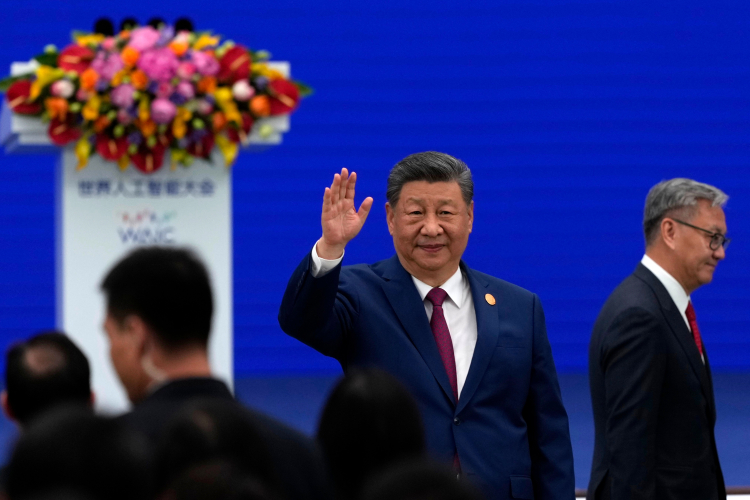
China's Central Military Commission normally seats seven men. It currently seats two. On January 24th, General Zhang Youxia, the senior vice chairman and the most powerful uniformed officer in China, was placed under investigation for serious violations of discipline and law. So was General Liu Zhenli, who ran the Joint Staff Department, meaning he was the officer responsible for coordinating combat operations, unit movements, and intelligence across every branch of the People's Liberation Army. Both men had combat experience from the war with Vietnam, which almost nobody in the PLA does anymore. Zhang had known Xi Jinping since childhood, their fathers having served together, and had survived every previous round of anti-corruption sweeps. He was removed anyway, and what remains at the top of China's military command is Xi and a discipline officer.
That is not an isolated event. More than a hundred senior PLA officers have been removed or have simply stopped appearing in public since 2022, including the rocket force commander, multiple theater commanders, an acquisitions chief, and a sitting defense minister. Analysts who study the PLA describe the campaign as prioritizing loyalty over competence and assess that it is degrading command cohesion at precisely the moment Beijing would need it most. This matters because the question everyone keeps asking about China and Taiwan is whether Xi will decide to move. The more useful question is whether the institution that would have to execute that decision is currently in any condition to try.
The reason the question is live at all is a calculation Russia already ran and lost.
In February 2022, Moscow looked at its own numbers and concluded that waiting was worse than moving. The demographic decline was visible. Energy revenue depended on European customers who were actively diversifying away. NATO expansion was approaching a line the Kremlin decided it could not absorb. Russia did not attack Ukraine from a position of strength. It attacked from the belief that this was the last moment its conventional military would still matter, and roughly four years and more than a million casualties later, that belief has been vindicated in the worst possible way. The army that entered as a supposed peer competitor demonstrated against an opponent with no meaningful air force that it was considerably less capable than its reputation, and it is now less capable still.
China is running the same math with worse inputs. Fewer than eight million children were born there in 2025, the lowest figure since the People's Republic began keeping records in 1949, and the fourth consecutive year of outright population decline. The working-age population peaked around 2011 and has shrunk every year since. The country is projected to lose close to sixty million people over the next decade, roughly the population of France, and growth that once ran above ten percent has settled near four and a half with the World Bank forecasting further deceleration. Xi's 2027 military readiness target was never a claim that China would be strong enough by then. It was an assessment of when the structural pressures become impossible to hide.
The strategic depth China built to give itself room inside that window has been coming apart faster than the window is closing. Russia was supposed to occupy American and European attention indefinitely, and instead Putin flew to Beijing in May, days after an American president had been there, and accepted energy pricing terms that only a client accepts. Iran was supposed to hold the chokepoint that made American action in the Gulf unthinkable, and Iran spent the spring watching its proxy network degrade across five theaters before its own Revolutionary Guard broke a ceasefire its own government had signed. Venezuela was supposed to be a hemisphere problem Washington would never have the appetite to solve, and Maduro was in American custody by January 3rd. Beijing did not lose those positions through any single decision. It lost them to events it neither planned nor controlled, which is the harder kind of loss to reverse.
Energy is where the pressure becomes physical, and it is also where Beijing looks smartest. China imports roughly eighty percent of the crude it burns, and about three quarters of that comes through the Persian Gulf, past a navy that just spent five months demonstrating what it can do to Russian-built air defenses and Iranian naval infrastructure. That is the vulnerability everyone names. What fewer people noticed is that China spent years building for exactly this. When the strait closed, Beijing cut crude imports by more than forty-four percent, dropping from 11.4 million barrels a day in February to 6.4 million by May, and covered the gap out of a strategic stockpile approaching a billion barrels that it had accumulated specifically against this scenario. Refineries kept running near normal rates. The IEA estimates China pulled forty-one million barrels from inventory in June alone. Pipelines from Russia and Central Asia that bypass the strait entirely carried more of the load, and an electrified vehicle fleet that Western commentary treats as a climate story quietly functioned as an oil-demand shock absorber.
The hedge worked. That is the honest complication in this piece, and it cuts against the desperate-actor framing the Russia parallel invites. A country that spends a decade building a billion-barrel buffer, laying pipelines around a chokepoint, and electrifying its transport fleet is not a country that failed to see the squeeze coming. It is a country that saw it clearly and paid for insurance.
Insurance runs out. Stockpiles do not refill themselves, and refilling this one means buying heavily in a market where prices spike every time the strait closes, which it has now done twice this year. Chinese crude imports in June fell to their lowest monthly level since 2015, and the July recovery to roughly 7.8 million barrels a day still sits far below where the country was before the war. Every barrel drawn down is a barrel of strategic flexibility spent, and the flexibility was the point. China can absorb one Hormuz closure. It has now absorbed two. The buffer that made Beijing look prepared in April is the same buffer that will be thinner in the next crisis, and the crisis that would matter most is one China itself would start.
Which brings the calculation to the island, and to the one asset that makes Taiwan structurally different from Ukraine. Russia attacked a country that had grain, geography, and remarkable resilience, but nothing the global economy could not survive losing. Taiwan Semiconductor Manufacturing Company produces roughly ninety percent of the world's leading-edge chips, the three-nanometer and smaller processors inside every advanced weapons system, every AI data center, and every flagship phone on the planet. There is no second source at that level on any timeline shorter than five to ten years, and that includes China's own military modernization program, which runs on chips Beijing cannot yet make. A move that damaged TSMC production would not merely provoke an American response. It would impose a simultaneous technology shock on every advanced economy at once, assembling a coalition that would include governments with no opinion whatsoever about Taiwan's political status and a very firm opinion about their own industrial base. China cannot fight a modern war without the chips it would be destroying.
The hedge against that trap is already under construction. Taiwan committed two hundred fifty billion dollars in semiconductor investment inside the United States in January in exchange for tariff relief, and every fab that comes online in Arizona reduces the catastrophic consequence of a Chinese move, which is to say it reduces Chinese leverage over American decision-making. That transfer is nowhere near complete. But Beijing is watching the direction of travel, and the direction is away from the one card that has made American policy cautious for two decades.
The complications that cut the other way deserve saying plainly. American long-range munitions stocks were significantly drawn down by the Gulf campaign, and rebuilding them is a multi-year problem, which is the strongest argument that now is a better moment for Beijing than 2028 will be. PLA activity around Taiwan has increased this summer, with Taipei tracking a record number of naval and coast guard vessels, though the annual exercise season always peaks between July and September and at least one retired Taiwanese naval officer attributed much of the recent surge to ships leaving port ahead of a typhoon. Beijing is also working the political track rather than only the military one, courting the KMT ahead of Taiwan's elections in an effort to make the governing party's defense cooperation with Washington look like the obstacle to peace rather than the guarantee of it. And the 2026 National Defense Strategy contains no direct reference to Taiwan at all, which is either deliberate ambiguity or something considerably less deliberate.
Russia moved through its closing window and lost the thing it was trying to protect. China is standing at the same window with a shrinking population, a client instead of a partner in Moscow, an energy buffer it has now spent twice, a semiconductor trap that punishes the very move it contemplates, and a high command that its own leader has spent four years hollowing out. The pressures pushing Beijing toward action and the damage limiting its ability to act are arriving together, which is the most dangerous configuration available, because a state can conclude it must move at the same moment it becomes least capable of moving well. Russia proved that combination is not hypothetical.
So far Beijing has decided to wait. The question nobody in Washington should mistake for settled is whether waiting is a decision or simply what happens when the men who would have run the operation are under investigation.
Jacob Childress is a retired Army Master Sergeant with four combat deployments and four years supporting presidential operations from inside the White House Communications Agency across two administrations. He is a Senior TSCM Technician supporting the National Nuclear Security Administration and writes geopolitical analysis at jacobchildress.com.
